


When checking the thermostat on a vehicle after starting a cold engine, the inlet and outlet hoses of the radiator cooling system should remain cold for some time.
In this case, the thermostat valve remains closed, and the coolant circulates in a small circle, bypassing the radiator.
After the liquid temperature reaches 87°C, the radiator hoses should start to heat up quickly, indicating that the coolant is beginning to circulate in a large circle.
For greater clarity, we show the work on a dismantled engine.
Remove the timing belt (see Checking the condition and replacing the timing belt).
Remove the rear cover of the timing drive (see Removal the coolant pump).
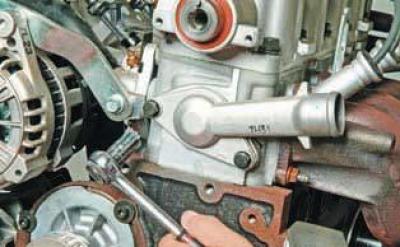
Using a 12 mm socket or wrench, unscrew the two bolts securing the exhaust pipe of the cylinder head.
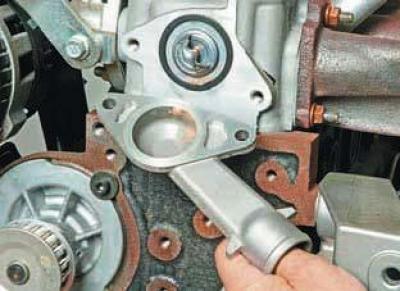
We move the pipe to the side (the hose does not need to be disconnected from the branch pipe).
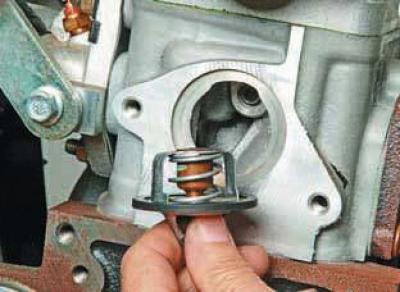
We remove the thermostat from its socket in the cylinder head.
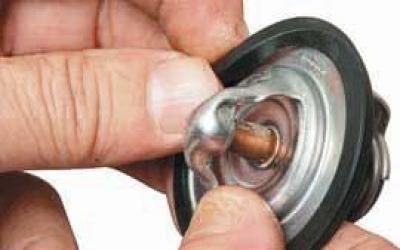
We remove the rubber gasket from the thermostat.
If the gasket is damaged or has lost its elasticity, it must be replaced with a new one.
To check the thermostat, place it in a container of water.
We heat the vessel, simultaneously stirring the water and monitoring the start of the valve opening using a thermometer.
The valve stem should begin to extend at 87°C…
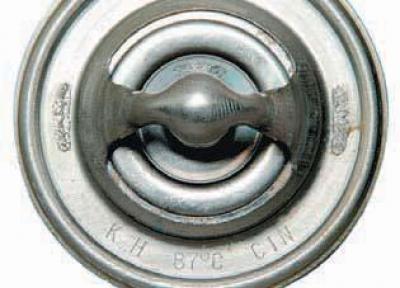
…which is indicated on the thermostat flange.
At a temperature of 102°C, the valve should be fully open - the stroke of the stem should be at least 8 mm.
We install the thermostat in the reverse order.