


Attention! Inspection and repair of exhaust system components should be performed only after sufficient time has passed after driving the vehicle for the system components to cool completely. Also, when working under your vehicle, make sure it is securely supported on jack stands.
1. The exhaust system consists of an exhaust manifold, a catalytic converter, a muffler, an exhaust pipe and connecting pipes, clamps, brackets and fasteners. The exhaust system is attached to the body with fixing brackets and rubber brackets (see illustration). If any of the exhaust system components are not connected correctly, excessive vibration and noise will be transmitted to the body.
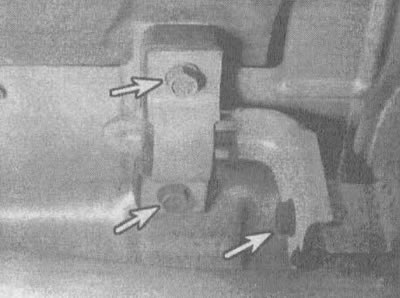
14.1 To detach this rubber bracket, unscrew the bolts (indicated by arrows)
2. Conduct regular inspections of the exhaust system to maintain it in good working order. Look for any damaged or bent system parts, open seams, holes, loose connections; find signs of corrosion and other defects in time that could lead to exhaust gases entering the vehicle's interior. Damaged system parts must not be repaired; they need to be replaced with new ones.
3. If the exhaust system components are heavily corroded or rusted together, welding equipment will likely be required to remove them. The most convenient way to carry out repairs is to remove the muffler at a service station using a gas cutter. You can simply cut off the old parts with a hacksaw. Be sure to wear safety glasses to protect your eyes from metal filings, and use gloves to protect your hands.
4. There are some rules that must be followed when repairing the exhaust system:
- a) Carry out work on removing the exhaust system parts from the rear of the vehicle to the front.
- b) To facilitate the removal of system components, apply a penetrating agent to the connections (see illustration).
- c) Use new gaskets, brackets and fasteners when installing exhaust system components.
- d) Use anti-seize agent on all threaded connections when assembling the exhaust system.
- d) Ensure that there is sufficient clearance between the parts you install and any points on the underfloor to prevent overheating of the floor covering and possible damage to the interior mat and insulation. Pay special attention to the location of the catalytic converter and heat shield (see illustration).
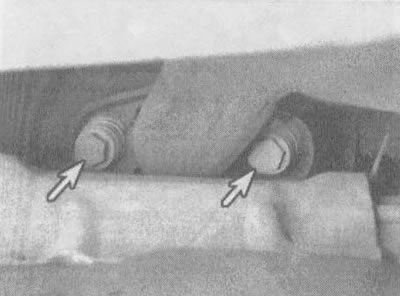
14.4a. Before unscrewing, lubricate the bolts connecting the exhaust manifold to the flange with penetrating spray |
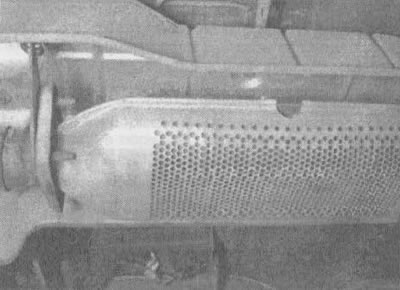
14.4b. Before repairing the catalytic converter, make sure that it has completely cooled down |