


Anti-skid chains are installed on the drive wheels.
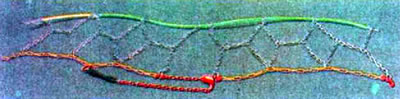
The design of a typical anti-skid chain consists of several interconnected transverse lugs. Lugs can be made from sections of chain with a couple dozen links, or they can be manufactured as a single part, usually from high-strength plastic.
To connect the lugs, pieces of chain or metal cables are used. The chains are attached to the wheels using locks, which come in different types. The design of the lock must allow for adjustment so that the chain fits tightly on the wheel and does not slip when the vehicle is moving. Chains are selected depending on the size of the wheels; as a rule, one chain can be installed on several types of wheels with similar dimensions.
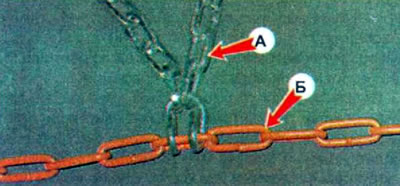
Note: It is recommended to install chains on wheels with link sizes such that link B of the side chain has a wire diameter of 3 mm, a length of 30 mm and a width of 10 mm, and lug link A (cross chain) has a wire diameter of 4 mm, a length of 25 mm and a width of 14 mm.
Most chain designs involve mounting the chain onto the wheel by running it over it. To avoid having to jack up a stuck vehicle, put on chains before attempting to cross a difficult section.
Since chains differ in design, to avoid unexpected difficulties, practice putting on the chain in good weather and in a convenient place in advance.
The installation of a typical snow chain is shown below. We put on the chain according to the instructions. Before starting work, remove any decorative caps from the wheel to avoid damaging them.
1. Place the car on a level surface. We open the lock and place part of the chain behind the inner surface of the wheel (or depending on the design, we run over sections of chains 30-40 cm long) so that the locks are on the outside.
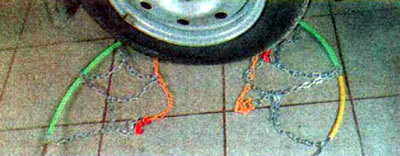
2. Place the chain on the wheel, distributing it evenly, making sure that the chain does not twist or get tangled, and fasten the locks.
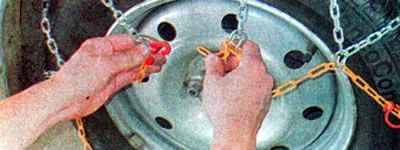
3. Install the chain on the second wheel in the same way.
Note: If your vehicle has a stability control system, turn it off before driving.
4. After driving 50-100 m at a speed of no more than 50 km/h, check the fastening of the chains, tighten their locks if necessary and continue driving.
Note: Do not use snow chains on roads with hard, non-slip surfaces. This will lead to rapid wear of both the chains and the tires.