


The vehicles in question use two types of systems: a rear brake release system (rWAL system) and a front and rear brake release system (4WAL system). The RWAL system only controls the rear wheel brakes, while the 4WAL system distributes braking across all wheels.
Actuator
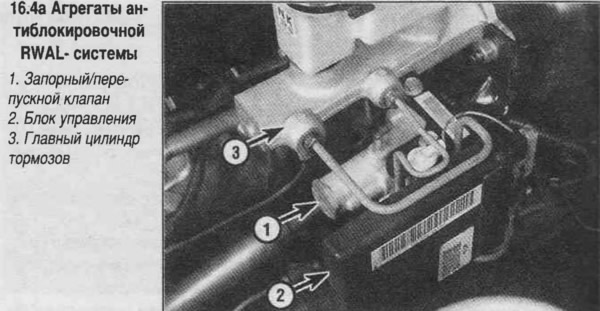
It consists of a main cylinder and a control valve, which includes a bypass valve and a shut-off valve. The valve ensures a change in fluid pressure in the hydraulic drive circuit in accordance with signals from the control unit.
Control unit
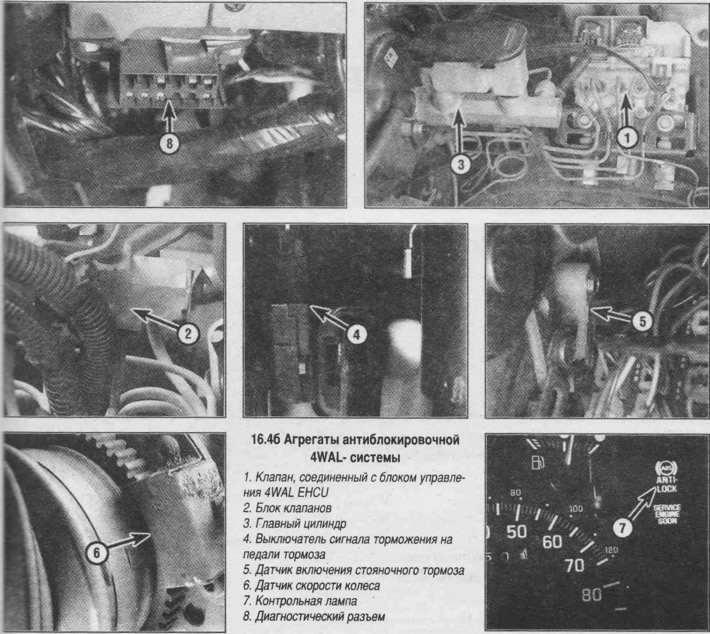
The ABS control unit is called the "Electro-Hydraulic Control Unit" (EHCU) on vehicles with the 4WAL system and the "Control Unit" on vehicles with the RWAL system. The control unit is installed in the engine compartment, under the master cylinder (see photo). The unit receives signals from the brake light switch and the speed sensors of each wheel, on the basis of which the pressure in the hydraulic drive of this wheel is regulated. If the wheel rotation speed differs from the base speed, the control unit opens the actuator valve and the fluid under excess pressure flows into the reservoir. The wheel is partially released. After the rotation speed is equalized, the valve closes, and the pressure increases again. Numerous repetitions of such cycles stabilize the rotation speed of all wheels and increase the stability of the car. The control unit also has a self-diagnostic function.
When the system fails, the BRAKE sign on the dashboard starts to light up (on vehicles with RWAL system) or ANTI-LOCK (on vehicles with 4WAL system).
Speed sensor
On vehicles with the 4WAL system, speed sensors are installed on each wheel. On vehicles with the RWAL system, the wheel speed sensor is mounted in the transmission housing tail on rear-wheel drive models, and in the transfer case on all-wheel drive models. The speed sensor generates a signal that is sent to the control unit indicating the speed of rotation of the wheel.
Brake light switch
The brake light switch informs the control unit that the brake pedal has been pressed. Without this signal, the anti-lock braking system will not operate.
Diagnostics and repair
The system is serviced at a car service center. However, you can perform the following checks yourself.
- a) Make sure that the brake calipers and cylinders are in good condition.
- b) Check the wire connectors in the control unit.
- c) Check the fuses.
- d) Check the integrity of the speed sensor wiring and the brake light switch.