


The ABS system provides the following benefits:
- avoiding obstacles with a higher degree of safety, including during emergency braking;
- reducing the braking distance during emergency braking while maintaining the vehicle's directional stability and controllability, including when turning.
In case of system failure, diagnostic functions and system failure support are provided.
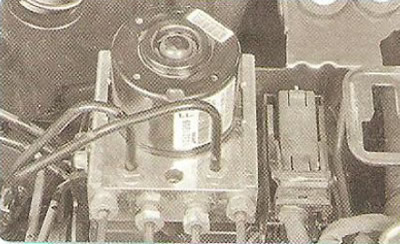
The hydroelectronic control module receives information about the vehicle's speed, direction of travel and road conditions from the wheel speed sensors and the throttle position sensor. After the ignition is turned on, the control unit supplies voltage to the wheel speed sensors. They use the Hall effect and generate an output signal in the form of rectangular pulses. The signal changes proportionally to the speed of the sensor's pulse ring.
Based on this information, the control unit determines the optimal wheel braking mode.
The following operating modes of the anti-lock braking system are distinguished:
- normal braking mode. During normal braking, the inlet valve is open and the outlet valve is closed. When you press the brake pedal, the brake fluid under pressure is supplied to the slave cylinder and activates the wheel brakes. When you release the brake pedal, the brake fluid returns to the master brake cylinder through the inlet and check valves;
- emergency braking mode. If the wheel starts to lock during emergency braking, the module issues a command to the pump electric motor to reduce the supply of brake fluid, then voltage is supplied to each electromagnetic valve, the inlet valve closes, and the supply of brake fluid from the master cylinder and the pump is blocked; the release valve opens and brake fluid flows from the slave cylinder to the master cylinder and then to the reservoir, causing a decrease in pressure;
- pressure maintenance mode. When the pressure in the working cylinder drops to the maximum, the module issues a command to maintain the brake fluid pressure, voltage is supplied to the inlet valve and is not supplied to the outlet valve. In this case, the inlet and outlet valves are closed and the brake fluid does not leave the working cylinder;
- pressure increase mode. If the module determines that the wheel is not locked, then the voltage is not supplied to the electromagnetic valves, the brake fluid enters the working cylinder through the inlet valve, the pressure in which increases.
Diagnostics and repair of the anti-lock braking system require special equipment and tooling, so if it fails, contact a specialized service station. Therefore, this subsection describes only the replacement of wheel speed sensors.
[The original source of the article is the website ChevyMan.ru]