


Warnings: Airbags do not replace seat belts. Moreover, when the vehicle is moving, the driver and front passenger must be fastened with seat belts, since in the event of a traffic accident, an airbag that has deployed itself can cause serious injury to a person not wearing a seat belt.
In addition, passengers in the back seat must be wearing seat belts. In the event of an accident, an unbelted passenger in the back seat can cause injuries and serious harm to all passengers in the car.
The SRS system includes the following elements:
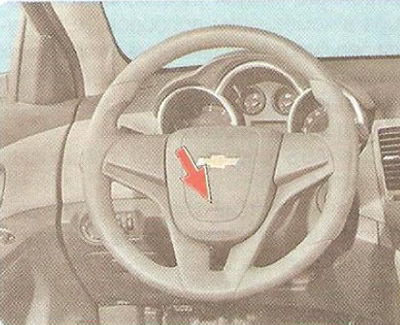
- driver airbag module located in the steering wheel hub pad and consisting of a folded airbag shell, a gas generator;
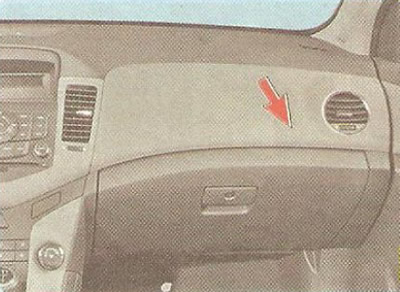
- front passenger airbag module, installed in the instrument panel on the passenger side and consisting of a folded airbag shell and a tubular gas generator. Differs from the driver's airbag in shape and larger volume;
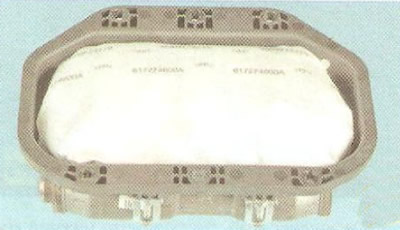
Note: This is what the front passenger airbag module looks like when removed from the vehicle.
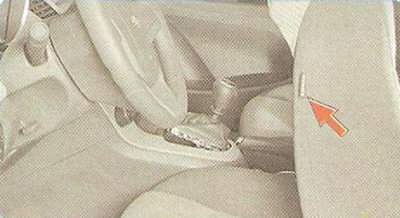
- the side airbag system consists of airbags installed in the backs of the front seats. The places where the airbags are installed are marked "AIRBAG";
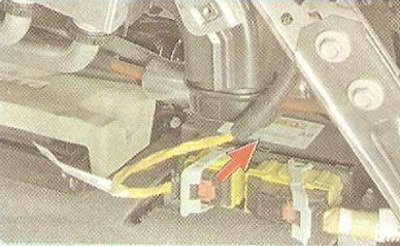
- electronic control unit (ECU) mounted on the floor tunnel under the center console.
The ECU has built-in sensors (accelerometers), measuring the longitudinal and lateral acceleration of the vehicle during a collision. The ECU evaluates the force of the impact by comparing the values it receives from the frontal impact sensor, side impact sensors and internal electronic sensors with a preset value. If the deceleration signal due to a frontal or side impact exceeds the preset value, the ECU initiates the operation of the seat belt pretensioners and the deployment of the corresponding airbags.
If the vehicle's battery is damaged during an accident, the electrical circuit that holds voltage in the ECU will still be able to activate the airbags for some time after the impact;
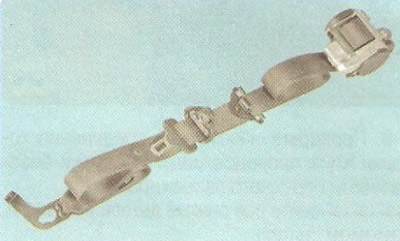
- front seat belt pretensioners (built into the inertia reels of the front belts) with limiters of their tension force.
Pretensioners provide timely response to emergency deceleration of the vehicle, pulling the driver and passengers to the seat backs, preventing them from moving forward further by inertia and getting injured from the deployed airbag;
Note: The seat belt pretensioner mechanism is always activated before the airbag.
- head restraints installed on the backs of the driver's and front passenger's seats of all vehicle configurations and on the back of the rear seat. Head restraints prevent damage to the cervical vertebrae of people sitting in the vehicle in the event of a strong impact from behind and when the airbags are deployed.
The front and rear seat head restraints can be adjusted in height by pressing the lock and moving the head restraint up or down to the desired height (see "Adjusting the position of the front seats");
Note: The optimal position of the headrest is considered to be one in which its upper edge is level with the top of the head.
For very tall people, raise the head restraint to its highest position; for very short people, lower the head restraint to its lowest position.
- airbag malfunction indicator light (see "Instrument cluster"). If the ECU detects a fault in the system, the warning lamp lights up.
Warning: If the lamp lights up, contact your car service immediately. In addition to possible failure in an emergency, the airbag may unexpectedly deploy while driving, which will lead to serious consequences.
(The original article can be found on the resource «ChevyMan»)