


Note: A four-wheel drive vehicle is equipped with two differentials, each located in the center of the corresponding axle. On a two-wheel drive vehicle, there is a single differential located in the center of the rear axle. When servicing a four-wheel drive vehicle, it is necessary to check the level in both differentials.
1. On all front and most rear differentials, the filler hole is closed with a metal threaded plug. To check the level, you need to remove the plug. To get to it, you need to lift the car and support it securely. It is prohibited to be under a vehicle supported only by a jack. During the check, the vehicle must be level, otherwise the level will be displayed with a significant error.
2. Unscrew the plug from the filler hole located in the differential housing or cover (see illustrations).
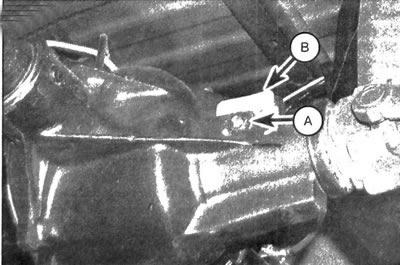
16.2 a. To check the differential oil level, remove the rear axle fill plug (A). Some models have a transmission oil specification plate (B)
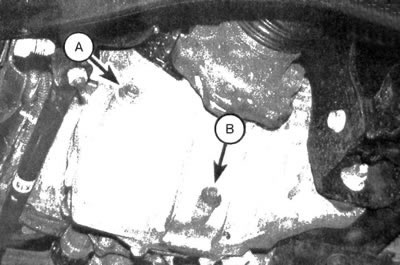
16.2b. To check the differential oil level (all wheel drive), remove the filler plug (A). The drain plug (B) is also located on the casing
3. The level should be at the lower edge of the filler hole. The level in the rear differential filled with synthetic oil should be 12 mm below the edge of the filler hole. If necessary, squeeze the bottle or use a pump to add oil until it begins to flow out of the filler hole. On some models, there is a label located next to the plug that provides information regarding the differential fluid.
4. Install and tighten the plug securely.