


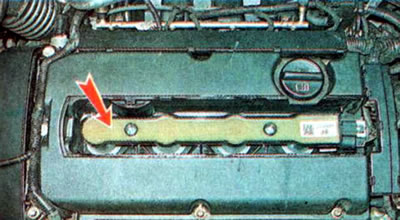
The vehicle uses a four-terminal ignition module. The module consists of four ignition coils and an electronic unit, housed in a single housing. The coils are mounted directly on the spark plugs. This eliminates current leaks (this is possible when high-voltage wires are used to connect the ignition coil to the spark plugs), causing a decrease in spark power. The ignition coil is a step-up transformer that converts the low voltage signal into a high voltage pulse for transmission to the spark plug.
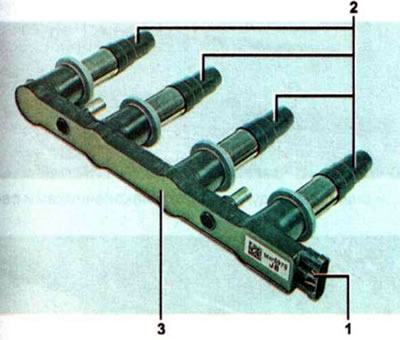
Ignition module:1 - terminals for connection to the wiring harness; 2 - high-voltage terminals of ignition coils with spark plug tips; 3 — body
The ECU controls each coil by providing control signals in accordance with the engine's operating cycles and load. A high voltage pulse is applied to the spark plug at the end of the compression stroke in the cylinder. The ignition moment and the duration of the discharge depend on the engine load. The ECU sets the optimal ignition timing angle depending on the signals received from the knock sensor and other sensors of the engine management system.
If one of the ignition module coils or the control circuit is faulty, the engine will run unstably at idle ("triple"), and the engine management system malfunction indicator lamp may light up. Misfires can be noticed by a disturbance in the periodicity of the exhaust gas emissions. Similar symptoms may also occur if one of the spark plugs is faulty
You can determine if the ignition module is faulty by diagnosing the engine management system.
The ignition module cannot be repaired and must be replaced if it malfunctions.