


- a) Before connecting the auxiliary battery, turn the ignition switch to the "Off" position.
- b) Make sure that all electrical equipment (lighting devices, heater, windshield wipers, etc.) off.
- c) Wear safety glasses.
- d) Make sure that the voltage of the auxiliary battery and the battery installed on the vehicle being started are the same.
- e) If the battery of another vehicle is used as an auxiliary battery, the vehicles MUST NOT TOUCH each other.
- f) Make sure the gearbox is in Park or Neutral.
- g) If the auxiliary battery is a non-rechargeable type, remove the vent caps and place a cloth underneath to absorb any condensed electrolyte.
Connect the red jumper cable to the positive (+) terminals of both batteries (see illustration).
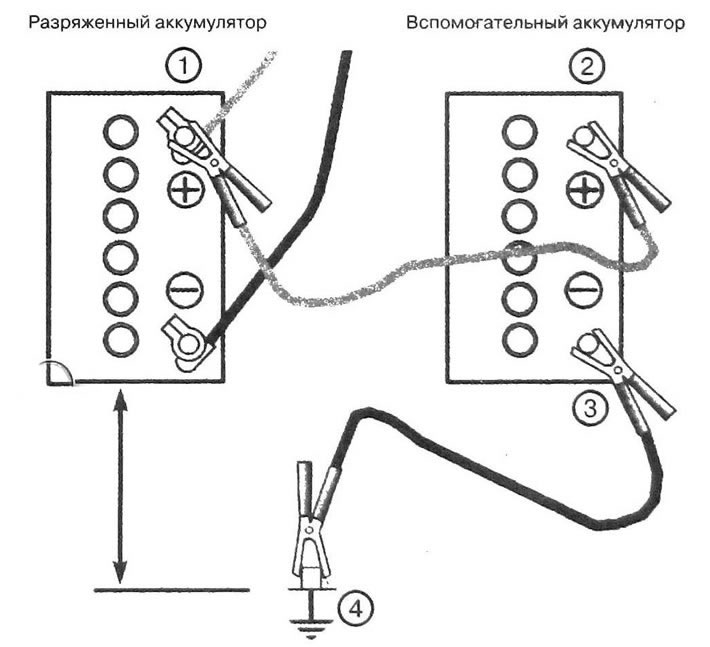
Connect the jumper cables to start the engine from the auxiliary battery in the sequence shown in the illustration (the negative terminal wire of the auxiliary battery is not connected to the negative terminal of the discharged battery)
Connect one end of the black jumper cable to the negative (-) terminal of the booster battery. Connect the other end of the black wire to some bracket or bolt (grounding point) starting engine, away from the battery. Make sure that the connecting wires do not come into contact with the fan, drive belt or any other moving part of the engine.
Start the engine from the auxiliary battery and wait until it reaches a stable idle speed, then disconnect the wires in the reverse order.
To ensure the ability to autonomously start a car with a discharged battery, the engine must run for at least 20 minutes.
[The material was created based on information from the website «CHEVYMAN»]