


Caution! Under no circumstances should the spark plug gaps be adjusted. If the gap does not meet specifications, replace the spark plug.
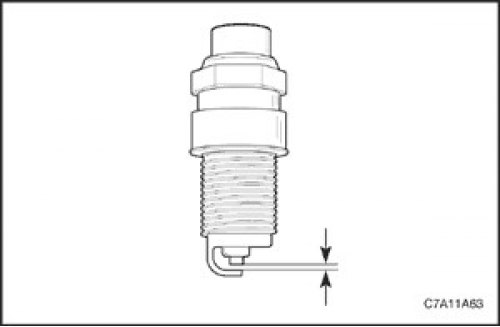
After checking the spark plug gap, the presence of carbon deposits, the degree of wear of the electrodes or the integrity of the insulators, replace with new ones if necessary.
Remove and check the spark plugs as follows:
1. Remove the spark plug tip and disconnect the spark plug wires from the spark plug. Once the spark plug wires are disconnected, the chain can be disconnected. Therefore, you should only take hold of the part with the tip.
2. Remove the spark plugs from the cylinder head using a wrench.
3. Measure the spark plug gap with a gap gauge. If the measured value does not match the specified value, adjust the position of the ground electrode. When installing a new spark plug, check its quality and only then install it.
4. Inspect the spark plug as described below.
Deterioration of spark plug performance
A spark plug may perform poorly due to wear, contamination, carbon deposits, severe electrode wear, a bad insulator, or excessive gapping.
Worn or dirty spark plugs
Worn or dirty spark plugs may operate satisfactorily at idle, but may fail under load. This may be due to:
- High fuel consumption
- loss of power,
- loss of acceleration,
- difficult start or
- decrease in engine power.
Formation of carbon deposits
Carbon deposits are a layer of black soot. The black layer of carbon deposits is formed as a result of driving at low speeds over short distances. Under such conditions, the optimum engine operating temperature is rarely achieved. Carbon deposits can also be caused by:
- wear of piston rings,
- ignition malfunction,
- enrichment of the fuel mixture or spark plugs that are too cold.
Excessive wear of the electrode
Often this indicates the following:
- the engine is operated at high speeds,
- the engine operates at levels that are consistently higher than normal,
- spark plug too hot,
- too lean fuel mixture or overheating of the spark plug/spark plugs caused by insufficient tightening (gases released during combustion escape through the threads).
Damaged insulator
Bad insulators are usually the result of improper installation or carelessness.
A failure of the upper insulator can be the result of a poorly fitted spark plug or an impact. A cracked insulator may not be detectable until oil or moisture seeps through it. Often the crack is below the curved portion of the spark plug body and is not visible.
Lower insulator failure is often the result of careless clearance adjustment and can usually be detected.
This can also be the result of running the spark plug too hot. For example, running it at high speed or under heavy load.
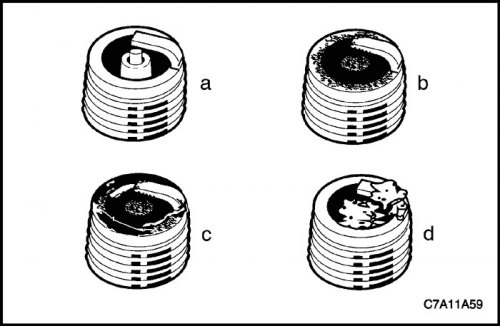
a - Normal state: A brown or grey carbon layer and a slight degree of electrode wear indicate that the thermal characteristics of the spark plug are correct and that the driving style is mixed at low and high speeds.
b - Covered with soot: A dry, loose layer of black soot can be caused by fuel with poor ignition properties, a loose coil, excessive idling or low speeds under light load. If the spark plug temperature is too low during normal combustion, the soot layer will not burn off.
c - Oiled: A wet oil film with slight electrode wear is caused by oil leaking through worn piston rings. Under such conditions, failure may occur in a new or recently overhauled engine before the rings are fully run in.
d - Carbon A: A reddish-brown, yellow, or white deposit on the spark plug insulator skirt that is a byproduct of combustion. The deposit is caused by fuel and lubricants, which usually contain additives. Most powdery deposits do not adversely affect spark plug performance, although they may cause temporary misfires under various operating conditions.
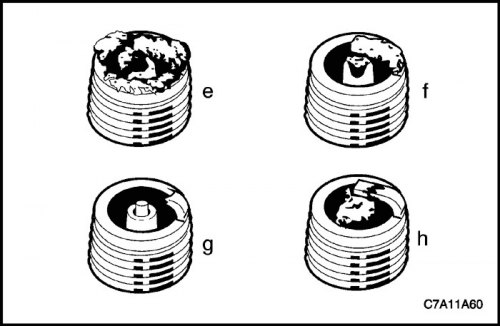
e - Carbon B: carbon deposit similar to the carbon deposit described in A (4). It is also a by-product of combustion of fuel and lubricants. Excessive valve stem clearances and/or damaged intake valve seals allow too much oil to enter the combustion chamber. Carbon deposits accumulate on the spark plug part, enter the chamber and settle on the side surface of the intake valve. Under these conditions, it can be found only in one or two cylinders, the valve stem seals should be checked.
f - Carbon C: Most of the powdery deposits described under deposit A (4) do not adversely affect the spark plug action as long as they remain in the powder state. Under certain operating conditions these deposits melt and form a shiny glaze on the insulator. At high temperatures this acts as a good conductor, allowing current to pass through the deposit instead of sparking across the gap.
g - Detonation: Usually associated with engine knocking or engine detonation, detonation causes strong jolts inside the combustion chamber, which can lead to damage to structural components.
h - Pre-ignition: A burnt or porous insulator skirt and very badly eroded electrodes, probably due to excessive heat. This is often caused by a clogged cooling system, sticking valves, improperly installed spark plugs, or spark plugs that are the wrong heat range (too high). Long-term operation at high speed with heavy load can result in temperatures so high that they cause pre-ignition.
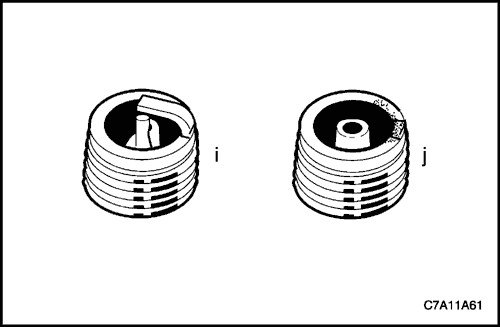
i - Malfunction due to thermal shock: A rapid increase in spark plug skirt temperature under certain operating conditions can cause thermal shock and lead to a crack in the insulator. This is a common cause of insulator skirt failure and cracking.
j - Insufficient installation tightening torque: Poor contact between the spark plug and the cylinder head seat. Poor contact with the seat prevents proper heat exchange, which causes the spark plug to overheat. Various types of damage occur very often. Contamination of the threads in the cylinder head can cause the spark plug, which has not yet been run in, to seize. Before installation, make sure that there is no carbon deposits, scoring or scale on the cylinder head and spark plug threads.
(The original source of the article is the website: «chevyman»)