


2. Prepare tools and equipment (see photo).
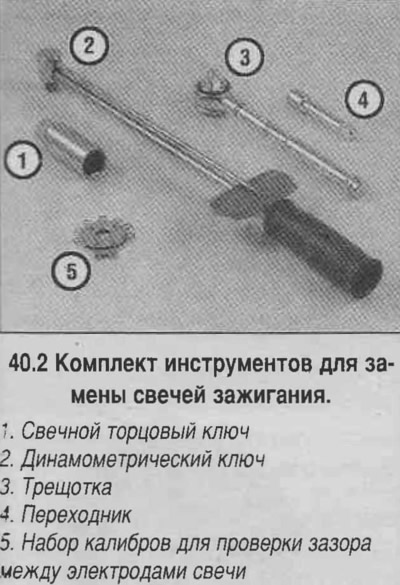
3. Before replacing the spark plugs, you must purchase new spark plugs of the recommended type, set the gap and screw them in place of the old ones, replacing each spark plug separately. When purchasing spark plugs, follow the data on the information plate under the hood (even if the data in the owner's manual contradicts that indicated on the plate).
4. Check the condition of the new spark plugs. If any signs of damage to the insulator are found, the spark plug must not be installed.
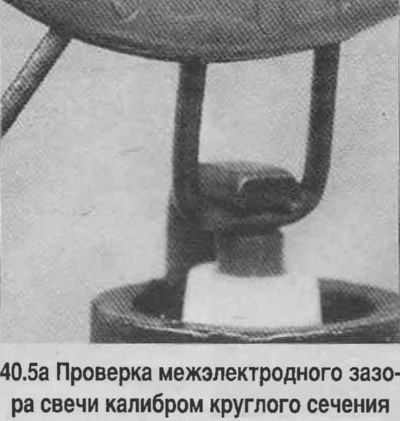
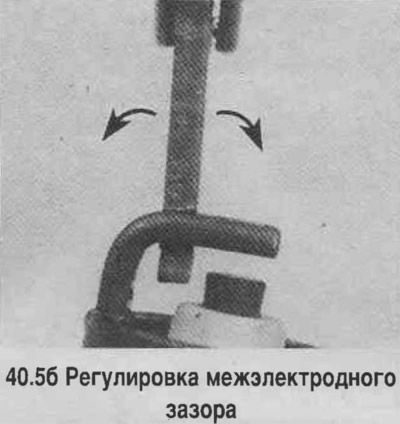
5. Check the gap between the electrodes of the new spark plugs with a round gauge (see photo). The gap between the electrodes must correspond to that specified in the section "Technical data", or in the underhood plate. The feeler gauge should move in the gap between the electrodes under a small force. If the gap does not correspond to the norm, then bend the electrode using the lever on the body of the gauge set (see photo).
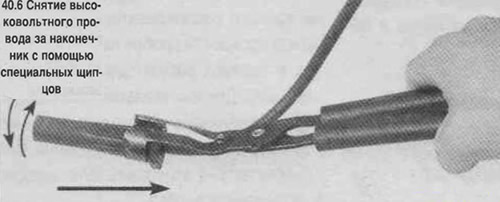
6. Rotate the tip half a turn while applying upward force and remove the wire (see photo).
7. Blow out the area around the spark plug with a pump to remove any dirt.
8. Remove the spark plug by turning the key counterclockwise.
9. Regardless of whether the spark plug is being changed or the old one is being screwed in, check the condition of the spark plug.
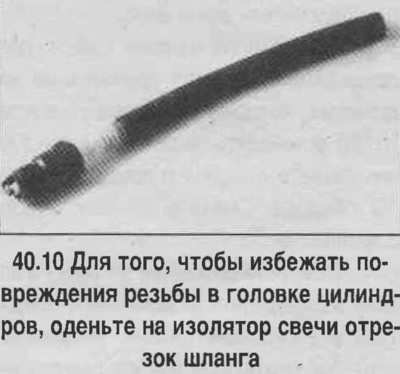
10. To screw the spark plug in without distorting it, place a piece of hose with an internal diameter of 45 mm on the spark plug tip (see photo). As soon as the spark plug starts to screw in at an angle, the hose will start to rotate on the insulator, which prevents damage to the thread. Tighten the spark plug to the specified torque.
11. Install the tip by turning it half a turn while applying downward force.
12. Replace the remaining spark plugs in the same order.