
ChevyMan.ru
Mazda Mitsubishi Toyota Land Rover Honda Kia Nissan
English Русский
Български
Беларускі
Український
Српски
Hrvatski
Română
Polski
Slovenský
Magyar
|
Articles | Sitemap | Contacts |


Home   Aveo   Captiva   Cruze   Lacetti   Lanos   Niva   Tahoe   Others  
Captiva 1 (2006-2018)
  • Home
  • Captiva
  • 1 (2006-2018)
  • Engine HFV6 3.2L
  • Control and power systems
  • Spark plugs

Spark plugs (Chevrolet Captiva 1)

            0

Contents: Removal procedure ↧ Installation procedure ↧

Removal procedure


1. Disconnect the negative battery cable.

2. Remove the decorative engine cover. See Part 1C2, "Engine Mechanical - HFV6 3.2L".

3. Unscrew the fastening screws (1) of the ignition coils and remove the ignition coils (2). See "Ignition coil" in this section.

Caution! Allow the engine to cool to at least 50 degrees Celsius before removing the spark plugs. Trying to remove the spark plugs from a hot engine can cause the spark plug threads in the cylinder head to seize, which can lead to stripping of the threads in the aluminum alloy cylinder head.


4. Using a suitable spark plug wrench, loosen the spark plug slightly and screw it back in to break up any carbon deposits on the threads.

5. Loosen the spark plug again one or two turns and use compressed air to remove any dirt from the spark plug to prevent it from getting into the combustion chamber.
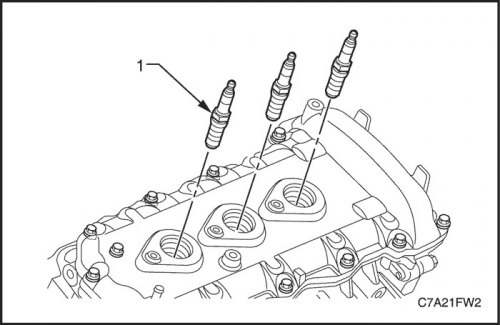
5. Loosen the spark plug again one or two turns and use compressed air to remove any dirt from the…


6. Remove the spark plug (1).

7. Repeat the procedure for the remaining spark plugs.

Note:


Install the spark plugs in the same order as they were removed. This will allow you to match the spark plug problems to the cylinders.


If you remove the spark plugs for a long time, plug the spark plug holes to prevent foreign particles from getting into them.

8. Check the spark plug gap with a gauge. If the gap is not within specifications, replace the spark plug.

Caution! Under no circumstances should the spark plug gaps be adjusted. If the gap does not meet specifications, replace the spark plug.


9. Check spark plugs if necessary. See Part 1A3, Basic data of the HFV6 3.2L engine.
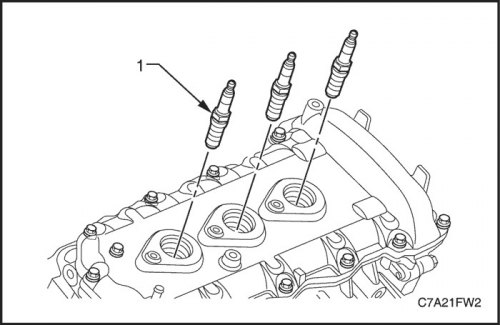
9. Check spark plugs if necessary. See Part 1A3, Basic data of the HFV6 3.2L engine.


Installation procedure


Caution! Do not apply anti-seize compounds or other similar lubricants to spark plug threads.


1. Using a rubber tube of the appropriate size on the spark plug contact pin, manually install each spark plug into the threads of the cylinder head.

Caution: Failure to tighten the spark plug to the specified torque may result in premature spark plug failure and/or engine damage.


Tighten

Tighten the spark plug to 18 N·m (13 lb-ft).
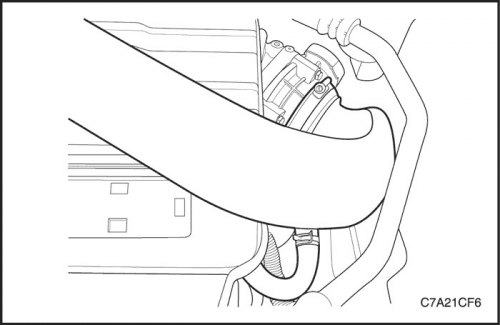
Tighten the spark plug to 18 N·m (13 lb-ft).

The article was checked: Vladimir Romannikov
This article is available at russian, bulgarian, belarusian, ukrainian, serbian, croatian, romanian, polish, slovak, hungarian

Share information:

Previous articles
Captiva 1: Control and power systems
Next articles

Ignition coil
Fuel rail assembly
Fuel filter
Fuel level sensor
Fuel pump assembly
Throttle body assembly
Intake manifold geometry change solenoid valve
Mass Air Flow (MAF) Sensor Assembly
Knock sensor
Camshaft Position Control Solenoid


See similar articles on the topic of Chevrolet cars:
Diagnosing engine condition by the appearance of spark plugs Chevrolet Aveo T300 (2012-2018)
Diagnosis of engine condition by the appearance of spark plugs Chevrolet Cruze 1 (2008-2016)
Checking the condition and replacing spark plugs Chevrolet Lacetti 1 (2002-2009)
Checking the condition and replacing spark plugs Chevrolet Lanos T150 (2002-2009)
Spark plugs Chevrolet Niva 1 (2002-2016)
Replacing spark plugs Chevrolet Tahoe 1 (1992-2000)
Replace spark plugs (every 30,000 miles or 12 months) Chevrolet Lumina 1 (1989-1994)
Link in different formats to this page


Visitor comments

No comments yet


How much will 22 + 32 =


Captiva 1 (2006-2018) 
  • Manual
  • Before leaving
  • Keys, doors and windows
  • Seats, protection systems
  • Instruments and controls
  • Lighting system
  • Information and entertainment
  • Navigation system
  • Climate control
  • Driving a car
  • Car care
  • Maintenance
  • Engine 2.0 l (diesel)
  • Engine device
  • Troubleshooting
  • Engine repair
  • Cooling system
  • Engine electrical equipment
  • Control and power systems
  • Exhaust system
  • Engine FAM II 2.4D
  • Engine device
  • Troubleshooting
  • Engine repair
  • Cooling system
  • Engine electrical equipment
  • Control and power systems
  • Exhaust system
  • Engine HFV6 3.2L
  • Engine device
  • Troubleshooting
  • Engine repair
  • Cooling system
  • Engine electrical equipment
  • Control and power systems
  • Exhaust system
  • Transmission
  • Front drive axle
  • Rear drive axle
  • Automatic gearbox - device
  • Automatic gearbox - service
  • Automatic gearbox - repair
  • Manual gearbox - device
  • Manual gearbox - service and repair
  • Clutch
  • Transfer case
  • Chassis
  • Car suspension
  • Brake system
  • Steering
  • Body
  • Heating and ventilation
  • Air conditioning (manual)
  • Air conditioning (automatic)
  • Seat belts
  • Airbags
  • Car seat
  • Interior (internal elements)
  • Exterior (external elements)
  • Doors and windows
  • Electrical equipment
  • Equipment and devices
  • Lighting and lamps
  • Windshield wipers and washers
  • Electrical circuits


ChevyMan.ru © 2017-2026 · Mobile version · Feedback · Site search · Interesting to read · Sitemap: EN BG BY UA RS HR RO PL SK HU

Aveo 2003-2008 · Aveo 2006-2011 · Aveo 2012-2018 · Captiva 2006-2018 · Cruze 2008-2016 · Lacetti 2002-2009 · Lanos 2002-2009 · Niva 2002-2016 · Tahoe 1992-2000 · Tahoe 2000-2014 · Lumina 1 1989-1994 · Trailblazer 1 2001-2008 · Orlando 1 2010-2018 ·
🛡️ For your security and to improve our service, this site uses cookies. You can disable them in your browser.