


Contents: Wheel replacement ↧ Tire running-in ↧ Wheel balancing ↧ Spare wheel ↧ Checking tire pressure ↧ Wheel storage ↧
Wheel replacement
When changing a wheel, do not change the direction of rotation of the tire, even if its tread pattern is non-directional, since repeated running-in of the tire causes increased wear.
If the front tires are noticeably worn, it is recommended to replace them with the rear ones.
When replacing tires, always install the less worn tires at the front.
When changing wheels, be careful not to damage the paint finish on light alloy wheels.
Tighten the wheel nuts gradually, crosswise.
When attaching light alloy wheels, use only chrome-plated cap nuts.
Tire running-in
New tires have a smooth outer surface, so they are run in. The initial wear during running in makes the tire rougher.
The first 200 km of the car's run should be driven very carefully (especially on wet surfaces).
Wheel balancing
Wheel balancing is performed to compensate for uneven weight distribution. When driving, imbalance makes itself known in the form of vibration, which is transmitted to the steering wheel. Vibration of the steering wheel from wheel imbalance occurs in a certain speed range and disappears when the speed decreases or increases. Wheel imbalance can lead to damage to joints, steering and shock absorbers. It is necessary to balance the wheels after 20,000 km of vehicle mileage or after any tire repair.
Spare wheel
The spare wheel can be installed on both the front and rear axles. The car is equipped with a full-size spare wheel.
Checking tire pressure
The check is carried out with a special tire pressure gauge. Check the pressure only in cold tires.
Note: Air pressure should only be checked on cold tires. Tires can be considered cold if at least three hours have passed since the car was stopped or if you have driven no more than 1 km after a long parking period. After the car has run for several kilometers, the tires have time to warm up and the air pressure in them increases by 30-40 kPa (0.3-0.4 kgf/cm²) compared to the cold state. This is not a sign of malfunction. Do not reduce the air pressure in warm tires to bring it to the nominal value set for cold tires. Otherwise, the tires will be used with reduced air pressure.
Check frequency: once a month or when servicing the vehicle.
It is advisable to check the pressure before long trips, as this is when the maximum temperature load on the tires is reached. When driving long distances at high speed and with low tire pressure, more energy is spent on the deformation of the tire, as a result of which it overheats and the separation of the profile layer or even a tire rupture may occur.
Wheel storage
After removing summer or winter tires, you need to find a suitable place to store them. A dry and dark room with a temperature no higher than +25°C is best suited for this. If the temperature is too high or too low, the tires will develop microcracks, which will reduce their service life. Make sure that the tires are not stored closer than one meter to a heating source in the room.
Keep gasoline and lubricants away from tires as they can corrode tires.
If the wheels are moved seasonally, mark the direction of rotation and place of installation of the removed tire or wheel with chalk: PP - front right, PL-front left, PO-rear right, ZL - rear left.
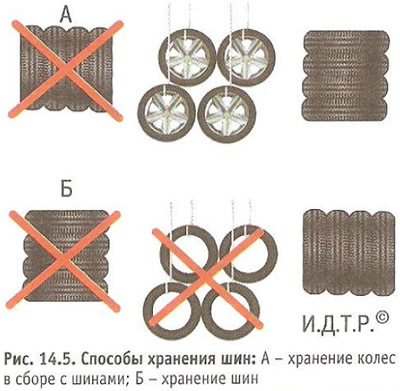
If the seasonal set consists of tires with rims (fig. 14.5, A), then the best option would be to hang the wheels by the central hole of the disk or stack them on top of each other (well). You can pump them up a little beforehand. You can't store tires separately from disks this way: under the weight of other rings, the sides and protectors of the lower ones will deform, the grip with the road will deteriorate, the tires will wear out quickly and unevenly. Tires without disks (see Fig. 14.5, B) stored in an upright position (on the floor or shelf), about once a month they need to be turned around the axis, If there is a tube inside the tire, it is necessary to significantly reduce the pressure in it. Separately stored tubes should not be crushed or folded, as this leads to the formation of folds and then cracks. Before storage, you can sprinkle the tires with talc so that they do not stick together.
(The original article can be found on the resource chevyman.ru)