


There are currently hundreds of tire models on sale from dozens of manufacturers. This section is designed to help car owners understand the main features of tire design and make the right choice when buying.
The design of a pneumatic tire is shown in Fig. 14.2.
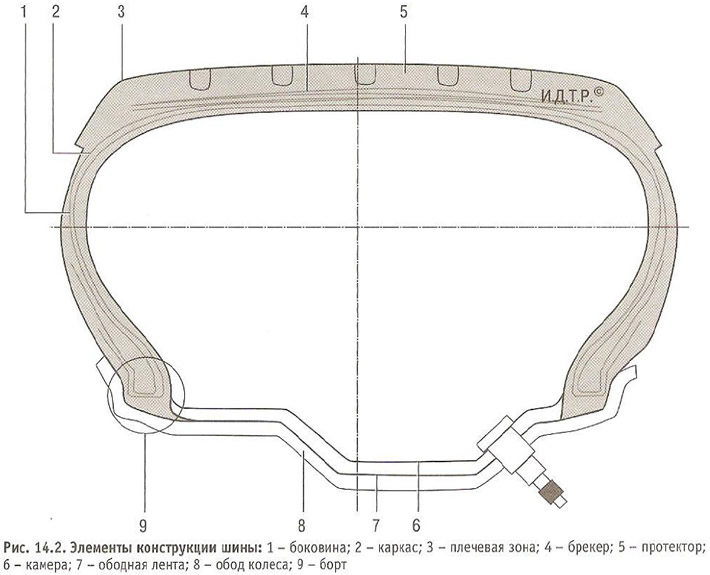
Frame 2 (see fig. 14.2) - the most important power part of the tire, ensuring its strength, taking up internal air pressure and transmitting loads from external forces acting on the wheel from the road.
The carcass consists of one or more layers of rubberized cord superimposed on each other. In modern tires with a radial carcass design (with the inscription "RADIAL" on the sidewall), the cord is stretched from one side to the other without overlapping threads. This arrangement of the cord layers reduces the tension in the threads, which allows for a reduction in the number of layers, gives the carcass elasticity, reduces heat generation and rolling resistance.
Breaker 4 - a part of the tire consisting of layers of cord and located between the carcass and the tread of the tire. The breaker serves to improve the connections of the carcass with the tread, prevents its detachment under the influence of external and centrifugal forces, cushions impact loads and increases the resistance of the carcass to mechanical damage.
Depending on the cord material, tires are divided into tires with textile belts, tires with metal belts and solid metal cord tires (when using metal cord both in the breaker and in the carcass). The sidewalls of tires with metal breakers are sometimes marked "STEEL BELTED" (belted with steel).
Protector 5 - the outer part of the tire, which is a massive layer of rubber. The outer surface of the tread has a relief pattern in the form of protrusions and grooves (lamellas), the so-called tread. The pattern of the relief part determines the suitability of the tire for operation in various road conditions. The wear resistance of the tire and the grip of the wheel with the road, as well as the level of noise and vibration, depend on the quality of the tread.
Shoulder area 3 - the part of the tread located between the tread and the sidewall of the tire. It increases the lateral rigidity of the tire, absorbs part of the lateral loads transmitted by the tread, and improves the connection of the tread to the carcass.
Sidewall 1 - the part of the tire located between the shoulder area and the sidewall. The sidewall is a relatively thin layer of elastic rubber, which is a continuation of the tread on the side walls of the frame and protects it from moisture and mechanical damage. The sidewalls are marked with tire markings and symbols.
Board 9 - the rigid part of the tire, used for its fastening and sealing (if the tire is tubeless) on the wheel rim.
The base of the bead is an inextensible ring woven from rubberized steel wire. The bead consists of a layer of cord wrapped around a wire ring and a round or profiled rubber filler cord.
The steel ring gives the board the necessary rigidity and strength, and the filling cord provides solidity and an elastic transition from the rigid ring to the rubber sidewall.
On the outside of the sidewall there is a sidewall tape made of rubberized fabric or cord, which protects the sidewall from abrasion against the rim and damage during installation and dismantling.
The vast majority of modern passenger car tires are tubeless. In them, the tightness of the internal cavity is achieved by the special structure of the tire itself and the wheel rim.
In tube tires, the connection between the sides and the rim is not airtight; rubber is used in the construction of such tires camera 6 and rim tape 7.
In operation, tubeless tires are considered more reliable than tires with a tube, because when a tire is punctured, the air leaves it only through the puncture hole, while in tires with a tube, the air flows out of the tire cavity along the entire circumference of the mounting hole. For this reason, a tubeless tire leaves more time for maneuvering before driving on a damaged wheel becomes dangerous. In addition, tubeless tires are lighter than their counterparts with a tube.
[Original version of the article on the website: «ChevyMan.ru»]