


2. Original tires (that is, tires installed by the vehicle manufacturer) have 1/2-inch wide stripes that appear when the tread depth drops to 1/16-inch, indicating tire wear. Tread wear can be checked using a simple, inexpensive device known as a tread depth indicator (see illustration).
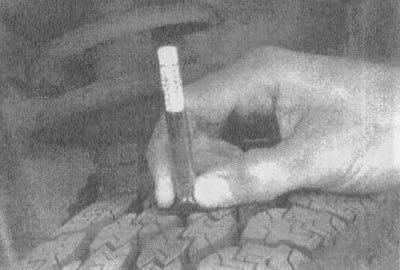
5.2. Use the tread depth indicator to check the degree of tire wear (they are available in spare parts stores and service stations)
3. Pay attention to any abnormal tire wear (see illustration). Incorrect tread pattern (flat spots, nicks, or more wear on one side than the other) indicate incorrect wheel alignment and/or incorrect balancing. If you notice at least one of the above symptoms, eliminate the malfunction by contacting a service station or tire fitting shop.
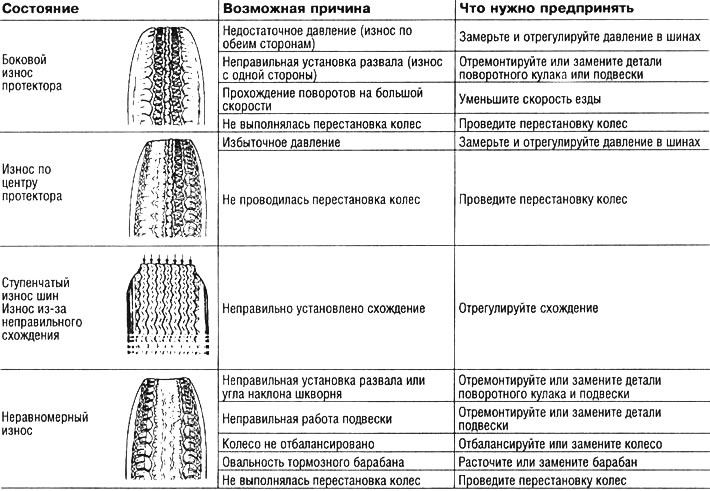
5.3. Using this table you will be able to determine the condition of your tires, the probable cause of abnormal wear and the actions required in these cases
4. Check for cuts, punctures, or nails or other objects embedded in the tread. Sometimes a tire may only hold air pressure for a short time or deflate very slowly after a nail has penetrated the tread. If a small air leak persists, check that the valve core is seated tightly (see illustration). Check the tread for objects that may become embedded in the tire or "plugs" that may cause a bulge (radial punctures in tires are repaired with plugs inserted into the puncture). If a puncture is suspected, it can be easily checked by spraying the suspected area with a soapy water solution (see illustration). If there is a leak, the soap solution will bubble. If the puncture is small, the tire can be repaired at a tire shop or service station.
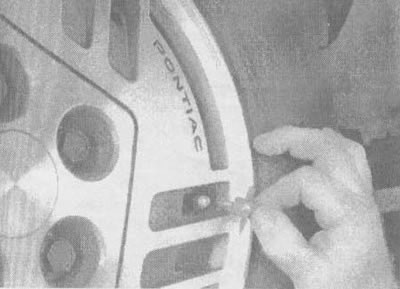
5.4a. If you notice a constant leak of air from your tire, first check the valve core to make sure it is tight (auto parts stores usually have inexpensive tools designed for this purpose) |
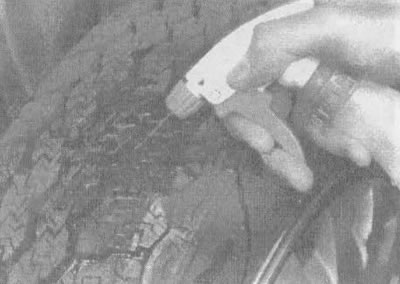
5.4b. If the valve core is leaking, lift the vehicle on the side of the flat tire and spray the tread with a soapy water solution while slowly turning the wheel - the presence of a leak will cause air bubbles to appear |
5. Carefully check the inside sidewall of each tire for signs of brake fluid leakage. If you see any marks, check your brakes immediately.
6. Correcting tire pressure increases tire life and improves driving comfort. It is impossible to accurately assess the tire pressure by its appearance, especially if they are radial. Be sure to use a pressure gauge. Always keep an accurate pressure gauge in your vehicle. Pressure gauges attached to air hose nipples at gas stations are often inaccurate.
7. Checking the tire pressure is only done when the tires are cold. "Cold" in this case means that the vehicle has not been driven in the previous three hours before the tire pressure was checked. When tires are warm, pressure may increase by 4 to 8 pounds.
8. Place the pressure gauge firmly on the valve (see illustration). Read the pressure gauge reading and compare it with the recommended tire pressure values shown on the label attached to the inside of the glove compartment lid. Don't forget to install the cap to prevent dirt from getting into the valve. Check all four tires and inflate them to the recommended pressure if necessary.
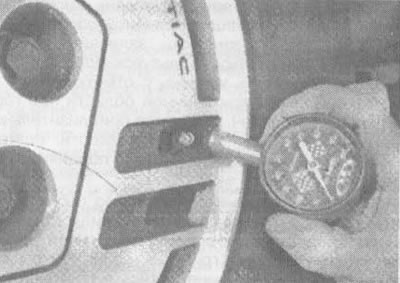
5.8 To extend the life of your tires, check your tire pressure at least once a week using an accurate pressure gauge (don't forget to do the same with the spare tire!)
9. Don't forget to inflate the spare tire to the recommended pressure (see your owner's manual or the sidewall of the tire).
The article is reprinted from the website: «CHEVYMAN»