


Wheel disk markings, for example, 16x6.5J 5x10⁵ DIA 56.6 ET39, are deciphered as follows:
- 16 - rim diameter in inches;
- x - deep rim;
- 6.5 - rim profile width in inches;
- J - rim flange shape (J-shaped);
- 5x10⁵ - number and diameter of mounting holes, mm;
- DIA 56.6 - diameter of the hole for the hub, mm;
- ET39 - disc offset 39 mm.
Fix the disk without the tire on the axis of the balancing device. Install the measuring tip of the dial indicator first on the radial and then on the lateral inner surface of the disk, on which the tire bead rests (Fig. 14.1).
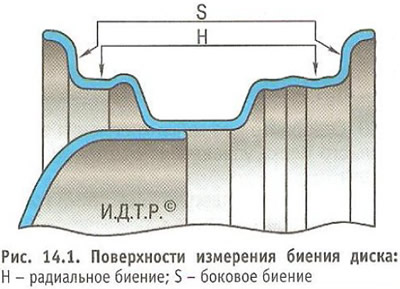
Note: Maximum runout of steel disk: I = 1.015 mm; S = 1.143 mm. Maximum runout of alloy wheel: H = S = 0.762 mm.
Slowly rotate the balancing device disk with your hands, while simultaneously reading the indicator. Do not take into account deviations of the indicator arrow from local protrusions or depressions on the disk.
If the maximum runout is greater than the specified values, replace the disc.
(The original source of the article is the website chevyman)