


1. Summer tires - designed for use in the summer, primarily on highways. The tread pattern consists of blocks or ribs separated by grooves (as a rule, not wide).
2. All-season tires of types M+S ("Mud" + "Snow" - mud and snow) and R+W ("Road" + "Winter" - road and winter) - are intended for use both in winter and in summer. Provide acceptable implementation of operating characteristics during year-round use on highways and dirt roads. The pattern is more sparse than that of summer tires and can be with microgrooves (lamellas) that provide traction on icy and snowy roads.
3. Winter tires - are used on winter roads and are:
- non-studded - made from soft types of rubber, most often with a directional pattern with a large number of sipes and intended mainly for use on cleared roads;
- studded or with the possibility of studding, made of medium-hard rubber, with studs or marked places for mounting studs. The tread pattern is sparse, with a developed network of lamellas. Provides good cross-country ability on deep snow and removes snow slush well. Studded tires have better grip on ice and packed snow compared to non-studded winter tires. However, studs worsen grip on hard road surfaces and create increased noise.
Warning: Do not forget that in accordance with the requirements of traffic regulations, when using studded tires on a car, you must place a triangular warning sign with the letter "W" on the rear window. This will help drivers of cars following you to choose the correct distance, taking into account the higher braking capabilities of your car on slippery surfaces.
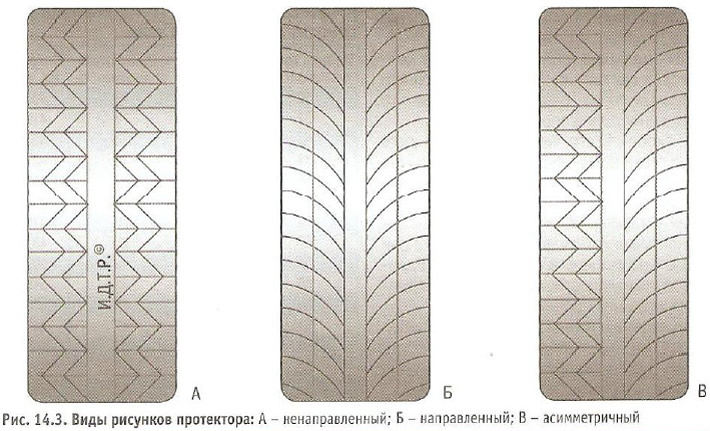
Depending on the arrangement of the elements, the tire tread pattern can be non-directional, directional or asymmetrical:
- non-directional pattern (A, Fig. 14.3) - symmetrical relative to the radial plane of the wheel (passing through its axis of rotation). It is the most universal, so most tires are produced with this pattern;
- directional drawing (B, Fig. 14.3) - symmetrical relative to the central plane of rotation of the wheel (passing through the middle of the tread). It has an improved ability to drain water from the contact patch with the road and reduced noise. The spare wheel only matches the direction of rotation of the wheels on one side of the car, but it is also possible to temporarily install it on the other side if driving at low speeds;
- asymmetrical pattern (B, Fig. 14.3) - asymmetrical relative to the central plane of rotation of the wheel. It is used to implement different properties in one tire. For example, the outer side of the tire works better on a dry road, and the inner side - on a wet one.
Tires are also distinguished by the method of sealing the cavity. Tires can be with or without a tube.
On the side of a tubeless tire you can find the designation "TUBELESS", "TL", on board the chamber - "TUBETYPE", "TUBED TIRE".
According to the arrangement of threads in the carcass and breaker, tires are divided into two types:
- diagonal tires (A, Fig. 14.4), the frame of which consists of one or more pairs of cord layers, arranged so that the threads of adjacent layers cross.
- You probably won't have to choose your tires based on this feature, as bias tires have been almost completely replaced by radial tires. Bias tires are an outdated design, but they continue to be produced in small quantities because they are relatively cheap to produce. The only advantage of these tires is that they have stronger sidewalls;
- radial tires (B, Fig. 14.4), in which the carcass cord is stretched from one side to the other without overlapping threads. The direction of the thread tension follows from the name.
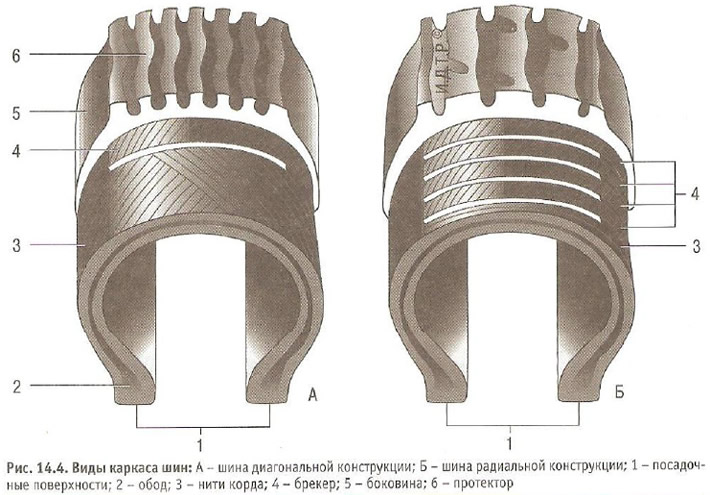
The thin soft shell of the carcass is covered on the outer surface with a powerful flexible breaker - a belt made of high-strength non-stretchable cord, usually steel. Therefore, to the inscription "RADIAL" (radial) "BELTED" is often added to the sidewalls of tires (girt) or "STEEL BELTED" (belted with steel).
This arrangement of cord layers reduces the tension in the threads, which allows for a reduction in the number of layers, gives the carcass elasticity, reduces heat generation and rolling resistance.
Radial tires have many advantages, they are more comfortable, durable, stable, have lower rolling resistance. Diagonal tires are preferable off-road and with high impact loads on the wheel.
(The text of the article was obtained from the website: «ChevyMan»)