


We remove the brake drum, the upper tension spring and move the upper brake shoe stops away from the wheel cylinder pistons (see Replacing the brake pads of the rear wheels).
To make it easier to unscrew the brake pipe nipple…
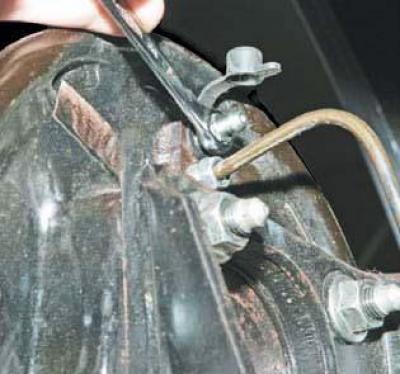
…using an 8 mm open-end wrench, we unscrew the bleed nipple from the cylinder.
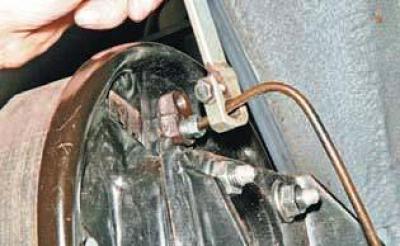
Using a special 10 mm wrench for brake pipe fittings, unscrew the brake pipe fitting.
Putting a rag underneath..
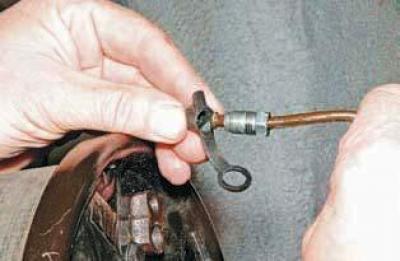
…we remove the tip of the tube from the cylinder hole and close the hole of the tube with a protective cap from the bleed nipple.
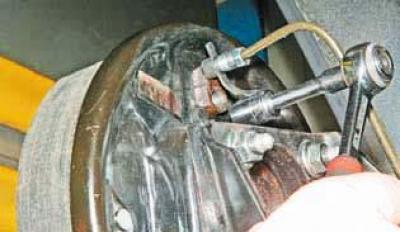
Using a 10 mm socket or open-end wrench, unscrew the bolt securing the cylinder to the brake shield…
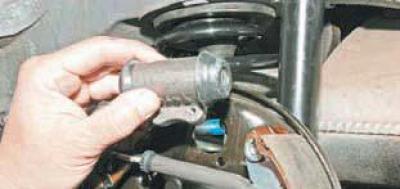
…and we remove the cylinder from the hole in the brake mechanism shield.
During long-term operation of the vehicle, the connection between the brake pipe and the nipple may become "stuck", as a result of which, when the nipple is unscrewed, the pipe will rotate with it and become deformed.
To avoid damaging the brake pipe, unscrew the bolt securing the wheel cylinder to the brake shield (see above) and move the cylinder together with the pipe away from the shield.
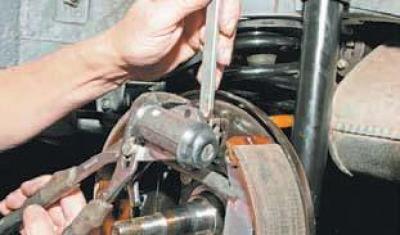
We clamp the brake pipe fitting with a special 10 mm wrench for brake pipes and, turning the cylinder with sliding pliers, unscrew it.
We install the new wheel cylinder in the reverse order.
After assembling the brake mechanism (including drum installation) we bleed the brake hydraulic system (see Bleeding the hydraulic brake system).