


This will require a pressure gauge with a measurement range of 0–6 bar (for example, from a tire pump), oil and petrol resistant hose (with an internal diameter of 8 mm), tee (with an outer tube diameter of 8 mm) and worm gear clamps (6 pcs.).
We carry out the work on a cold engine.
We release the pressure in the engine fuel system (see Replacing the fuel filter).
Remove the fuel pipe connecting the fuel filter and the fuel rail (see Replacing the fuel filter and Removal the fuel rail and injectors).
We put a hose on the outlet fitting of the fuel filter and secure it with a clamp.
We put the other end of the hose on the inlet fitting of the fuel rail and secure it with a clamp.
In a convenient place, we cut the hose and install the tee, securing the hoses to the tee fittings with clamps.
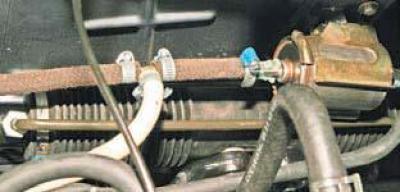
We put a piece of hose on the free fitting of the tee, on the other end of which we install a pressure gauge, and secure the hose with clamps.
We turn on the ignition and check the tightness of the connections of the installed device.
We start the engine and when it is idling..
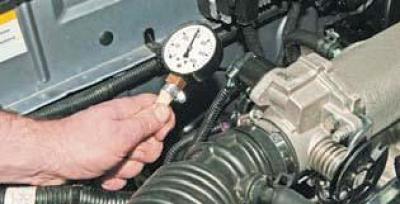
…we measure the fuel pressure in the system, which should be equal to 2.8–3.3 bar.
After the pump stops, the pressure may drop slightly and then stabilize for a while.
If the pressure in the system is more than 3.3 bar, the fuel pressure regulator is faulty.
Low but stable fuel pressure in the fuel system may be caused by a clogged fuel filter or mesh filter of the fuel module, as well as a malfunction of the fuel pump or fuel pressure regulator.
To check the fuel filter for contamination, it must be removed (see Replacing the fuel filter), drain the remaining fuel from the filter and blow it through a section of hose (you can do it with your mouth).
The resistance to air flow during purging should be insignificant.
Otherwise, replace the fuel filter with a new one, which we recommend always having in stock.
If the fuel pressure in the engine fuel system is low and continues to drop after the pump is turned off, the cause may be a leak in the fuel module connections, a faulty pump, or leaky injectors.
To find the cause of the malfunction, turn on the fuel pump again and after it stops, completely pinch the rubber hose in the area between the filter and the tee.
If the pressure stabilizes, then the fuel module is leaky or the pump is faulty.
If the pressure continues to drop, one or more injectors are leaking or the fuel pressure regulator is faulty.
A leaky injector can usually be identified by the dark color of its spray nozzle, which contains coked drops of fuel.
(The original article can be found on the resource «ChevyMan.ru»)