


You can check the technical condition of the shock absorber yourself only by external signs:
- when operating, the shock absorber knocks or makes another extraneous sound;
- shock absorber fluid is leaking;
- mechanical damage (dent on the body, burrs or corrosion on the stem, deformation of the stem).
If the listed faults are detected, the shock absorber must be replaced.
When inspecting the shock absorber, it is also necessary to check the condition of its covers - sand, snow and dirt, getting on the shock absorber rod, increase the intensity of its wear.
If the shock absorber does not show obvious signs of replacement, this does not mean that everything is fine. As the vehicle's mileage increases, wear of the shock absorber elements inevitably increases. As a result, the tightness of the seals deteriorates, and the technical parameters of the shock absorbers deviate further and further from the calculated values, and the controllability and stability of the car deteriorate.
A clear sign of a faulty shock absorber is that the car, after driving over an uneven surface, makes several more oscillatory movements, but already on a level section of the road. This type of malfunction occurs on cars with high mileage, if the shock absorbers have never been changed.
Recommendation. The performance of the shock absorbers should be checked immediately after a long trip, while the working fluid in them has not cooled down.
1. Vigorously swing the front part of the car body in a vertical direction.
2. If the body continues to oscillate due to inertia (more than two up-down movements) after it has stopped rocking, then one or both shock absorber struts are faulty. To identify a faulty shock absorber strut, repeat the test, applying force first on one side of the car, and then on the other.
Note: This check can only detect completely faulty shock absorber struts. The efficiency of vibration damping by shock absorber struts and compliance with all technical parameters can only be checked on a special stand.
3. We check the rear shock absorbers in the same way.
4. We prepare the vehicle for maintenance and repair and install it on an inspection pit or overpass.
5. Inspect the parts of the front shock absorber strut. Sagging or broken springs, as well as deformed strut elements, must be replaced.
6. Lift the protective cover of the rod and inspect the shock absorber seals. Leakage of working fluid from them is not allowed.
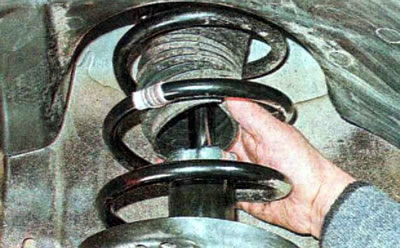
When inspecting the shock absorber, we also check the condition of the protective cover. A damaged cover must be replaced - sand, snow and dirt, getting on the shock absorber rod, increase the intensity of its wear.
7. We check the rear shock absorbers in the same way. Leakage of working fluid along the shock absorber rod is not allowed.
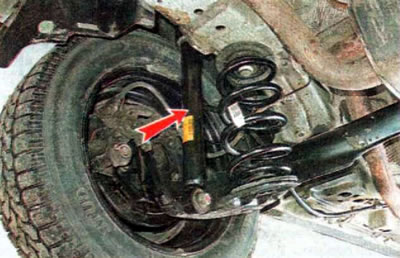
If you have any doubts, it is better to remove the shock absorbers and check them one by one, pushing the rod in and out several times. Tensile strength should be three to four times greater than compressive strength. The rod should move smoothly throughout its entire stroke. At the same time, the shock absorbers should not make gurgling or other extraneous sounds (except for the barely audible sound of liquid flowing). The gas-filled shock absorber rod should move smoothly out of the housing without any outside assistance. If any symptoms of malfunction are detected, the shock absorbers must be replaced. If even a slight difference in the operation of shock absorbers installed on one axle of the vehicle is felt, then they also need to be replaced. This type of inspection allows you to identify faulty shock absorbers with a higher probability than when they are installed on the vehicle.