
ChevyMan.ru
Mazda Mitsubishi Toyota Land Rover Honda Kia Nissan
English Русский
Български
Беларускі
Український
Српски
Hrvatski
Română
Polski
Slovenský
Magyar
|
Articles | Sitemap | Contacts |


Home   Aveo   Captiva   Cruze   Lacetti   Lanos   Niva   Tahoe   Others  
Orlando 1 (2010-2018) Trailblazer 1 (2001-2008, petrol) Lumina 1 (1989-1994)
  • Home
  • Chevrolet
  • Orlando 1
  • Chassis
  • Car suspension
  • Front suspension — design and testing

Front suspension — design and testing (Chevrolet Orlando 1)

            0

The front suspension is independent, with a telescopic shock absorber strut, one wishbone on each side and a torsion-type anti-roll bar. The lever is attached to the front subframe via silent blocks and connected to the steering knuckle via a ball joint.

The front suspension shock absorber strut consists of a shock absorber, an upper support, a coil spring and an upper spring support cup.

The shock absorber strut is attached to the car body with one nut screwed onto the rod - it compresses the body elements between the elastic elements of the upper support and the thrust washer.
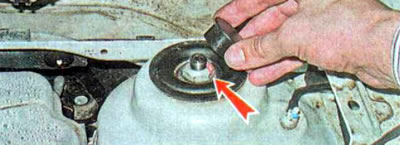
The shock absorber strut is attached to the car body with one nut screwed onto the rod - it…


The cylindrical spring rests on the lower and upper support cups. The lower support part is welded to the shock absorber body, and the upper part is secured to the shock absorber rod together with the upper support of the strut, consisting of a body and a bearing. The bearing allows the shock absorber strut to rotate when the steering wheel is turned, together with the spring and the upper support cup of the spring, and the rubber cushion prevents the transmission of vibrations to the car body. To protect the shock absorber from dirt and dust, a dust cover is installed on it.
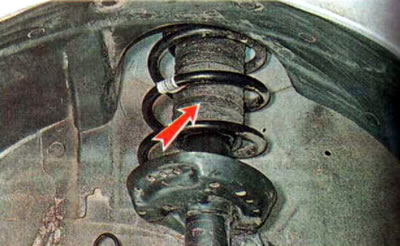

The cylindrical spring rests on the lower and upper support cups. The lower support part is welded…


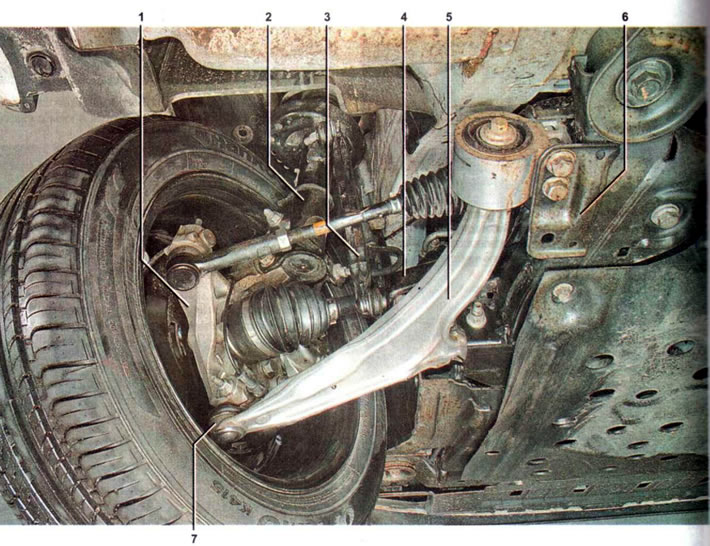
Front suspension parts: 1 - steering knuckle; 2 — front suspension strut; 3 — stabilizer bar for…

Front suspension parts: 1 - steering knuckle; 2 — front suspension strut; 3 — stabilizer bar for lateral stability; 4 — anti-roll bar; 5 - lever; 6 — front suspension subframe; 7 — ball joint


To prevent hard impacts when the suspension breaks through, a compression stroke buffer is installed on the piston rod.
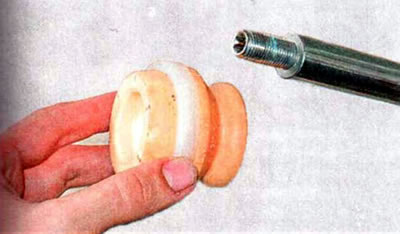
To prevent hard impacts when the suspension breaks through, a compression stroke buffer is…


At the bottom, the shock absorber strut is secured with bolts to the steering knuckle.


The steering knuckle rests on the front suspension arm and is connected to it via a ball joint.

A wheel bearing is pressed into the steering knuckle and secured with a support ring. And the front wheel hub, in turn, is pressed into the inner bearing race.

The anti-roll bar is attached via rubber cushions to the rear subframe, and its ends are connected via the anti-roll bar struts to the front suspension struts.

Checking the technical condition


The technical condition of the front suspension must be checked in accordance with the maintenance plan.

You can assess the technical condition of the suspension while driving. When driving at low speed on an uneven road, the suspension should operate without knocking, creaking or other extraneous sounds. After driving over an obstacle, the car should not dissipate.

Recommendation. It is advisable to combine checking the condition of the suspension with checking the tires, wheels and wheel hub bearings.


Note: One-sided wear of the tire tread indicates deformation of the front suspension parts or incorrect wheel alignment angles.


1. We prepare the car for maintenance and repair.

Recommendation. The functionality of the shock absorbers should be checked immediately after a long trip, while the working fluid in the shock absorbers has not cooled down.


2. Check the shock absorbers.

3. We hang up the front wheels of the car.

4. Check the condition of the hub bearing by using your hands to rock the wheel in a vertical plane. To make sure that the play is not caused by faulty suspension components, repeat the check with the brake pedal pressed. If the play has disappeared, the bearing is to blame. But sometimes the play can be eliminated by tightening the nut to the prescribed tightening torque specified in the reference data.
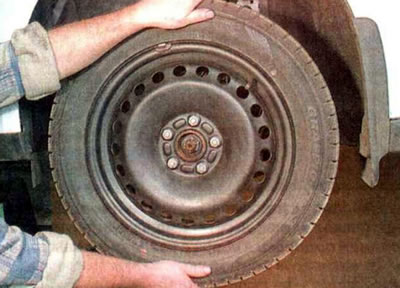


4. Check the condition of the hub bearing by using your hands to rock the wheel in a vertical…


5. Inspect the shock absorber struts of the suspension - no fluid leakage from them is allowed.
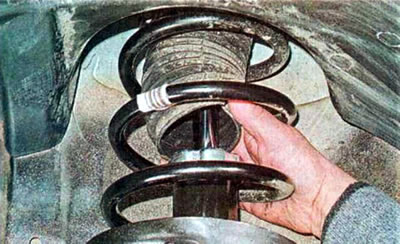
5. Inspect the shock absorber struts of the suspension - no fluid leakage from them is allowed.


6. Inspect the front suspension springs. Sagging, deformed or broken springs must be replaced simultaneously on both sides of the vehicle.

7. By rocking the front suspension arm with a mounting blade, we check the condition of the front...
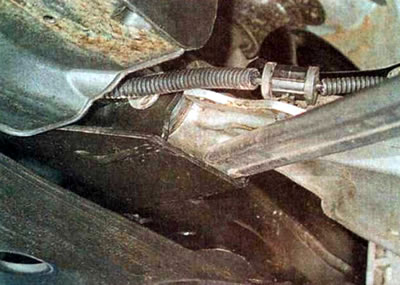
7. By rocking the front suspension arm with a mounting blade, we check the condition of the front...


...and rear silent blocks.
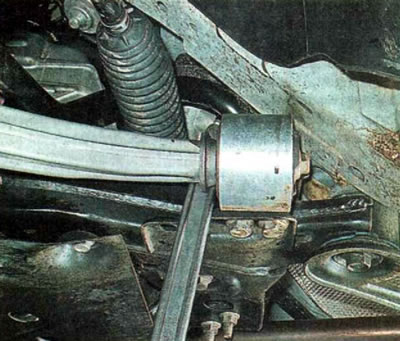


...and rear silent blocks.


There should be no play or breaks in the rubber, otherwise it is necessary to replace the front suspension arm assembly with silent blocks.

8. Using a mounting blade as a lever, check for any play in the ball joint.
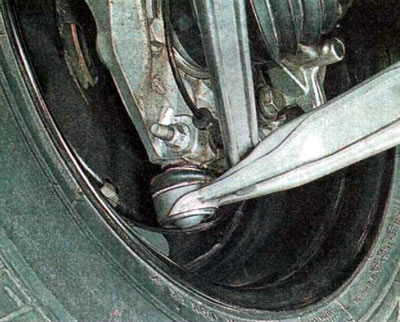
8. Using a mounting blade as a lever, check for any play in the ball joint.


9. Check the condition of the anti-roll bar cushions and struts.
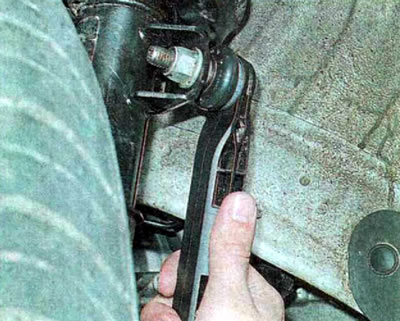
9. Check the condition of the anti-roll bar cushions and struts.


10. Check the condition of the steering rod end joints.
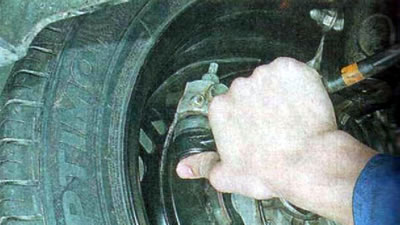


10. Check the condition of the steering rod end joints.


11. Visually check the condition of the ball joint covers, stabilizer strut joints, drive joints...
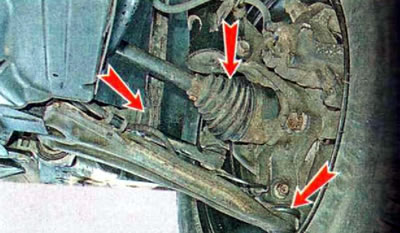
11. Visually check the condition of the ball joint covers, stabilizer strut joints, drive joints...


...and steering rods.
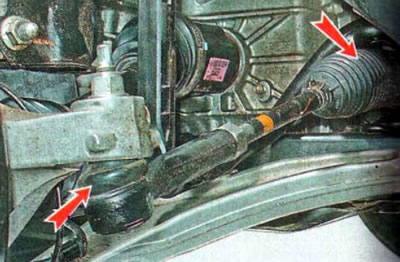
...and steering rods.


12. Joints with play, cushions and covers of ball joints and steering rods with one-sided bulging of rubber, ruptures and cracks are replaced (see relevant sections).

13. We check the front suspension on the other side of the car in the same way.

14. Inspect the suspension parts. Deformation and fatigue cracks in suspension parts are not allowed. We replace damaged parts (see relevant sections).

The reliability of the suspension elements is very important to ensure safe operation of the vehicle. Therefore, in strict accordance with the maintenance plan, check the tightening of all fastening bolts and nuts to the prescribed tightening torques of threaded connections.

[The article was reprinted from the website «ChevyMan.ru»]

The article was checked: Vladimir Romannikov
This article is available at russian, bulgarian, belarusian, ukrainian, serbian, croatian, romanian, polish, slovak, hungarian

Share information:

Previous articles
Orlando 1: Car suspension
Next articles

Rear suspension
Removal and installation the front shock absorber
Removal and installation the rear shock absorber
Checking the technical condition of shock absorbers
Car shock absorbers — design description
Replacing rear and front suspension springs
Front suspension arm
Stabilizer bar
Front suspension strut
Wheel alignment angles


See similar articles on the topic of Chevrolet cars:
Features of the front suspension design Chevrolet Aveo T300 (2012-2018)
Front suspension unit of the gearbox with the main gear assembly Chevrolet Captiva 1 (2006-2018)
Features of the front suspension design Chevrolet Cruze 1 (2008-2016)
Front suspension device Chevrolet Lacetti 1 (2002-2009)
Replacing the silent block and cushion of the front suspension arm Chevrolet Lanos T150 (2002-2009)
Front axle design Chevrolet Niva 1 (2002-2016)
Front suspension shock absorber — removal and installation Chevrolet Tahoe 1 (1992-2000)
Link in different formats to this page


Visitor comments

No comments yet


How much will 27 + 38 =


Orlando 1 (2010-2018) 
  • General information
  • Introduction to manual
  • User manual
  • Maintenance
  • Troubleshooting
  • Power unit
  • Engine repair
  • Fuel and control system
  • Cooling and lubrication system
  • Ignition system
  • Transmission
  • Clutch
  • Gearbox
  • Drive shafts
  • Chassis
  • Car suspension
  • Steering
  • Brake system
  • Body
  • Exterior (external elements)
  • Doors, locks and windows
  • Electrical equipment
  • Equipment and devices
  • Windscreen wipers
  • Power devices
  • Electrical diagrams


Trailblazer 1 (2001-2008) 
  • General information
  • User manual
  • Troubleshooting
  • Maintenance
  • Power unit
  • Engine in a car
  • Engine overhaul
  • Cooling and heating
  • Fuel and exhaust system
  • Engine electrical equipment
  • Engine control
  • Transmission
  • Automatic gearbox
  • Transfer case
  • Drive shafts and cardan
  • Chassis
  • Brake system
  • Car suspension
  • Steering
  • Body
  • Exterior (external elements)
  • Interior (internal elements)
  • Doors, locks and windows
  • Electrical equipment
  • Equipment and devices
  • Electrical circuits


Lumina 1 (1989-1994) 
  • General information
  • Maintenance
  • Power unit
  • Engine 3.1L V6
  • Engine 3.8L V6
  • Engine overhaul
  • Cooling system
  • Power and exhaust system
  • Fuel injection
  • Engine electrical equipment
  • Reduced exhaust gas toxicity
  • Transmission
  • Automatic gearbox
  • Drive shafts
  • Chassis
  • Brake system
  • Car suspension
  • Steering
  • Body
  • Heating and air conditioning
  • Repair of body elements
  • Doors, covers and windows
  • Interior (internal elements)
  • Electrical equipment
  • Equipment and devices
  • Electrical circuits


ChevyMan.ru © 2017-2026 · Mobile version · Feedback · Site search · Interesting to read · Sitemap: EN BG BY UA RS HR RO PL SK HU

Aveo 2003-2008 · Aveo 2006-2011 · Aveo 2012-2018 · Captiva 2006-2018 · Cruze 2008-2016 · Lacetti 2002-2009 · Lanos 2002-2009 · Niva 2002-2016 · Tahoe 1992-2000 · Tahoe 2000-2014 · Lumina 1 1989-1994 · Trailblazer 1 2001-2008 · Orlando 1 2010-2018 ·
🛡️ For your security and to improve our service, this site uses cookies. You can disable them in your browser.