


Recommendation. After repairing or replacing any suspension or steering components, be sure to check the wheel alignment angles. A high-quality check and adjustment of wheel alignment angles can only be performed in a specialized workshop with a special stand for performing adjustment work.
The following wheel alignment angles are monitored:
The camber angle of the front wheels is the angle of inclination of the plane of rotation of the wheel relative to the vertical.
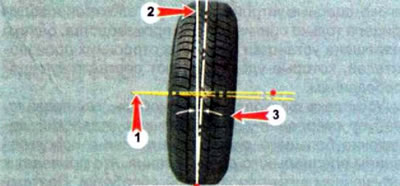
1 — wheel rotation axis; 2 - vertical line to the supporting surface; 3 — camber angle
Uneven camber angles cause the car to pull to the side when driving in a straight line. Large positive camber (when the top of the wheel protrudes outward) leads to accelerated wear of the outer part of the tire tread, and large negative camber leads to wear of the inner part of the tire tread.
The camber angle of the front wheels is set by design and is not adjustable. If the longitudinal tilt angle of the steering axis is outside the permissible limits, repair of the suspension elements is required.
Front wheel toe is the angle between the plane of rotation of the wheel and the longitudinal plane of symmetry of the vehicle when moving in a straight line. Wheel alignment problems impair the vehicle's handling and directional stability, and also lead to intensive tire wear.
Sometimes toe-in is defined as the difference in distance between the rims of the front wheels in millimetres.
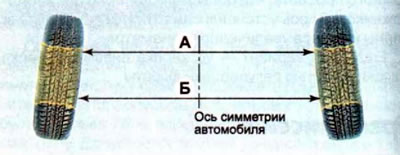
The toe-in of the front wheels is adjusted by changing the length of the steering rods, screwing them into the ends or unscrewing them from them. After completing the adjustment, tighten the tie rod end nuts to the specified torque specified in the reference data.
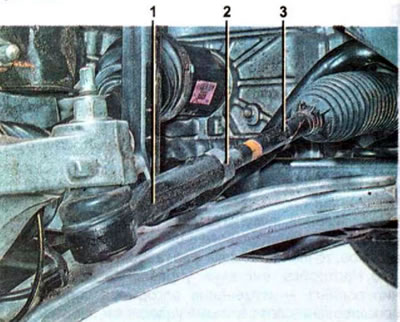
1 — steering rod end; 2 — lock nut; 3 - steering rod
Wheel alignment angles of a car
| Front wheels | Rear wheels | |
| Convergence | 0,07°±0,20° | 0,0°±0,40°* |
| Collapse | -0,30°±0,75°* | -1,4°±0,50°* |
| Longitudinal angle of inclination of the steering knuckle axis (caster) | 4,35°±0,75°* | - |
* Non-adjustable values - used for indirect control over the condition of the suspension and body.
The front wheel caster is the angle between the front wheel turning axis and the vertical in a plane parallel to the vehicle's centerline.
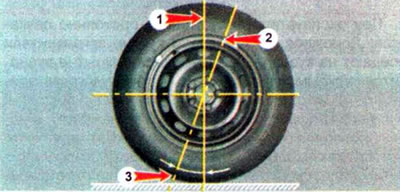
1 - vertical line to the supporting surface; 2 — front wheel pivot axis; 3 — the longitudinal tilt angle of the front wheel pivot axis.
Violation of the correct angle of the front wheel steering axis will cause deterioration in vehicle control. If the longitudinal tilt angle is large, the resistance to steering wheel rotation increases, a small angle worsens the stabilization of the front wheels in the direction of straight ahead movement.
The tilt of the wheel pivot axis is determined by design and is not adjustable. If the longitudinal tilt angle of the steering axis is outside the permissible limits, repair of the suspension elements is required.
The camber angle of the rear wheels is the angle of inclination of the plane of rotation of the wheel relative to the vertical. Uneven camber angles cause the car to pull to the side when driving in a straight line. Large positive camber (when the top of the wheel protrudes outward) leads to accelerated wear of the outer part of the tire tread, and large negative camber leads to wear of the inner part of the tire tread. The camber angle of the rear wheels is set by design and is not adjustable. The camber angle can be used to diagnose the condition of the rear suspension.
Rear wheel toe is the angle between the plane of rotation of the wheel and the longitudinal plane of symmetry of the vehicle when moving in a straight line. Wheel alignment problems impair the vehicle's handling and directional stability, and also lead to intensive tire wear. The toe-in of the rear wheels in the car is determined by design and is not adjustable.
Note: It is practically impossible to check, much less properly adjust, the wheel alignment angles in a garage. In case of uneven wear of tires and wheels, as well as after suspension repairs with replacement of parts, contact a specialized service station equipped with a special stand for adjusting wheel alignment angles.
Warning! If any of the suspension corners (except for the front wheel alignment) does not comply with the standards, repair or replacement of suspension elements is required! If the deviation appeared after an accident, then body repair may be required.