
ChevyMan.ru
Mazda Mitsubishi Toyota Land Rover Honda Kia Nissan
English Русский
Български
Беларускі
Український
Српски
Hrvatski
Română
Polski
Slovenský
Magyar
|
Articles | Sitemap | Contacts |


Home   Aveo   Captiva   Cruze   Lacetti   Lanos   Niva   Tahoe   Others  
Orlando 1 (2010-2018) Trailblazer 1 (2001-2008, petrol) Lumina 1 (1989-1994)
  • Home
  • Chevrolet
  • Orlando 1
  • Chassis
  • Car suspension
  • Car shock absorbers — design description

Car shock absorbers — design description (Chevrolet Orlando 1)

            0

A shock absorber is a vehicle suspension element designed to dampen suspension vibrations that occur as a result of hitting an uneven road surface.

Shock absorbers come in different designs.

Two-pipe hydraulic - the most common design, when two cylinders are located one inside the other and filled with oil.

The inner cylinder contains a piston and valves through which the cavities outside and inside the cylinder communicate with each other. When a load occurs on the cylinder rod, the piston presses on the oil and forces it to flow into the strained cylinder, dissipating the energy. These shock absorbers have the softest operating characteristics, however, at high temperatures and increased loads, the oil in hydraulic shock absorbers can foam, which will greatly affect its operation.

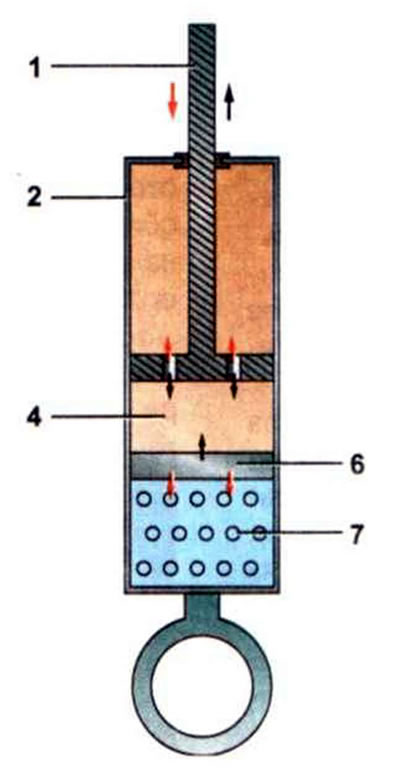
In single-tube gas-filled shock absorbers, the lower part of the working cylinder is filled with gas (nitrogen) under high pressure.

Oil and gas are separated by a floating spacer (piston) and do not mix, which allows maintaining stable characteristics throughout the entire range of suspension travel and temperature. These shock absorbers work in the same way as twin-tube hydraulic ones, only the role of the outer cylinder is filled with nitrogen, which is compressed under load, compensating for the volume of displaced oil. Gas pressure not only prevents oil foaming and reduces shock absorber response time, but such shock absorbers are also more rigid and durable.

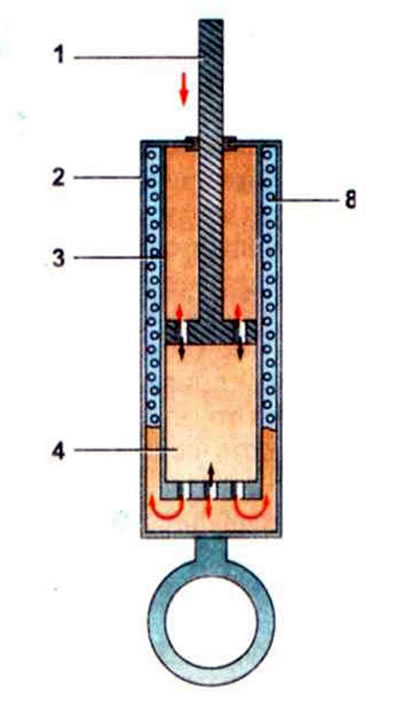
Twin-tube gas-filled shock absorbers - similar in design to hydraulic ones, only here the upper part of the outer cylinder is filled with nitrogen at low pressure (about 5 bar) pressure.


This design combines the strength and reliability of a hydraulic shock absorber with the advantages of a gas-filled one and is well suited for MacPherson front suspension.

Under constant loads, shock absorbers wear out quickly, the seals are damaged, scratches and traces of corrosion appear on the surface of the rod, which also negatively affects the operation of the shock absorber. The cause of shock absorber failure may be incorrect installation, loose mounting nuts, lack of a dust cover protecting the rod, and severe suspension breakdowns.

A faulty shock absorber affects the technical condition of the suspension, handling deteriorates, the density of contact between the wheel and the road decreases and, consequently, the braking distance increases, wear of almost all transmission and suspension components increases, tires wear unevenly, and discomfort and fatigue of the driver and passengers increases. The technical condition of the shock absorbers must be checked in accordance with the maintenance plan.

As for the choice of shock absorber, there is no clear answer. At the manufacturer's plant, shock absorbers are optimally selected for a specific car model based on multiple experiments and tests. Therefore, when replacing shock absorbers with softer or harder ones, be prepared for the car to behave differently on the road.

Stiffer shock absorbers hold the car well on a smooth road, improving handling at the expense of comfort and ride smoothness. However, on a road with potholes and bumps, such shock absorbers will not be able to constantly maintain the wheels' grip on the road, and the car will lose control. Softer hydraulic shock absorbers are suitable here, which will allow the wheel to flow around all the unevenness of the road and maintain good control and comfort.
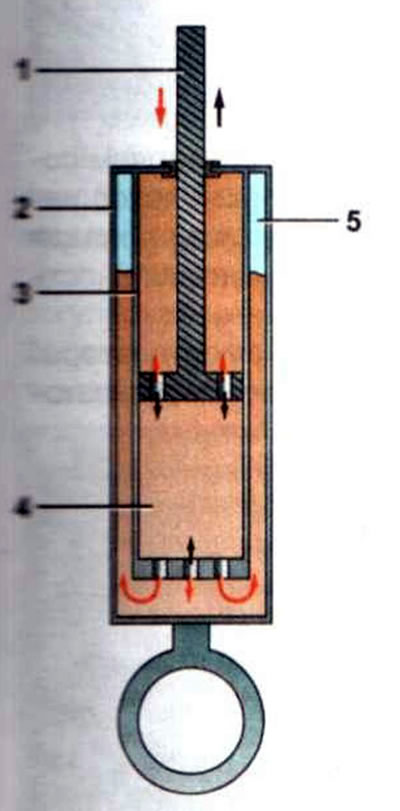


Twin-tube hydraulic shock absorber
Twin-tube hydraulic shock absorber


Monotube gas-filled shock absorber
Monotube gas-filled shock absorber


Twin-tube gas-filled shock absorber

Twin-tube gas-filled shock absorber

  • 1 — shock absorber rod;
  • 2 - outer cylinder;
  • 3 - inner cylinder;
  • 4 - oil;
  • 5 - airspace;
  • 6 - floating piston;
  • 7 - high pressure gas (25 atm);
  • 8 - gas under low pressure (5 atm).

The article was checked: Vladimir Romannikov
This article is available at russian, bulgarian, belarusian, ukrainian, serbian, croatian, romanian, polish, slovak, hungarian

Share information:

Previous articles
Orlando 1: Car suspension
Next articles

Checking the technical condition of shock absorbers
Removal and installation the rear shock absorber
Removal and installation the front shock absorber
Rear suspension
Front suspension — design and testing


See similar articles on the topic of Chevrolet cars:
Vibration and shock on the steering wheel Chevrolet Aveo T300 (2012-2018)
Front shock absorber fault diagnostics Chevrolet Captiva 1 (2006-2018)
Design Features of F16D and F18D Engines Chevrolet Cruze 1 (2008-2016)
Removal the shock absorber strut and disassembling it Chevrolet Lacetti 1 (2002-2009)
Chevrolet Lanos Design Options Chevrolet Lanos T150 (2002-2009)
Checking shock absorbers on a stand Chevrolet Niva 1 (2002-2016)
Rear shock absorbers — removal and installation Chevrolet Tahoe 1 (1992-2000)
Link in different formats to this page


Visitor comments

No comments yet


How much will 45 + 47 =


Orlando 1 (2010-2018) 
  • General information
  • Introduction to manual
  • User manual
  • Maintenance
  • Troubleshooting
  • Power unit
  • Engine repair
  • Fuel and control system
  • Cooling and lubrication system
  • Ignition system
  • Transmission
  • Clutch
  • Gearbox
  • Drive shafts
  • Chassis
  • Car suspension
  • Steering
  • Brake system
  • Body
  • Exterior (external elements)
  • Doors, locks and windows
  • Electrical equipment
  • Equipment and devices
  • Windscreen wipers
  • Power devices
  • Electrical diagrams


Trailblazer 1 (2001-2008) 
  • General information
  • User manual
  • Troubleshooting
  • Maintenance
  • Power unit
  • Engine in a car
  • Engine overhaul
  • Cooling and heating
  • Fuel and exhaust system
  • Engine electrical equipment
  • Engine control
  • Transmission
  • Automatic gearbox
  • Transfer case
  • Drive shafts and cardan
  • Chassis
  • Brake system
  • Car suspension
  • Steering
  • Body
  • Exterior (external elements)
  • Interior (internal elements)
  • Doors, locks and windows
  • Electrical equipment
  • Equipment and devices
  • Electrical circuits


Lumina 1 (1989-1994) 
  • General information
  • Maintenance
  • Power unit
  • Engine 3.1L V6
  • Engine 3.8L V6
  • Engine overhaul
  • Cooling system
  • Power and exhaust system
  • Fuel injection
  • Engine electrical equipment
  • Reduced exhaust gas toxicity
  • Transmission
  • Automatic gearbox
  • Drive shafts
  • Chassis
  • Brake system
  • Car suspension
  • Steering
  • Body
  • Heating and air conditioning
  • Repair of body elements
  • Doors, covers and windows
  • Interior (internal elements)
  • Electrical equipment
  • Equipment and devices
  • Electrical circuits


ChevyMan.ru © 2017-2026 · Mobile version · Feedback · Site search · Interesting to read · Sitemap: EN BG BY UA RS HR RO PL SK HU

Aveo 2003-2008 · Aveo 2006-2011 · Aveo 2012-2018 · Captiva 2006-2018 · Cruze 2008-2016 · Lacetti 2002-2009 · Lanos 2002-2009 · Niva 2002-2016 · Tahoe 1992-2000 · Tahoe 2000-2014 · Lumina 1 1989-1994 · Trailblazer 1 2001-2008 · Orlando 1 2010-2018 ·
🛡️ For your security and to improve our service, this site uses cookies. You can disable them in your browser.