


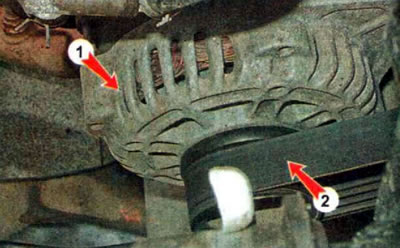
The generator is installed on the rear wall of the cylinder block on the right. Generator 1 is driven by an auxiliary drive belt 2 from the engine crankshaft pulley.
The vehicle uses an electrical power management system. The system monitors the battery status and optimizes the generator operation for the most efficient battery charging and increased engine fuel efficiency. To do this, the system regulates idle speed and charging voltage. The system monitors the battery status based on the voltage in the network when the ignition is on and off. Also, to monitor the charge, a current sensor operating on the Hall effect is installed on the battery ground connection wire.
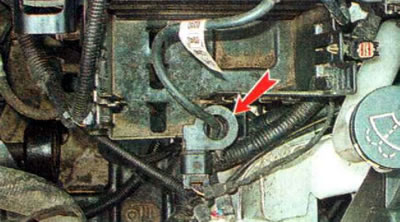
The sensor signals are sent to the engine electrical control unit. The electrical equipment control unit controls the activation of the vehicle's energy consumers and exchanges data with the ECU and instrument panel. Based on the data received from the electrical equipment control unit, the generator signal and the engine operating mode, the ECU controls the generator voltage regulator.
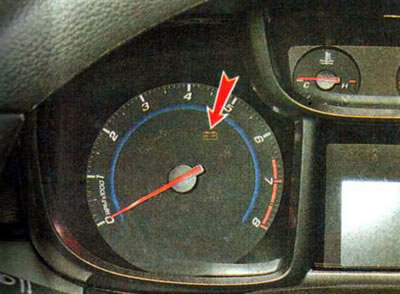
If there is a fault in the battery charging circuit, a warning light will come on on the instrument panel.
The generator is a difficult-to-disassemble structure, so if it malfunctions, contact a specialized service station or replace the generator assembly. This chapter describes only those operations that do not require special equipment skills.
Recommendation. If the battery charge indicator light comes on on the instrument panel, do not rush to immediately remove the generator for repair or replacement. First, make sure that the problem is caused by a failure of the generator itself, and not by the wires of its electrical circuit or by loosening the drive belt tension (see below "Generator fault diagnostics").
Generator specifications
| Manufacturer | VALEO |
| Generator model | TG13 |
| Supply voltage, V | 14 |
| Current strength, A | 125 |
(The article was reprinted from the website chevyman.ru)