


It is convenient to do the work with an assistant.
1. We prepare the car for maintenance and repair.
2. Check the condition and tension of the auxiliary drive belt.
Note: A worn drive belt causes it to slip on the pulley and prevents the generator from developing the required power. Belt slippage can be indirectly determined by the dim glow of the headlights at night and by a whistling sound in the front of the engine when the gas pedal is pressed sharply.
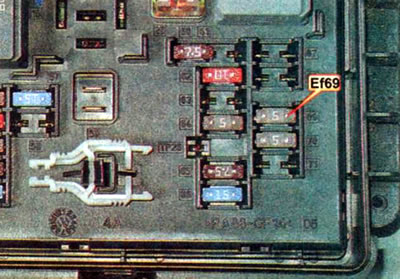
3. Check the serviceability of fuse Ef69 in the fuse and relay box in the engine compartment. We replace the faulty fuse. If after replacement the fuse burns out again, then there is a short circuit in the electrical circuit that must be found and eliminated.
4. Check the connection of the wires to the generator terminals and the battery.
5. Check the battery voltage, which at a temperature of 20°C should be at least 12 V. If necessary, charge the battery.
6. Turn off all electricity consumers.
7. The assistant, pressing the gas pedal and monitoring the engine operation using the tachometer, maintains the engine crankshaft speed at 2500 min⁻¹.
Recommendation. If you don't have an assistant, you can connect the multimeter to the battery using two pieces of wire. The length of the wires must be sufficient to allow the device to be placed inside the car.
8. Check the battery voltage, which at a temperature of 18-25°C should be within 12.6-15.0 V. If the voltage goes beyond the specified limits, the generator is faulty.
9. At an engine crankshaft speed of 2500 min⁻¹. We turn on powerful consumers - air conditioning, air conditioning fan and high beam headlights and check the battery voltage, which at a temperature of 18-25°C should be within 12.6-15.0 V. If the voltage goes beyond the specified limits, the generator is faulty.
10. Using a stethoscope, we evaluate the condition of the generator bearings based on the noise. A loud hum indicates wear of the bearing or bearings (the most common bearing to fail is the front bearing, on the pulley side).