


2. The initial factors by which the vacuum gauge readings are analyzed and the most accurate conclusions about the engine condition are made are the absolute reading of the device and the nature of the movement of the instrument pointer (dynamics of readings). It is advisable to combine vacuum diagnostics with other methods (for example, with a change in compression in the cylinders).
3. The vacuum gauge is connected to the throttle body to measure the pressure directly on the intake manifold. It is not allowed to connect the vacuum gauge to the hoses of auxiliary units. Before testing, make sure that all vacuum hoses are connected in place. Before starting the test, warm up the engine completely, block the wheels.
Attention! It is not allowed to disconnect the engine sensors or electro-pneumatic drives to connect the vacuum gauge, since after their disconnection the engine operation will be disrupted, the vacuum gauge readings will be obviously false.
4. Check the vacuum gauge reading. On a working engine, the vacuum gauge should show a vacuum of 430-560 mm Hg, and the instrument needle should be practically motionless.
5. A low but steady vacuum level usually indicates a leak in the gasket between the intake manifold and the throttle body, a vacuum hose, as well as too late ignition timing or incorrect valve timing due to improper installation of the camshaft sprocket (see photo).
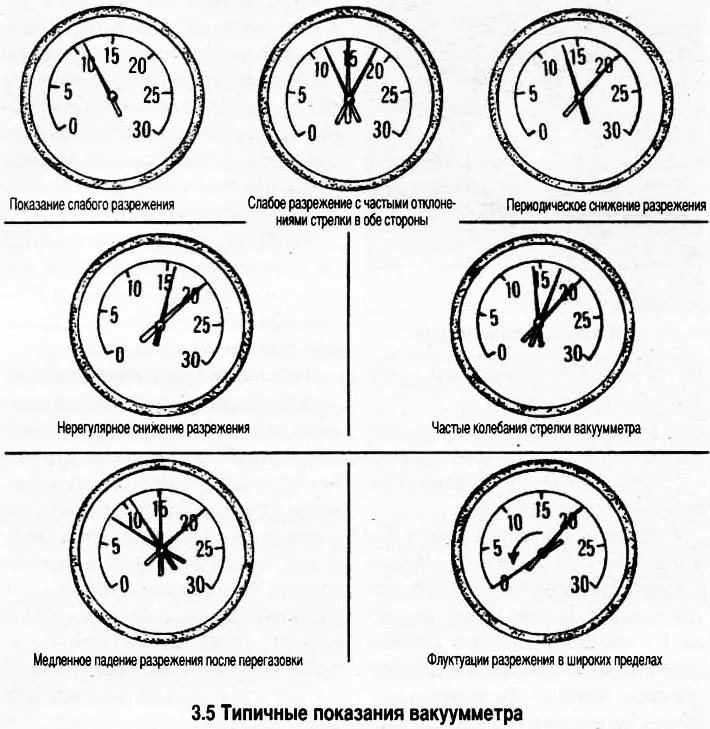
6. If the vacuum gauge readings are 75-200 mm Hg below normal and are unstable (the arrow twitches), then this indicates a leak in the gasket at the inlet of the suction manifold (see photo).
7. If the arrow regularly deviates by 50-100 mm Hg, then the reason is that the valves are not tight (see photo). Check the compression in the engine cylinders.
8. If the needle irregularly deviates towards low readings, or trembles and shows low vacuum, then the cause is increased resistance to valve movement, or interruptions in the operation of the cylinders. Check the compression in the cylinders and inspect the spark plugs (see photo).
9. If the needle quickly fluctuates within 100 mm Hg at idle, and the engine operation is accompanied by smoke from the muffler, then the valve guides are worn out. If the needle quickly fluctuates with a simultaneous increase in engine speed, then it is necessary to check the tightness of the intake manifold gasket, the elasticity of the valve springs. Such readings can also be caused by burnt valves and interruptions in the operation of the cylinders (ignition failures).
10. Weak fluctuations of the arrow within 20-30 mm Hg indicate unstable ignition operation.
11. If the arrow fluctuates greatly, check the compression in the cylinders.
12. Bring the engine speed to 2500 rpm and release the pedal. The vacuum gauge readings should drop to almost zero, then increase and exceed the control readings corresponding to steady-state idle speed by approximately 125 mm Hg, after which the vacuum should be restored to the previous level. Different vacuum behavior indicates wear of the piston rings. If the pressure is restored for a long time, then the cause is a clogged exhaust system (usually a catalytic converter). To check, temporarily disconnect the section of the exhaust system in front of the suspected part and repeat the test.
(The original text can be found on the website: «chevyman.ru»)