


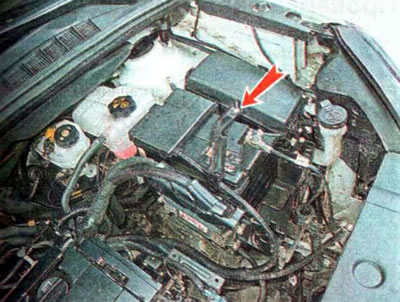
When the coolant cools down, the pressure in the system decreases and may become less than atmospheric pressure. To prevent a vacuum from occurring, a check valve is built into the expansion tank cap.
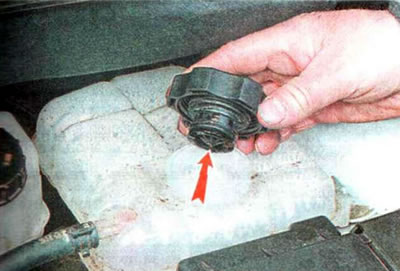
Excess pressure in the cooling system is necessary to increase the boiling point of the cooling liquid. But it should not exceed the value set by the manufacturer - at this pressure, the safety valve opens, and some of the air is forced out of the expansion tank into the atmosphere.
The pressure value at which the lid valve opens is indicated on its body. In this case it is 140 kPa.
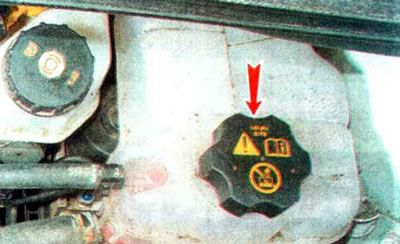
Operating the vehicle without an expansion tank cap or with a cap whose valve has insufficient operating pressure is unacceptable! This will not damage the cooling system components, but may cause the engine to overheat.
Warning. Do not open the radiator cap of a hot engine until it has cooled down. If the pressure drops sharply, the hot coolant will instantly boil, splash out of the filler neck of the tank and can cause serious burns!
The situation is even more dangerous if the valve fails to operate when the pressure increases. The fact that the pressure in the system is higher than normal can be determined by the swollen and too hard rubber hoses of the cooling system. Long-term operation of a vehicle with increased pressure in the cooling system will inevitably lead to damage to its elements.
The check valve operates at a pressure of 1-5 kPa. In this case, the liquid from the expansion tank returns to the cooling system. The check valve malfunction can be judged by the shrinking hoses of the cooling system when the engine cools down.
The operation of the valves can be accurately checked using a special device at a specialized service station. A cap with a faulty valve must be replaced.
Warning. Do not replace the expansion tank cap with one of similar size but with a different valve opening pressure. This may cause damage to the cooling system!
[For details, visit the website «chevyman.ru»]