


1. Start the engine and warm it up to operating temperature.
2. We prepare the car for maintenance and repair.
Recommendation. The pressure may decrease due to the loss of oil performance properties as a result of aging or the ingress of foreign impurities into it (water, antifreeze or gasoline). Therefore, if you do not know the exact date of the previous oil change and are not sure of its quality, it is better to change it before checking the pressure. If you find foreign impurities in the oil, eliminate the cause of their appearance before checking.
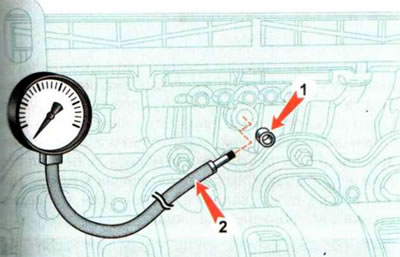
3. Stop the engine. We unscrew the plug of the control hole 1 from the cylinder head and, through a special adapter 2, connect the hole to the pressure gauge.
4. The assistant starts the engine.
Warning. If the pressure gauge shows insufficient oil pressure, stop the engine immediately and do not start it until you eliminate the cause of the malfunction!
5. Let the engine run for 2-3 minutes at idle speed so that the lubrication system is filled with oil, and check the pressure. It should be at least 130 kPa (1.3 bar).
If the pressure is lower than prescribed, it means: the oil pump is faulty, the pressure relief valve is faulty, the crankshaft liners or the crankshaft itself are worn out. Other, rarer faults cannot be ruled out. In any case, the oil pump or engine needs to be repaired.
A clogged oil filter or oil receiver may also cause a drop in pressure. In this case, as the crankshaft speed increases, the pressure will first increase and then decrease. In case of such a malfunction, it is necessary not only to replace the filter or clean the oil receiver, but also to remove dirt from the engine, as well as the cause of contamination.
If the measurement shows that the pressure is normal, but the low oil pressure indicator light is on, then the emergency oil pressure sensor or its electrical circuit is faulty. To get to the sensor, you need to remove the air conditioning compressor. It is extremely difficult to do this at home, so it is advisable to contact a specialized service station to replace the sensor.
Note. When the speed increases above average, the pressure should not exceed 700 kPa. If it is higher and continues to increase as the crankshaft speed increases, the pressure relief valve is most likely faulty - the oil pump needs to be repaired.
7. After completing the check, disconnect the engine pressure gauge and tighten the plug to a torque of 15 Nm
(The original article can be found on the resource CHEVYMAN.ru)