


The American Petroleum Institute (API) classification determines the performance properties of oil. Motor oils in it are divided into classes, which are designated by Latin letters. The first letter characterizes the purpose of the motor oil: for a diesel or gasoline engine. Oil for a gasoline engine is designated by the letter S (Service), and for a diesel engine - C (Commercial). Oil for diesel engines, in turn, can be intended for two-stroke or four-stroke engines. The second letter in the class designation characterizes the "quality" of the oil, that is, its compliance with certain technical requirements. After the development and certification of a new class of motor oil with improved properties, it is assigned the next letter of the Latin alphabet. The closer to the end of the alphabet the second letter in the group designation is located, the higher the requirements the oil will meet. The latest certified class of motor oils for gasoline engines—SN—was adopted in 2010, for diesel engines—CJ-4—was adopted in 2010. As new classes of oil appear, the previous ones are gradually cancelled. Motor oils of class SH/CE and "older" have been discontinued.
Universal motor oil, which can be used in both petrol and diesel engines, has double marking, indicating the oil quality group for each engine type. The number 2 or 4 in the diesel oil group designation indicates the number of strokes in the engine for which this oil is intended. If the oil has energy-saving properties, its designation will include the letters FE or EC after the group (Fuel Economy or Energy Conserving respectively), After the letters there may also be a Roman numeral, which indicates the conditional amount of savings (II – energy savings up to 2.7%, without a number – 1.7%).
The classification of motor oil according to API has become widespread.
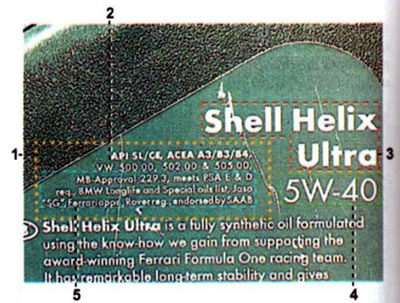
An example of motor oil marking indicating compliance with the requirements of European manufacturers: 1 - marking of oil compliance with technical requirements; 2 — according to API standards, the oil corresponds to quality class SL/CE, according to ACEA standards, the oil corresponds to quality class A3/B3/B4; 3 - name of the oil; 4 — oil viscosity marking according to SAE; 5 - marking of compliance with the vehicle manufacturer's requirements.
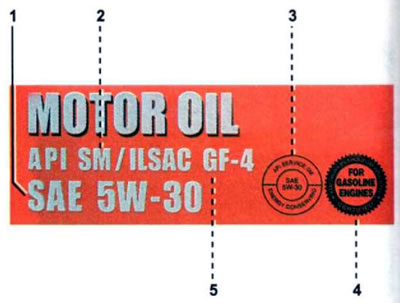
An example of marking the conformity of motor oil with the technical requirements of international standards: 1 — oil viscosity no SAE 5W-30; 2 — according to API standards, the oil corresponds to quality class SM; 3 — API and SAE motor oil certification marks (API — classification designation; SERVICE — oil for gasoline engines; SM class oil; SAE 5W-30 - viscosity grade; ENERGY CONSERVING II — oil has energy-saving properties; 4 - designation of compliance with API and ILSAC requirements; 5 — according to ILSAC standards, the oil corresponds to class GF-4
The classification of the European Automobile Manufacturers Association (ACEA - Association des Cons truc ted Europeans des Automobiles) also determines the performance properties of motor oil.
Classification of the International Lubricant Standardization and Approval Committee (ILSAC). This standard was developed jointly by the Japan Automobile Manufacturers Association and the American Automobile Manufacturers Association. Currently, the standard provides for three classes of oils for gasoline engines, which are designated by two letters GF and numbers 1-5. The highest performance requirements are for class GF-5. All motor oils certified by ILSAC are energy-saving.
There are also other standards for motor oil classifications. Thus, car manufacturers often develop additional requirements for motor oil and use their own internal oil class markings. Domestic oil manufacturers sometimes apply viscosity markings in accordance with GOST, but at the same time duplicate them with SAE markings.
The oil's markings indicating its properties are placed on the packaging.
(The article was reprinted from the website CHEVYMAN.RU)