


The engine cooling system uses a special cooling liquid based on a mixture of water and ethylene glycol (Dex-cool). It circulates thanks to a centrifugal pump of the cooling system, installed on the right side of the cylinder block. The pump is driven by a poly-V belt from the crankshaft pulley.
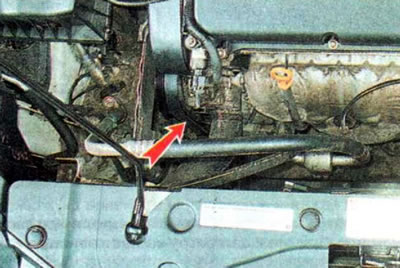
The thermostat ensures rapid engine warm-up and maintains the optimum coolant temperature. It is installed in a separate housing located on the left side of the cylinder head.
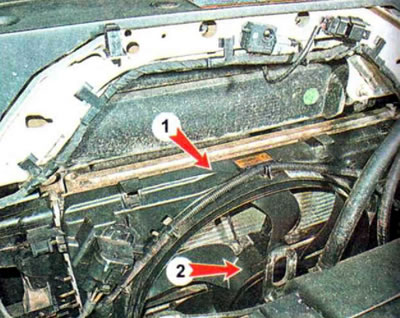
In the radiator of cooling system 1, the liquid is cooled by the oncoming air flow, but during prolonged movement at low speed this may not be enough. When the coolant temperature increases to a certain value, the two-speed electric fan 2 will turn on.
When the air conditioner is off, the electric fan is switched on by a signal from the electronic control unit (ECU). Depending on the coolant temperature, it operates at the first or second speed. When the air conditioner is on, the electric fan runs continuously at first speed.
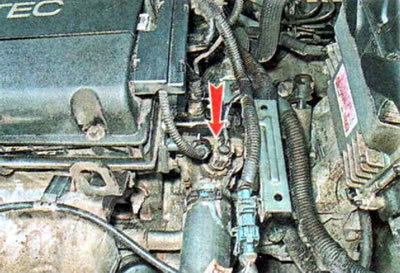
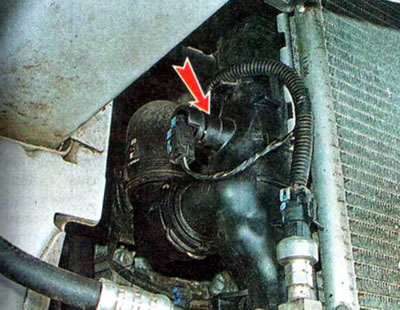
The ECU controls the engine temperature using signals from the coolant temperature sensors, which are located on the thermostat housing...
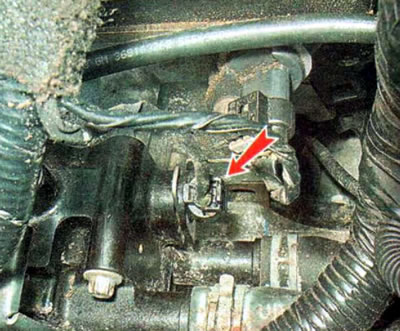
...and on the radiator of the cooling system (for clarity, the front bumper has been removed).
| Air conditioner operating mode | Radiator fan operating mode | Engine coolant temperature (°C) | |
| Turning on | Shutdown | ||
| With the air conditioner turned off or on vehicles without air conditioning | Low revs | 96 | 93 |
| High revs | 100 | 97 | |
| The air conditioner is on | Low revs | Constantly | |
| High revs | 100 | 97 | |
Warning! The electric fan turns on automatically regardless of the position or presence of the key in the ignition switch. To avoid injury while performing work, do not allow hands, other body parts or clothing to enter the rotation zone of the electric fan impeller.
When heated, the coolant expands in volume and the pressure in the cooling system increases. To prevent damage to the system, a safety valve in the filler cap is activated, and some of the air enters the atmosphere from the expansion tank. After the engine stops, as the coolant cools and the pressure in the system decreases, air again enters the expansion tank.
In case of a leak in the cooling system, it is allowed to add distilled water, but after this it is necessary to restore the optimal concentration of antifreeze in the coolant as quickly as possible.
The volume of the engine cooling system is about 5.6 l.
Diagnostics of the malfunction
The most typical signs of a faulty cooling system are:
- engine overheating;
- increased time for the engine to warm up to operating temperature;
- constant decrease in coolant level.
1. The engine overheats
When operating the vehicle, we monitor the engine temperature using the coolant temperature gauge on the instrument panel.
The indicator arrow should not enter the red zone.
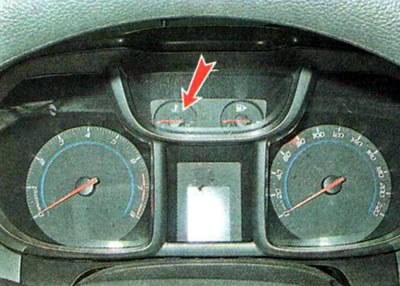
Warning! Overheating can cause serious engine damage. Therefore, do not operate the vehicle when the indicator arrow has reached the red zone. If this happens while driving, stop the car, open the hood and let the engine idle for a while. If this is not enough to cause the temperature to start dropping, turn off the engine and let it cool down. Do not operate the vehicle until the cause of the malfunction has been identified and corrected.
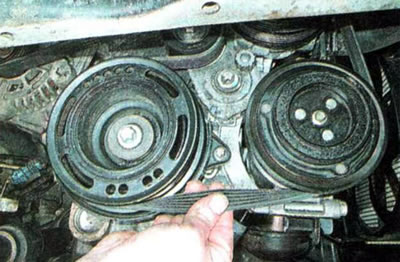
The most common cause of engine overheating is low coolant level - check its level in the expansion tank. The engine may also overheat if the accessory drive belt is loose or broken (for clarity, the right front wheel and mudguard have been removed).
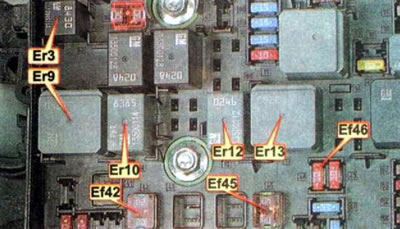
If the engine overheats only during prolonged driving at low speed and the fluid level is normal, the electric fan of the engine cooling system is faulty. Confirmation that it is the one that is not working will be the normalization of the engine thermal regime when the speed increases. If the electric fan does not turn on when the arrow reaches the red zone of the scale, check the serviceability of fuses Ef42 20A, Ef45 40A and Ef46 10A, relays Er3, Er9, Er10, Er12 and Er13 in the fuse and relay box in the engine compartment.
The overheating may be due to a faulty thermostat - its operation needs to be checked.
If the electric fan and thermostat are working properly, the accessory drive belt is tight, the coolant level is normal, and the engine still overheats, then the radiator of the cooling system or the condenser of the air conditioning system, which is installed in front of the radiator, may be clogged (for cars equipped with air conditioning). With this malfunction, the engine will overheat less in cold weather. The radiator and condenser must be flushed and blown out - it is advisable to contact a specialized service station to perform this work
2. Increasing engine warm-up time
The most likely reason for the increased time it takes for the engine to warm up to operating temperature is a faulty thermostat, which is stuck in the open position. This malfunction is especially noticeable in winter when the ambient temperature is below zero. We check its work. We replace the faulty thermostat.
3. Constant decrease in coolant level
If you have to add coolant frequently, it means that the cooling system is not sealed properly. We make sure that there is no fluid leakage from the thermostat housing, from under the coolant temperature sensors, or at the joints of the rubber hoses of the cooling system. We check the integrity of the hoses themselves, the tightness of the expansion tank and radiator. Sometimes, when there is a minor fluid leak, it can be very difficult to find the faulty connection, since the leaks have time to dry out. In this case, we perform the search immediately after stopping the engine warmed up to operating temperature, and even better on a cooled engine after several hours of parking.
We replace damaged cooling system hoses or loose clamps, as well as other faulty parts.
Recommendation. You can try to eliminate coolant leaks from under the hoses by installing new hose clamps or replacing them with screw clamps. When tightening the screw clamps, do not overtighten them as they may damage the hoses.