
ChevyMan.ru
Mazda Mitsubishi Toyota Land Rover Honda Kia Nissan
English Русский
Български
Беларускі
Український
Српски
Hrvatski
Română
Polski
Slovenský
Magyar
|
Articles | Sitemap | Contacts |


Home   Aveo   Captiva   Cruze   Lacetti   Lanos   Niva   Tahoe   Others  
Orlando 1 (2010-2018) Trailblazer 1 (2001-2008, petrol) Lumina 1 (1989-1994)
  • Home
  • Chevrolet
  • Orlando 1
  • Power unit
  • Cooling and lubrication system
  • Cooling liquid

Cooling liquid (Chevrolet Orlando 1)

            0

The engine cooling system uses special cooling liquids (antifreezes) consisting of ethylene glycol, water and additives. They have a low freezing point and a high boiling point.

Note: Some coolants use less toxic propylene glycol instead of ethylene glycol. Propylene glycol-based coolants have not gained widespread popularity due to the high cost of propylene glycol and the deterioration of the heat-dissipating properties of the liquid. All antifreezes are more or less poisonous, be careful! In addition, antifreeze leaves indelible stains on the car body enamel, if it gets on the paintwork, it should be removed immediately and the surface washed with clean water.


The coolant must meet the following basic requirements:
  • remove heat from engine cylinders;
  • do not freeze at low temperatures;
  • do not form deposits in the cooling system;
  • do not cause corrosion of metal parts and destroy rubber elements of the cooling system;
  • do not foam during operation.

These requirements are met by adding a special complex of additives. Antifreezes are divided into traditional ones according to the composition of additives (Traditional coolants or Conventional nts), hybrid (Hybrid coolants) and carboxylate types.

Warning! It is not recommended to mix antifreezes of different brands during topping up, and those with different bases are completely unacceptable! Do not fill the system with plain water, even distilled, and even in summer. Firstly, if you forget about this, you can ruin the engine in the October frosts. Secondly, it is most likely impossible to avoid corrosion and destructive cavitation in the system, this is how modern engines are designed. And finally, pure water has poor lubricating properties and the pump seal will wear out quickly.


Note: Carboxylate antifreeze has a longer service life and better, compared to traditional and hybrid antifreezes, protects engine cooling system parts from corrosion.


* Cavitation is the formation of vapor-gas bubbles in a liquid flow. As these bubbles disappear, they cause microscopic explosions that destroy the walls of pipelines and other parts washed by the flow.

To designate the type of antifreeze, many manufacturers use the standard adopted by the VAG group:
  • G11 - hybrid antifreezes;
  • G12 and G12+ are carboxylate antifreezes.

In 2008, a new type of antifreeze appeared, in which an organic base is combined with a small amount of mineral corrosion inhibitors. There is no generally accepted designation for them yet. The developers of antifreeze have given it the name Lobrid coolants and SOAT coolants. This antifreeze has the G12++ standard (according to VAG group specification).

Various dyes are added to antifreezes, giving the antifreeze a particular color that does not affect its operational and chemical properties. Therefore, when choosing antifreeze, you should pay attention not to its color, but to its chemical composition (type), recommended by the car manufacturer.

On sale you can find both ready-to-use antifreezes and concentrated ones, which must be diluted with distilled water in a certain proportion before use. The proportions for diluting antifreeze with distilled water are usually indicated on the label attached to the container.

Note: Dilute antifreeze with distilled water before adding to the cooling system. This is the only way to ensure that the specified ratios of antifreeze and distilled water are precisely observed. Check the density of the antifreeze after mixing.


The car's cooling system uses a mixture of water and GM LLC antifreeze (Dex-Cool). The volume of the cooling system is about 5.6 liters.
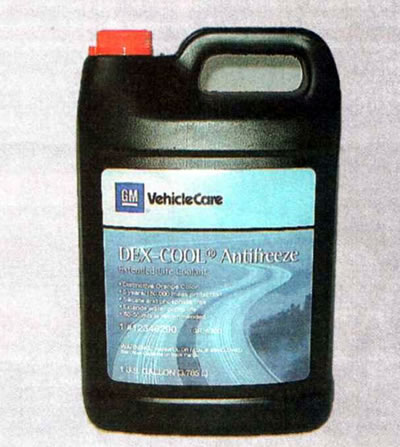
The car's cooling system uses a mixture of water and GM LLC antifreeze (Dex-Cool). The volume of…


The original source of the article is the website CHEVYMAN

The article was checked: Vladimir Romannikov
This article is available at russian, bulgarian, belarusian, ukrainian, serbian, croatian, romanian, polish, slovak, hungarian

Share information:

Previous articles
Orlando 1: Cooling and lubrication system
Next articles

Requirements for oil quality and replacement periods
Classification of motor oil
Motor oil
Oil filter
Coolant temperature sensor
Cooling system — description and testing
Thermostat — Checking and Replacing


See similar articles on the topic of Chevrolet cars:
Design features of the cooling system Chevrolet Aveo T300 (2012-2018)
Technical characteristics of the cooling system Chevrolet Captiva 1 (2006-2018)
Features of the design of the engine cooling system Chevrolet Cruze 1 (2008-2016)
Engine cooling system device Chevrolet Lacetti 1 (2002-2009)
Cooling system Chevrolet Lanos T150 (2002-2009)
Checking the level and density of the liquid in the cooling system Chevrolet Niva 1 (2002-2016)
Cooling liquid Chevrolet Tahoe 2 and 3 (2000-2014)
Link in different formats to this page


Visitor comments

No comments yet


How much will 34 + 32 =


Orlando 1 (2010-2018) 
  • General information
  • Introduction to manual
  • User manual
  • Maintenance
  • Troubleshooting
  • Power unit
  • Engine repair
  • Fuel and control system
  • Cooling and lubrication system
  • Ignition system
  • Transmission
  • Clutch
  • Gearbox
  • Drive shafts
  • Chassis
  • Car suspension
  • Steering
  • Brake system
  • Body
  • Exterior (external elements)
  • Doors, locks and windows
  • Electrical equipment
  • Equipment and devices
  • Windscreen wipers
  • Power devices
  • Electrical diagrams


Trailblazer 1 (2001-2008) 
  • General information
  • User manual
  • Troubleshooting
  • Maintenance
  • Power unit
  • Engine in a car
  • Engine overhaul
  • Cooling and heating
  • Fuel and exhaust system
  • Engine electrical equipment
  • Engine control
  • Transmission
  • Automatic gearbox
  • Transfer case
  • Drive shafts and cardan
  • Chassis
  • Brake system
  • Car suspension
  • Steering
  • Body
  • Exterior (external elements)
  • Interior (internal elements)
  • Doors, locks and windows
  • Electrical equipment
  • Equipment and devices
  • Electrical circuits


Lumina 1 (1989-1994) 
  • General information
  • Maintenance
  • Power unit
  • Engine 3.1L V6
  • Engine 3.8L V6
  • Engine overhaul
  • Cooling system
  • Power and exhaust system
  • Fuel injection
  • Engine electrical equipment
  • Reduced exhaust gas toxicity
  • Transmission
  • Automatic gearbox
  • Drive shafts
  • Chassis
  • Brake system
  • Car suspension
  • Steering
  • Body
  • Heating and air conditioning
  • Repair of body elements
  • Doors, covers and windows
  • Interior (internal elements)
  • Electrical equipment
  • Equipment and devices
  • Electrical circuits


ChevyMan.ru © 2017-2026 · Mobile version · Feedback · Site search · Interesting to read · Sitemap: EN BG BY UA RS HR RO PL SK HU

Aveo 2003-2008 · Aveo 2006-2011 · Aveo 2012-2018 · Captiva 2006-2018 · Cruze 2008-2016 · Lacetti 2002-2009 · Lanos 2002-2009 · Niva 2002-2016 · Tahoe 1992-2000 · Tahoe 2000-2014 · Lumina 1 1989-1994 · Trailblazer 1 2001-2008 · Orlando 1 2010-2018 ·
🛡️ For your security and to improve our service, this site uses cookies. You can disable them in your browser.