


The system is filled with liquid (antifreeze) based on ethylene glycol, does not freeze at ambient temperatures down to -40°C. The circulation of liquid in the system is created by a water pump. From the pump, the liquid is fed into the engine cooling jacket, washes the combustion chambers and then goes to the thermostat. Depending on the position of the thermostat valve, the liquid goes to the water pump (at low temperature) or radiator (at high temperature). The normal thermal mode of the engine is determined by the temperature of the coolant, which is maintained automatically by the thermostat in the range of 85-96°C.
Warnings: It is not recommended to fill the cooling system with water, since the antifreeze contains anti-corrosion and anti-foam additives, as well as additives that prevent scale deposition.
Coolant is toxic! Avoid inhaling its vapors and getting it on your skin. Promptly eliminate any leaks in the cooling system to prevent coolant vapors from getting into the car's interior during operation. Your health is more valuable than a new cooling system hose or a tube of sealant!
Radiator with horizontal liquid flow, with a tubular-ribbon aluminum core and plastic tanks. At the bottom of the supply tank there is a drain cock. The tanks contain supply and discharge hose pipes to the engine water jacket, hose pipes connecting the radiator to the expansion tank. If the car has an automatic transmission, a heat exchanger is installed on the left side of the radiator to cool the working fluid.
Expansion tank (Fig. 5.15) serves to compensate for the changing volume of the coolant depending on its temperature. The tank is made of translucent plastic. To control the level of the coolant, marks of the maximum and minimum levels of the working fluid are applied to its walls. At the top is a filler neck, hermetically sealed with a plastic plug with two valves inside it (inlet and outlet), assembled in a single block. The outlet valve opens at a pressure of 140 kPa (1.4 kgf/cm²), ensuring an increase in the boiling point of the coolant and preventing intensive vaporization. When the liquid cools, its volume decreases and a vacuum is created in the system. The inlet valve in the plug opens at a vacuum of about 3 kPa (0.03 kgf/cm²) and allows air to pass into the expansion tank.
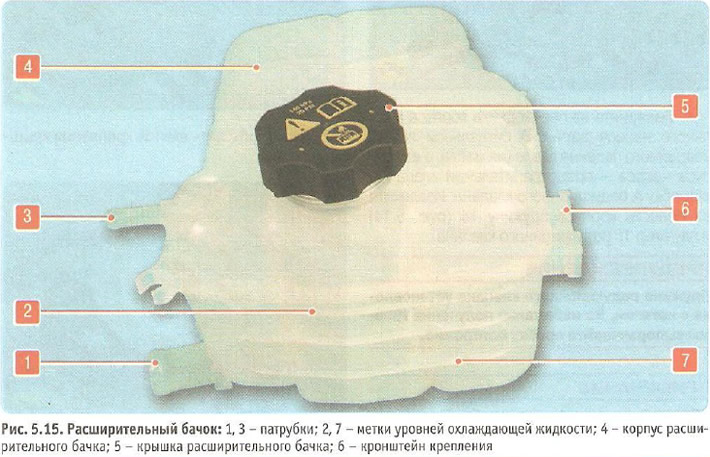
Note: The correct operation of the plug valves is very important for the normal operation of the cooling system, but often when problems occur (boiling of coolant, etc.) car enthusiasts pay attention only to the operation of the thermostat, forgetting to check the valves. A leaky exhaust valve leads to a decrease in the boiling point of the coolant, and its jamming in the closed state leads to an emergency increase in pressure in the system, which can cause damage to the radiator and hoses.
Water pump centrifugal type provides forced circulation of liquid in the cooling system, is installed on the front plane of the cylinder block and is driven by a toothed belt of the timing mechanism drive. The axis of rotation of the pump pulley is made eccentric to the axis of its housing, which allows you to adjust the belt tension by turning the housing around the axis. The pump has sealed bearings that do not require replenishment of lubrication. The pump is not subject to repair, in case of failure (fluid leak or bearing damage) it is replaced as a whole.
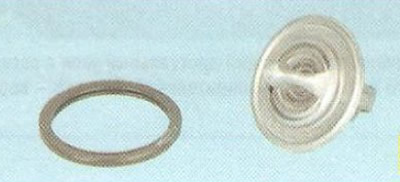
Thermostat with a solid temperature-sensitive filler maintains the normal operating temperature of the coolant and reduces the engine warm-up time.
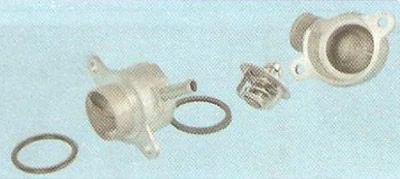
It is installed on the cylinder head in its front part on the right in an aluminum disassemblable housing. At a coolant temperature of up to 82°C, the thermostat is completely closed and the liquid circulates along a small circuit, bypassing the radiator, which accelerates engine warm-up. At a temperature of 82°C, the thermostat begins to open, and at 96°C it opens completely, ensuring the circulation of liquid through the radiator.
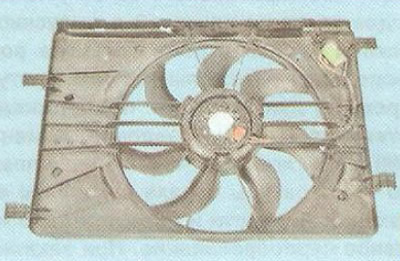
Electric fan with a plastic seven-blade asymmetric impeller provides air blowing through the radiator at low vehicle speeds, mainly in urban conditions or on mountain roads, when the oncoming air flow is insufficient to cool the radiator.
To improve the efficiency of the fan, it is installed in a casing and attached to it at three points through rubber pads. The casing, in turn, is attached to the radiator at four points.
The electric fan is controlled by the engine control unit, which receives information about the coolant temperature from the coolant temperature sensor located in the water jacket of the cylinder head. When the coolant temperature reaches 95°C, the fan switches on at low speed. When the coolant temperature reaches 96°C, the control unit switches on high speed fan rotation via the thermal relay. When the coolant temperature drops to 82°C, the electric fan switches off.
On cars with air conditioning, an additional electric fan may be installed as an option, designed to blow air over the air conditioning heat exchanger. In this case, the engine control unit additionally uses information from the air conditioning pressure sensor to turn on the electric fans. When the air conditioning is on, the additional electric fan of the cooling system radiator begins to rotate at low speed until the liquid reaches a temperature of 96°C or until a certain pressure is reached at the outlet of the air conditioning compressor. After reaching these conditions, the control unit turns on a high speed of the electric fan.
The interior heater radiator is also connected to the cooling system via hoses.
[The article is reprinted from the website «CHEVYMAN»]