
ChevyMan.ru
Mazda Mitsubishi Toyota Land Rover Honda Kia Nissan
English Русский
Български
Беларускі
Український
Српски
Hrvatski
Română
Polski
Slovenský
Magyar
|
Articles | Sitemap | Contacts |


Home   Aveo   Captiva   Cruze   Lacetti   Lanos   Niva   Tahoe   Others  
Cruze 1 (2008-2016)
  • Home
  • Cruze
  • J300 (2008-2016)
  • Power unit
  • Cooling system
  • Replacing the coolant

Replacing the coolant (Chevrolet Cruze J300)

            0

According to the manufacturer's recommendation, the coolant should be replaced after 45 thousand km of mileage or 3 years of operation (whichever comes first).

You will need: a flat-blade screwdriver, coolant, a cleaning cloth, a container for draining the coolant with a capacity of at least 8 liters, and pliers.

Warnings: Use ethylene glycol based coolant (antifreeze).


Replace coolant only when the engine is cold.


When starting the engine, the expansion tank cap must be closed. Screw the tank cap tightly. The cooling system is under pressure when the engine is running, so coolant may leak from under a poorly screwed cap.


Coolant is toxic, so be careful when handling it.


1. Place the vehicle on a level, horizontal surface.
1. Place the vehicle on a level, horizontal surface.


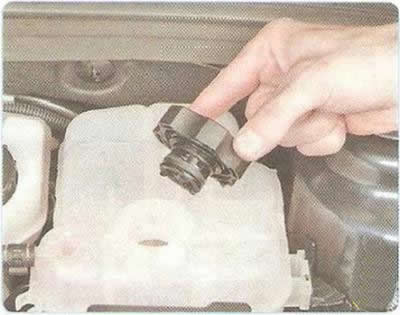
2. Unscrew the expansion tank cap.
2. Unscrew the expansion tank cap.


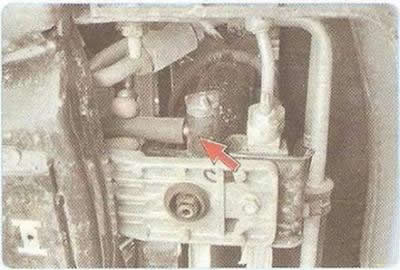
3. Connect the radiator hose of the cooling system to the drain cock, located at the bottom of the tank on the right side.


3. Connect the radiator hose of the cooling system to the drain cock, located at the bottom of the…


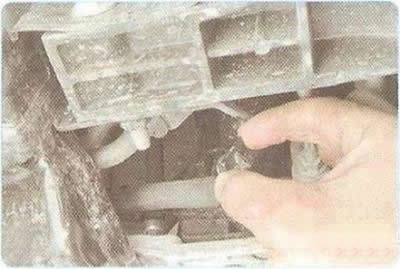
4. Unscrew the drain cock valve.

5. Place a container under the hose and drain the liquid from the cooling system.
5. Place a container under the hose and drain the liquid from the cooling system.


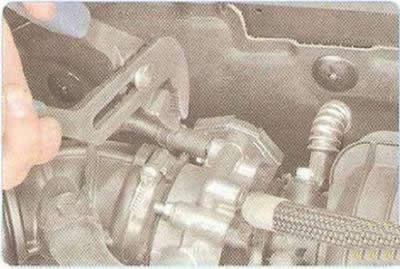
6. To ensure complete drainage of fluid from the system and guaranteed removal of air from it when filling, squeeze the tabs of the throttle heating hose clamp, slide the clamp along the hose...
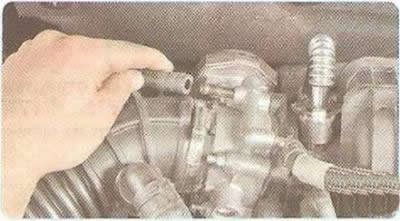
6. To ensure complete drainage of fluid from the system and guaranteed removal of air from it when…


7. ...and remove the hose from the throttle body fitting.


8. Close the drain valve.

Note: If the expansion tank is heavily contaminated, remove and clean it.


9. Flush the cooling system by reinstalling the coolant supply hose to the throttle assembly and slowly filling the system with water through the expansion tank to the level of the steam outlet tube.

10. Start the engine and let it run until the electric fan turns on.

11. Turn off the engine and drain the water.

12. Flush the cooling system until clean water starts to drain.

13. Disconnect the hose from the throttle body fitting again.

14. Fill the engine cooling system by pouring coolant into the expansion tank until it starts to flow out of the fitting on the throttle assembly and from the removed hose. When the liquid starts to flow out, put the hose back in place and secure it with a clamp.

15. Start the engine and warm it up to operating temperature (before turning on the fan). After this, stop the engine, check the coolant level and, if necessary, add it to the expansion tank up to the "MAX" mark.

Note: While the engine is running, monitor the coolant temperature using the gauge. If the needle reaches the red zone and the radiator fan does not turn on, turn on the heater and check what kind of air passes through it. If the heater supplies warm air, the fan is most likely faulty, and if it supplies cold air, then an air lock has formed in the engine cooling system. To remove it, turn off the engine, let it cool down and unscrew the expansion tank cap. Start the engine, let it run for 3-5 minutes and screw the tank cap back on.


Helpful Hints: To ensure the system fills better without air locks, periodically squeeze the radiator hoses with your hand.


After several days of vehicle operation after replacing the coolant, check its level. Replenish the level if necessary.


If after a very short time the color of the fresh liquid turns brown, it means that you have poured in a fake, to which the manufacturer "forgot" to add corrosion inhibitors. In addition, one of the signs of a fake is a sharp complete discoloration of the liquid. The dye of a quality cooling liquid is very stable and only darkens over time. The liquid tinted with linen blue discolors. Such "antifreeze" must be replaced quickly.

The article was checked: Vladimir Romannikov
This article is available at russian, bulgarian, belarusian, ukrainian, serbian, croatian, romanian, polish, slovak, hungarian

Share information:

Previous articles
Cruze 1: Cooling system
Next articles

Checking the cooling system hoses and connections
Possible malfunctions of the cooling system, their causes and methods of elimination
Features of the design of the engine cooling system
Removal and installation the electric fan of the radiator of the cooling system
Replacing the cooling system radiator
Replacing the water pump
Removal and installation the thermostat
Removal and installation the expansion tank


See similar articles on the topic of Chevrolet cars:
Replacing the coolant Chevrolet Aveo T300 (2012-2018)
Engine coolant temperature gauge Chevrolet Captiva 1 (2006-2018)
Replacing the coolant Chevrolet Lacetti 1 (2002-2009)
Replacing the coolant Chevrolet Lanos T150 (2002-2009)
Replacing fuses Chevrolet Niva 1 (2002-2016)
Replacing the coolant Chevrolet Tahoe 2 and 3 (2000-2014)
Checking and replacing the coolant temperature sensor Chevrolet Lumina 1 (1989-1994)
Link in different formats to this page


Visitor comments

No comments yet


How much will 28 + 22 =


Cruze 1 (2008-2016) 
  • General information
  • User manual
  • Troubleshooting
  • Maintenance
  • Power unit
  • Engine repair
  • Lubrication system
  • Cooling system
  • Exhaust system
  • Supply system
  • Control system
  • Transmission
  • Clutch
  • Car gearbox
  • Front wheel drives
  • Chassis
  • Front suspension
  • Rear suspension
  • Steering
  • Brake system
  • Body
  • Exterior (external elements)
  • Interior (internal elements)
  • Doors, covers and windows
  • Heating and air conditioning
  • Security systems
  • Electrical equipment
  • Equipment and devices
  • Power devices
  • Lighting and signaling
  • Electrical circuits


ChevyMan.ru © 2017-2026 · Mobile version · Feedback · Site search · Interesting to read · Sitemap: EN BG BY UA RS HR RO PL SK HU

Aveo 2003-2008 · Aveo 2006-2011 · Aveo 2012-2018 · Captiva 2006-2018 · Cruze 2008-2016 · Lacetti 2002-2009 · Lanos 2002-2009 · Niva 2002-2016 · Tahoe 1992-2000 · Tahoe 2000-2014 · Lumina 1 1989-1994 · Trailblazer 1 2001-2008 · Orlando 1 2010-2018 ·
🛡️ For your security and to improve our service, this site uses cookies. You can disable them in your browser.