
ChevyMan.ru
Mazda Mitsubishi Toyota Land Rover Honda Kia Nissan
English Русский
Български
Беларускі
Український
Српски
Hrvatski
Română
Polski
Slovenský
Magyar
|
Articles | Sitemap | Contacts |


Home   Aveo   Captiva   Cruze   Lacetti   Lanos   Niva   Tahoe   Others  
Captiva 1 (2006-2018)
  • Home
  • Captiva
  • 1 (2006-2018)
  • Electrical equipment
  • Equipment and devices
  • Operation of the automatic cruise control system

Operation of the automatic cruise control system (Chevrolet Captiva 1)

            0

Contents: Automatic speed maintenance device… ↧ Automatic cruise control system… ↧
The purpose of the cruise control system is to automatically maintain the vehicle speed set by the driver. When the cruise control system is on, the speed is maintained or increased by the ECM.

If driving conditions require sudden acceleration after the cruise control is set, the speed can be increased in the normal way by mechanically pressing the accelerator. The cruise control device is switched off when the brakes are applied (or clutch, with manual transmission).

The minimum speed for automatic cruise control to be activated is 30 km/h (19 miles per hour). When the cruise control system is operating, the CRUISE indicator lamp in the instrument cluster lights up.

The Motor Control Controller (ECM) controls the signal circuits of the speed control circuit breakers. The signal circuits of the speed control switch are used in the ECM controller to determine when the vehicle speed is stored and maintained. The ECM controller controls the vehicle speed sensor signal circuit to maintain the vehicle's speed. The ECM controller uses an electric throttle actuator (TAC) motor to control the vehicle's speed.

Automatic speed maintenance device switch


After the main switch is turned to the on position and the cruise control drive detects the neutral position of the switch, the cruise control switch can perform the following operations:

Installation


To activate the cruise control system, turn on the system by pressing the ON/OFF button and briefly pressing the SET/COAST button (SET/COAST), when the minimum speed of 30 km/h is reached (19 miles per hour). The ECM will confirm that the cruise control conditions have been met. The ECM will remember the vehicle speed and illuminate the cruise control indicator.


Pressing the accelerator pedal while the cruise control system is engaged allows the driver to override the cruise control system to accelerate the vehicle above the vehicle's current set speed. When the accelerator pedal is released, the vehicle will slow down and resume driving at the set speed.

Coasting


If automatic speed maintenance is disabled by the main switch, all functions of the automatic speed maintenance system are terminated. When the automatic speed control system or ignition is turned off, the set speed value stored in the memory is erased.

Acceleration


Press and hold the RESUME/ACC button (RECOVER/SPEED UP) when the automatic speed control system is activated, it allows you to increase the speed of the car compared to the current set speed. When the RESUME/ACC button is released, the ECM controller remembers the vehicle speed and maintains the newly set speed value. When the automatic speed control system is activated, a short press of the RESUME/ACC button increases the vehicle speed in increments of 1.6 km/h (1 mph) with each short press of the RESUME/ACC button.

Renewal


If the cruise control is enabled but the system is disengaged due to the brake or clutch pedal being pressed, the maximum speed being exceeded, or the minimum speed being unable to be maintained, the last memorized speed can be restored by pressing the RESUME/ACC button. Briefly pressing the RESUME/ACC button after the cruise control system has been disengaged by pressing the brake pedal will restore the previously set vehicle speed memorized in the ECM.


If automatic speed maintenance is disabled by the main switch, all functions of the automatic speed maintenance system are terminated. When the automatic speed control system or ignition is turned off, the set speed value stored in the memory is erased.

Automatic cruise control system diagram
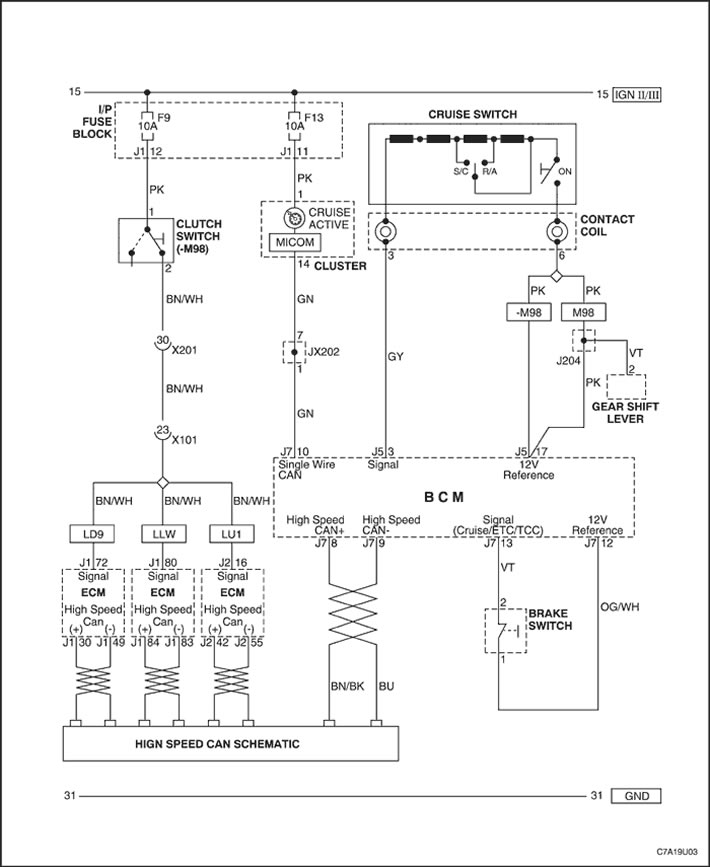


Automatic cruise control system diagram


[The original material is located on the website ChevyMan.ru]

The article was checked: Vladimir Romannikov
This article is available at russian, bulgarian, belarusian, ukrainian, serbian, croatian, romanian, polish, slovak, hungarian

Share information:

Previous articles
Captiva 1: Equipment and devices
Next articles

Immobilizer (PK3+) — removal and installation
Diagnostics of the immobilizing anti-theft system
General description and operation of the immobilizer
Anti-theft alarm — removal and installation
Security alarm sensor (shake)
Diagnostics of the automatic cruise control device
Automatic speed maintenance device switch
General description and operation of the body control system
Schematic and assembly diagram of the body controller
Body Controller Fault Diagnosis


See similar articles on the topic of Chevrolet cars:
Description of the operation of the engine control system elements Chevrolet Aveo T250 (2006-2011)
Scheme 12. Cruise control system Chevrolet Cruze 1 (2008-2016)
Automatic transmission electronic control system diagram (with MR-140 or HV-240 ECU) Chevrolet Lacetti 1 (2002-2009)
Heating, ventilation and air conditioning control unit Chevrolet Lanos T150 (2002-2009)
Remote control system for electrical package «Norma» Chevrolet Niva 1 (2002-2016)
Removal and installation the cruise control system control unit Chevrolet Tahoe 2 and 3 (2000-2014)
System — Cruise control Chevrolet Trailblazer 1 (2001-2008, petrol)
Link in different formats to this page


Visitor comments

No comments yet


How much will 13 + 37 =


Captiva 1 (2006-2018) 
  • Manual
  • Before leaving
  • Keys, doors and windows
  • Seats, protection systems
  • Instruments and controls
  • Lighting system
  • Information and entertainment
  • Navigation system
  • Climate control
  • Driving a car
  • Car care
  • Maintenance
  • Engine 2.0 l (diesel)
  • Engine device
  • Troubleshooting
  • Engine repair
  • Cooling system
  • Engine electrical equipment
  • Control and power systems
  • Exhaust system
  • Engine FAM II 2.4D
  • Engine device
  • Troubleshooting
  • Engine repair
  • Cooling system
  • Engine electrical equipment
  • Control and power systems
  • Exhaust system
  • Engine HFV6 3.2L
  • Engine device
  • Troubleshooting
  • Engine repair
  • Cooling system
  • Engine electrical equipment
  • Control and power systems
  • Exhaust system
  • Transmission
  • Front drive axle
  • Rear drive axle
  • Automatic gearbox - device
  • Automatic gearbox - service
  • Automatic gearbox - repair
  • Manual gearbox - device
  • Manual gearbox - service and repair
  • Clutch
  • Transfer case
  • Chassis
  • Car suspension
  • Brake system
  • Steering
  • Body
  • Heating and ventilation
  • Air conditioning (manual)
  • Air conditioning (automatic)
  • Seat belts
  • Airbags
  • Car seat
  • Interior (internal elements)
  • Exterior (external elements)
  • Doors and windows
  • Electrical equipment
  • Equipment and devices
  • Lighting and lamps
  • Windshield wipers and washers
  • Electrical circuits


ChevyMan.ru © 2017-2026 · Mobile version · Feedback · Site search · Interesting to read · Sitemap: EN BG BY UA RS HR RO PL SK HU

Aveo 2003-2008 · Aveo 2006-2011 · Aveo 2012-2018 · Captiva 2006-2018 · Cruze 2008-2016 · Lacetti 2002-2009 · Lanos 2002-2009 · Niva 2002-2016 · Tahoe 1992-2000 · Tahoe 2000-2014 · Lumina 1 1989-1994 · Trailblazer 1 2001-2008 · Orlando 1 2010-2018 ·
🛡️ For your security and to improve our service, this site uses cookies. You can disable them in your browser.