


Corrosion develops most quickly in hidden cavities and lower parts of the body when exposed to moisture, dirt, salts, and acids.
In this regard, during the operation of the vehicle, additional protection of the internal surfaces and hidden cavities of the body is required by applying special anti-corrosion compounds, and in the joints of parts - by applying sealing mastics.
The materials used for anti-corrosion treatment are listed in Table 8-1.
Table 8-1. Anti-corrosion compounds for body treatment
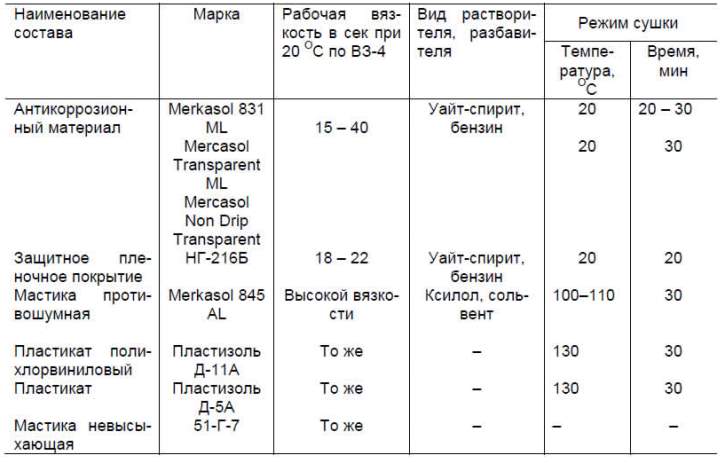
Anti-corrosion material Merkasol 831 ML and Mercasol Transparent ML, Non Drip Transparent is used for processing hidden cavities. It is recommended to process cavities every 2-3 years. Anti-corrosion material allows processing of rusty and damp surfaces.
Protective film coating NG-216B is used to cover parts of the car under the body.
Bitumen anti-noise mastic BPM-2 is used to protect the underbody from corrosion and to reduce noise. Coating thickness 1.0-1.5 mm.
Plastisol D-11A is used to protect the underbody from corrosion, abrasive wear and for noise insulation. Coating thickness is 1.0-1.2 mm. The underbody of new cars is treated with Plastisol D-11A.
Plastisol D-5A is used for sealing welded seams.
Non-drying mastic 51-G-7 is used for sealing body joints.
The anti-corrosion substance is sprayed into the internal cavities using air or airless spraying.
Air spraying requires compressed air with a pressure of 0.5-0.8 MPa (5-8 kgf/cm²), spray gun with tank, hoses and extension nozzles for the gun. The best quality of coating is achieved with airless spraying under pressure of 4-12 MPa (40-120 kgf/cm²), which allows spraying materials of significant viscosity.
The original text can be found on the website: chevyman.ru