


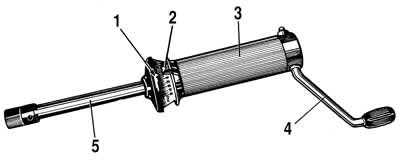
Figure 3-69. Dynamometer 02.7812.9501:
1 - movable pointer;
2 - torque limit indicator;
3 - body;
4 - handle;
5 - a rod with a tip inserted into the adapter sleeve.
The torque of resistance to rotation determines the degree of tightening of bearings. It should be 157...196 Ncm (16...20 kgf·cm) for new bearings, 39.2...58.8 Ncm (4...6 kgf·cm) — for bearings after a run of 30 km or more.
The flange nut should be tightened periodically by checking the moment of resistance of the bearings to turning of the drive gear with a dynamometer. In this case, the moment on the nut can be within 118...255 Nm (12...26 kgf·m).
To check the moment of resistance, install the adapter sleeve 3 on the dynamometer (figure 3-70), set pointer 2 (see figure 3-69) torque limiter on the scale division corresponding to 196 Ncm (20 kgf·cm), and make several turns clockwise with handle 4. During the rotation of the drive gear, the movable indicator 1 should not go beyond the indicator 2 and should show at least 157 Ncm (16 kgf·cm).
If the torque resistance is less than 157 Ncm (16 kgf·cm), and for bearings after 30 km of travel 39.2 Ncm (4 kgf·cm), then tighten the drive gear flange nut (without exceeding the specified tightening torque) and check again the moment of resistance to turning of the drive gear.
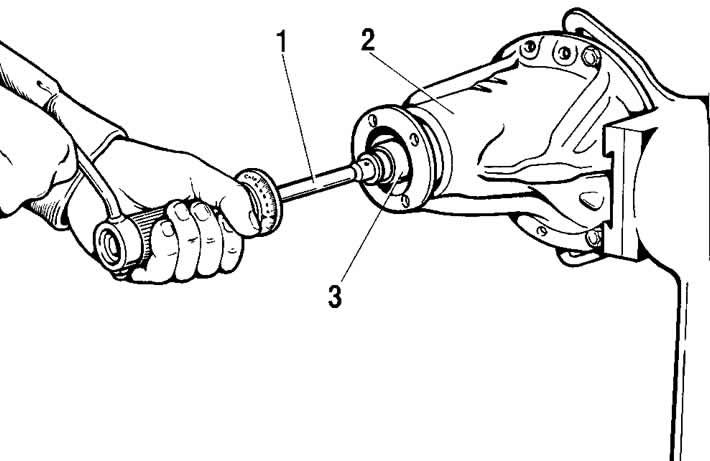
Figure 3-70. Checking the preload of the pinion bearings:
1 - Dynamometer 02.7812.9501;
2 - crankcase;
3 - adapter sleeve.
If the torque resistance to rotation is more than 196 Ncm (20 kgf·cm), and for worn-in bearings 58.8 Ncm (6 kgf·cm), which indicates that the bearing preload is too high, replace the spacer sleeve with a new one, since it has been deformed due to excessive load to a size that does not allow for proper adjustment. After replacing the spacer sleeve, repeat the assembly with the appropriate adjustments and checks.
[The original article can be found on the resource: «chevyman.ru»]