
ChevyMan.ru
Mazda Mitsubishi Toyota Land Rover Honda Kia Nissan
English Русский
Български
Беларускі
Український
Српски
Hrvatski
Română
Polski
Slovenský
Magyar
|
Articles | Sitemap | Contacts |


Home   Aveo   Captiva   Cruze   Lacetti   Lanos   Niva   Tahoe   Others  
Orlando 1 (2010-2018) Trailblazer 1 (2001-2008, petrol) Lumina 1 (1989-1994)
  • Home
  • Chevrolet
  • Lumina 1
  • General information
  • Maintenance
  • Checking and adjusting the ignition timing (3.1L engine)

Checking and adjusting the ignition timing (3.1L engine) (Chevrolet Lumina 1)

            0

Note: If the information contained in this section differs from the information on the release control label (located on the right front shock absorber in the engine compartment of the car), the information on the plate should be considered correct.


1. The engine must be warmed up to normal operating temperature and the air conditioner must be turned off.

2. Set the vehicle's parking brake and block the wheels to prevent the vehicle from moving. The gearbox must be set to the park position.

3. If the lamp is on "SERVICE ENGINE SOON" ("perform urgent engine maintenance"), do not start checking the ignition advance angle (for more information on this issue, see chapter 6).

4. Before checking the ignition timing, the Electronic Spark Control (EST) system should be inspected. Locate the single wire with a black stripe attached to the engine wiring harness at the front right shock absorber mount (next to the release control information sign) and disconnect the connector (see illustration). Do not disconnect the four-wire harness connector at the distributor.
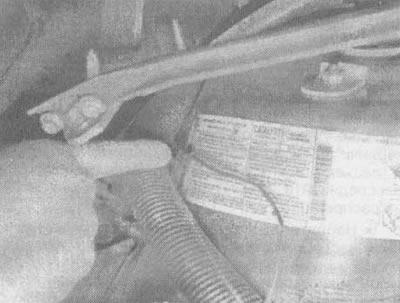
34.4 Disconnect the EST wire before checking the ignition timing setting

34.4 Disconnect the EST wire before checking the ignition timing setting


5. Locate the timing marks on the front of the engine (they should be visible from above after opening the hood) (see illustration). The crankshaft pulley or vibration damper has a mark and a small metal plate with teeth and numbers attached to the timing cover. Clean the plate with solvent to make the numbers more visible.
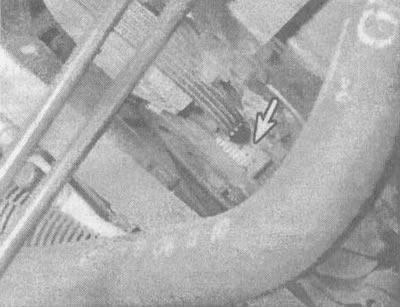
34.5. Ignition timing angle setting marks (indicated by an arrow) located on the front of the engine

34.5. Ignition timing angle setting marks (indicated by an arrow) located on the front of the engine


6. Using chalk or white paint, mark the indentation or groove on the pulley/anti-vibration device.

7. Select the mark on the timing plate that matches the ignition timing data on the exhaust control information plate (most often it says 0 degrees or TDC).

8. Connect the strobe light following the manufacturer's instructions. In general, the supply wires are attached to the battery terminals, and the sensor wire is attached to the spark plug wire of the 1st cylinder. To find this cylinder, see section "Technical data" in chapter 2, part 2.1.

9. Make sure the synchronization lamp wires are routed away from the drive belts and fan, then start the engine.

10. After the engine idle speed has stabilized, aim the strobe light at the timing marks, but beware of moving engine parts!


11. The mark on the pulley/damper will appear to be stationary. If it is aligned with the specified point on the synchronizing plate, then the ignition timing angle is set correctly.

12. If the marks are not aligned, adjustment is required. Loosen the distributor mounting bolt and very slowly turn the distributor until the marks align. Since the bolt is difficult to access, a special key may be required.

13. Tighten the bolt and check the ignition timing again.

14. Turn off the engine and remove the strobe light and adapter (if it was used).

15. Reconnect the EST harness connector and clear any ECM fault codes that were set during the ignition timing adjustment procedure (see chapter 6).

The article was checked: Vladimir Romannikov
This article is available at russian, bulgarian, belarusian, ukrainian, serbian, croatian, romanian, polish, slovak, hungarian

Share information:

Previous articles
Lumina 1: Maintenance
Next articles

Determining faults by the appearance of spark plugs
Checking and replacing spark plug wires, distributor cap and rotor
Replace spark plugs (every 30,000 miles or 12 months)
Evaporative Emission System Check (every 30,000 miles or 12 months)
Check and replace PCV valve (every 30,000 miles or 24 months)


See similar articles on the topic of Chevrolet cars:
Checking and adjusting the tension of the timing belt of the 1.5L SOHC engine Chevrolet Aveo T250 (2006-2011)
Checking and adjusting the tension of the timing belt Chevrolet Captiva 1 (2006-2018)
Replacing and adjusting the timing belt of the F18D engine Chevrolet Cruze 1 (2008-2016)
Checking the condition and replacing the timing belt Chevrolet Lacetti 1 (2002-2009)
Checking the oil level in the engine oil pan Chevrolet Lanos T150 (2002-2009)
Checking the engine on a car after repair Chevrolet Niva 1 (2002-2016)
Checking the engine compartment Chevrolet Tahoe 1 (1992-2000)
Link in different formats to this page


Visitor comments

No comments yet


How much will 35 + 29 =


Orlando 1 (2010-2018) 
  • General information
  • Introduction to manual
  • User manual
  • Maintenance
  • Troubleshooting
  • Power unit
  • Engine repair
  • Fuel and control system
  • Cooling and lubrication system
  • Ignition system
  • Transmission
  • Clutch
  • Gearbox
  • Drive shafts
  • Chassis
  • Car suspension
  • Steering
  • Brake system
  • Body
  • Exterior (external elements)
  • Doors, locks and windows
  • Electrical equipment
  • Equipment and devices
  • Windscreen wipers
  • Power devices
  • Electrical diagrams


Trailblazer 1 (2001-2008) 
  • General information
  • User manual
  • Troubleshooting
  • Maintenance
  • Power unit
  • Engine in a car
  • Engine overhaul
  • Cooling and heating
  • Fuel and exhaust system
  • Engine electrical equipment
  • Engine control
  • Transmission
  • Automatic gearbox
  • Transfer case
  • Drive shafts and cardan
  • Chassis
  • Brake system
  • Car suspension
  • Steering
  • Body
  • Exterior (external elements)
  • Interior (internal elements)
  • Doors, locks and windows
  • Electrical equipment
  • Equipment and devices
  • Electrical circuits


Lumina 1 (1989-1994) 
  • General information
  • Maintenance
  • Power unit
  • Engine 3.1L V6
  • Engine 3.8L V6
  • Engine overhaul
  • Cooling system
  • Power and exhaust system
  • Fuel injection
  • Engine electrical equipment
  • Reduced exhaust gas toxicity
  • Transmission
  • Automatic gearbox
  • Drive shafts
  • Chassis
  • Brake system
  • Car suspension
  • Steering
  • Body
  • Heating and air conditioning
  • Repair of body elements
  • Doors, covers and windows
  • Interior (internal elements)
  • Electrical equipment
  • Equipment and devices
  • Electrical circuits


ChevyMan.ru © 2017-2026 · Mobile version · Feedback · Site search · Interesting to read · Sitemap: EN BG BY UA RS HR RO PL SK HU

Aveo 2003-2008 · Aveo 2006-2011 · Aveo 2012-2018 · Captiva 2006-2018 · Cruze 2008-2016 · Lacetti 2002-2009 · Lanos 2002-2009 · Niva 2002-2016 · Tahoe 1992-2000 · Tahoe 2000-2014 · Lumina 1 1989-1994 · Trailblazer 1 2001-2008 · Orlando 1 2010-2018 ·
🛡️ For your security and to improve our service, this site uses cookies. You can disable them in your browser.