


No one is immune from visiting a car service, just like from visiting a doctor. But, unlike, say, a dentist who, even if he wanted to, would not be able to explain to you why, in addition to a sick tooth, it would be necessary to remove a couple of healthy ones standing nearby, an unscrupulous auto mechanic often succeeds in doing something similar.
There is probably no car enthusiast in our country who has not at least once encountered what is called a "scam" in "professional" slang, and in strict legal language - "unreasonable overstatement of the volume of work". At the same time, the unaware, cheated car owner, in the eyes of some unscrupulous servicemen, is the very "teapot" from the jokes, on whose money they actually exist.
In fact, if we do not count the already openly criminal and, fortunately, rare cases of deliberate damage to the client's movable property for the purpose of subsequent repair, the scheme for making money on gullible car owners looks quite simple, if not primitive. And, therefore, methods of protection from "scammers" and preserving at least part of one's labor income are also within the power of every normal person.
First, you need to give yourself the right "psychological attitude". It is clear that a car is an expensive thing for you in all respects, and even a slight knock under the hood of unknown origin is sometimes perceived more acutely than a toothache. And if the words "play", "tie rod ends", "ball joints", "silent blocks" mean absolutely nothing to you, then, combined with a six-digit fear for your mobility, this ignorance forms a persistent automotive inferiority complex in you.
While your future opponents are completely devoid of such a complex, just like everyone else. And someone who lacks self-confidence is always doomed to failure in negotiations. That is, you are just about to go to a car service, but you have already been defeated in absentia by a man in overalls, greedily playing with a 42 mm wrench.
The correct installation is as follows. Yes, you don't understand anything about car maintenance. That's true. But you're a great veterinarian (baker, symphony orchestra conductor). And this serviceman, whom you have yet to meet, is no more qualified or smarter than you, although he knows why there are main bearings and no side bearings. But he has absolutely no understanding of pairing horses, maggots, or syncopation on a weak beat.
And most importantly, your future opponent doesn't yet know that you are a complete zero in his craft. And that's good: the less you know, the more money you'll save.
So, no fawning or servility before the key holder. In the end, you pay money, and you don't get it any easier than these guys...
While tuning in this way, try to avoid unnecessary aggressiveness and, in general, excessive emotionality. Remember that a car is just a piece of iron, albeit an expensive and beautiful one, and this whole "scam technology" is not an attack on your honor and dignity, but simply an attempt to earn a little more, but a little dishonestly.
And, why did you also tell the cat owner such a price for an injection yesterday that the horse could have been cured, and forever, but you don't put butter in your buns... you don't put it in, and your orchestra plays out of tune...
So it is in this matter: "nothing personal - just business", as they say in countries into whose language the word "scam" has long been untranslatable...
Now you are psychologically prepared for diagnosis. Because this is where any visit to any car service begins and, therefore, this is the same scam.
And so, the car is on the lift and you look at it from the point of view of the asphalt, and the auto mechanic standing next to you looks at it from the point of view of improving his financial situation. No, let's start a little earlier - from the moment you arrive at the service center and first meet the mechanic or service manager, (We do not consider options where the servicemen are your very good, trusted acquaintances or, in extreme cases, relatives, but without competition for the inheritance).
You come to the service center and say: "You know, I have something knocking really loudly on the left... no, on the right... no, on the left, I don't think either... and there's a smell, like the clutch... or oil leaking somewhere... and the exhaust is kind of dark, I'd like it to be lighter... well, you take a look yourself, as a specialist...". And you see the mechanic smiling. Not about your exhaust, but about your family budget, which after such a monologue has a good chance of increasing significantly. Because you said everything wrong, although everything you said was the pure truth. But "truth is good, but happiness is better."
A car enthusiast's happiness is saving on repairs. So the correct opening speech should sound something like this: "Please, I need to replace the right tie rod end, the left wheel bearing, the oil seals and the oil pan gasket. No, thanks, I don't want coffee...".
(Let us note here that all this correct technical terminology, after voicing which any serviceman will respect you, is contained in the adjacent sections of this book).
After such a speech, the probability of a scam, of course, remains, but decreases significantly. Here, however, there is a danger of going overboard, going to the other extreme and falling into the category of "too smart" that is so unpopular with everyone. There is no need to be too smart - you still don't know more than a professional auto mechanic, otherwise you wouldn't have come to him, but would have done everything yourself according to the book that you are holding in these hands now. But once you've found yourself with these guys, your task is to position yourself as a firm, sensible person who understands something about cars and intends to "get divorced" at least to a minimum.
Of course, when technical terms upset you, like long words upset Winnie the Pooh, the situation becomes difficult. But not hopeless.
Silence can help you out, which in this case is truly golden, and yours and the one you saved. And if "a miser pays twice", then a miser in words pays less at the car service. Therefore, you should voice your car enthusiast concerns with restraint. For example, like this: "Hello. There's... a little problem with the chassis of my car... can I take a look from below on a lift?., so I can see what's there and how...". That is, it's clear that we're talking about diagnosing a car, but pay attention: "car", "little problem", "something"... Yes, you're ready for repairs and certain expenses, but, naturally, within reasonable limits; fixing the "problem" can't be very expensive...
The most important thing is not to engage in a technical discussion with your opponent - he will outplay you right away, that's why he is a master, even though he is an acceptor. If, for example, he suddenly asks: "Or maybe a silent block?..", answer vaguely or evasively: "No, basically, it was the same then, it just pulled a little to the left... but we'll see on the lift...". Remember, if he guesses that you consider the aforementioned Silent to be the previously unknown English-speaking brother of the Block, then you are simply doomed to arrange a small financial holiday for the whole team. A man who is well versed in poetry is every auto mechanic's dream.
But now the car is lifted, and the show called "diagnostics" has begun. And here everything depends on the professionalism and skill of the mechanic himself. (Let's note in parentheses that some companies, especially large dealerships, do not allow customers into the repair area. Don't pay attention to it. In the sense that you, as the owner of the car, have every right (for rights, see. in the "Lawyer's advice" list) know what they are going to charge you for and, therefore, be present at the diagnosis. If you can't do without a guide, then let them provide you with a guide. If you can't do without a helmet, they should give you a helmet. Anything, even a bulletproof vest and dry rations for three days, but a confrontation with the malfunctions of your vehicle recorded in the work order is mandatory.
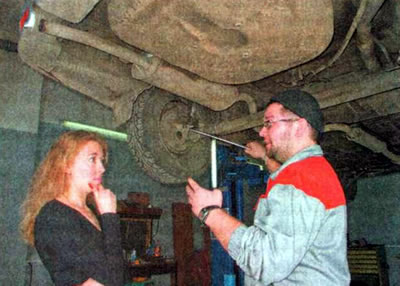
The professionalism of a car mechanic diagnosing a car in the presence of a client lies not so much in a thorough knowledge of the material, but in knowledge of the Stanislavsky system and the ability to apply it. Because some, and sometimes a large part, of the units and parts that he classifies as faulty and subject to replacement are not actually such. (It's funny, but in professional slang there is even a special word that denotes the statement of the need for a replacement - "to sentence". The legal associations here are apparently not accidental.) Cunning, as we know, requires a certain amount of acting skills. A typical mise-en-scene of car chassis diagnostics looks something like this. You and the mechanic are positioned under the bottom of the car hanging on the lift. The mechanic has a portable lamp and a mount in his hands, and on your face there is a faint hope for a low-cost repair. The serviceman, feigning professional attention and extreme concern for the technical condition of your car, methodically moves from one part of the suspension to another, pokes a tire iron here and there, clicks his tongue, shakes his head and remains silent. He has no lines in this episode. In extreme cases, he can improvise and say with a very sad, almost funeral intonation: "Yeah…".
And this is where you will need the utmost self-control. Because at this moment the mechanic, like any actor, requires empathy and sympathy from the viewer. And the viewer is you. Or rather, his task is to make you a viewer, so that he can then charge triple the price for the ticket. And your task is to feel like a theater director who can easily replace this actor with another one if he wants. Therefore, under no circumstances should you be taken in by all his oohs and aahs, let him click as he wants and swing as he wants - no need to grab for your wallet or for your validol. The more calm you show, the more chances there are that the actor in the robe will replace only what is needed and nothing more. And if you do pay extra, it will not be as if you were easily cheated, but as if you were paying a large sum of money of your own free will. The only way to completely avoid scams is to do everything yourself, as already mentioned.
(Please don't take this as being pushy, but let us remind you once again: you are holding a book in your hands that contains everything you need to take independent action).
In general, when this guy with the crowbar pretends to be Smoktunovsky, be cool-headed and, most importantly, every time he says words like "play", persistently ask him to show you this very mysterious play. No, it's not that you don't trust the mechanic - quite the opposite, if you ask someone to show you the play, then only a professional like him. (Pay special attention to fresh traces of allegedly leaked oil or liquid on the surface of some parts. "Allegedly" because these marks can only be fresh in one case - if they were just skillfully applied by your new acquaintance while you were looking for lipstick in your purse or a lighter in your briefcase).
In general, the annals of auto service scams contain a lot of heartbreaking stories - examples of the gullibility of naive car owners and the unpunished greed of insidious servicemen. A complete list of all the variations of this disgrace would probably fill more than one volume. We will limit ourselves to a few fairly common situations.
Let's say, a ball joint is being replaced on your car. Don't be shy and ask that the removed, old support be placed in your trunk. Of course, it won't decorate the interior of the latter, but it will be a kind of guarantee that it has given way to a new one. (By the way, this applies to any replaceable part).
The situation is similar with changing the engine oil. But in this case, even a branded canister of motor oil presented by a mechanic, alas, does not indicate that its contents are currently in your car's engine. The best way to protect yourself is to be present in person when changing the oil that you brought in.
Replacing brake pads. Having removed the wheel and having established the "lethal" condition of the pads, the serviceman tries to make the same diagnosis for the brake discs. To do this, he builds a mise-en-scène from the play "Suspension Diagnostics" that is already familiar to us: he holds onto the disk, clicks his tongue and shakes his head. Without waiting for a response, ask for a caliper and, with all due respect to your interlocutor's eye, measure the thickness of the disk. If it is less than the minimum specified by the manufacturer, change the disk. If the thickness is within normal limits and the disk does not have the characteristic blue color from overheating and the mechanic insists on replacement, change the mechanic.
Something is whistling under the hood. Mechanic (opening the hood): "Ah, it's understandable - the generator bearing is whistling, but the generator needs to be changed." Perhaps that's true. Or maybe it's not the generator whistling, but the mechanic. And it will be enough to simply either change or tighten the drive belt, which can whistle no worse than a faulty generator, but for some reason costs ten times less.
Of course, there are no universal recipes for combating scams, except perhaps the famous "I don't believe it!" from the same Stanislavsky. But it is possible that common sense, calmness and attention to detail will have a literally beneficial effect on your budget. And you will leave the car service, slightly poorer, but with a freshly repaired car and with the knowledge that you allowed good people to earn money, but did not allow them to deceive you too much. Don't forget to thank them. After all, money is a thing of the past, and confidence in your car is a bit like confidence in your future. Isn't it worth the amount stated in the work order?