


Contents: And who are you, Taha? ↧ Tahaya transmission ↧ Tah, tah, tah... ↧ So what's down there? ↧ Examination ↧ Short ↧
It is easy to explain the popularity of the Chevrolet Tahoe. Of course, this car is expensive (in our country the price is "aggravated" by high customs duties). But the chic appearance, luxurious interior and excellent driving characteristics, a low-wearing engine of enormous, by European standards, volume and the absence of serious "chronic diseases" bring this car closer to the ideal of all motorists. Suffice it to say that the lion's share of operating costs falls on gasoline, and the amount of expenses for spare parts practically tends to zero due to the lack of need for repairs. Of course, as they say, you can "shake up" everything... To know what exactly "shake up", let's figure it out...
And who are you, Taha?
The car we know as the Chevrolet Tahoe appeared in America in 1964 as the GMC Yukon and was produced only for the American market. In 1980, its twin, the Chevrolet Tahoe, was "born", supplied to both the domestic and European markets. Since 1990, the Tahoe body has remained virtually unchanged, except for the improvements in the interior design, headlights and radiator grille that occurred in 1995.
It is very easy to understand the modifications. Tahoe is produced with three-door and five-door bodies. There is also a sports modification of the three-door body (Sport), which has wheel arch extensions and plastic panels on the lower part of the doors and thresholds (regular bodies are decorated only with moldings). In 1997, a five-door seven-seater modification with two additional seats was produced.
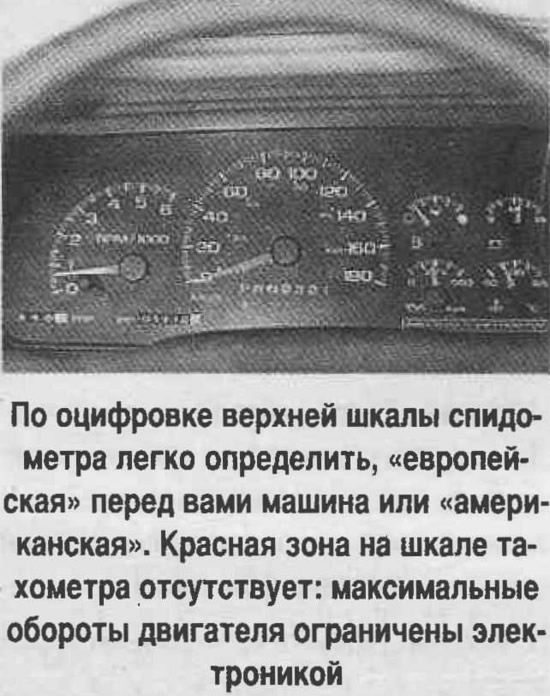 Панель приборов | 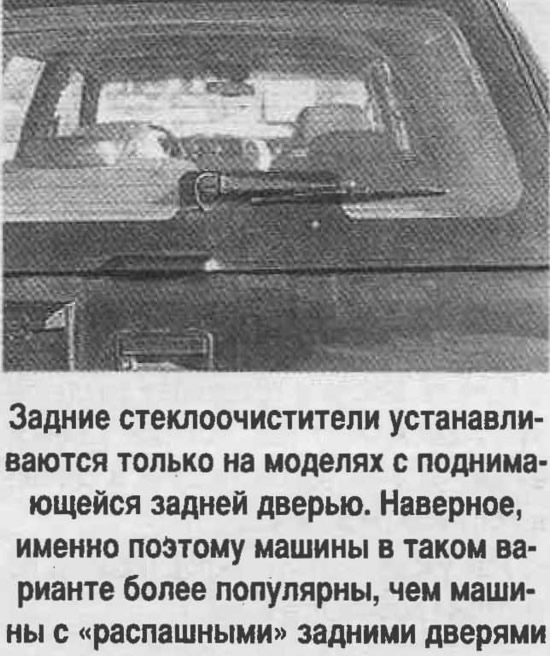 Задние стеклоочистители | 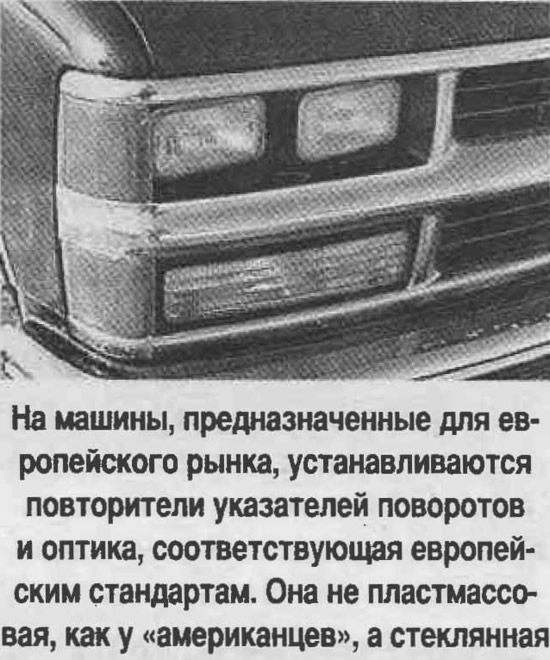 Повторители указателей поворотов |
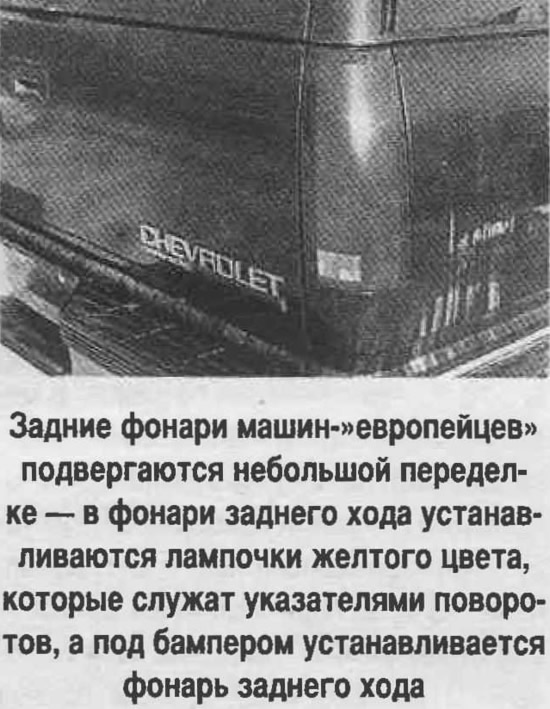
Задние фонари
The 6.2-litre diesel engine was replaced in 1995 by a 6.5-litre turbodiesel, which became more revvy but its torque was slightly reduced.
Regardless of the body type and engine, all cars are produced with both rear and all-wheel drive. To transmit the torque developed by the engine, the car is equipped with...
Tahaya transmission
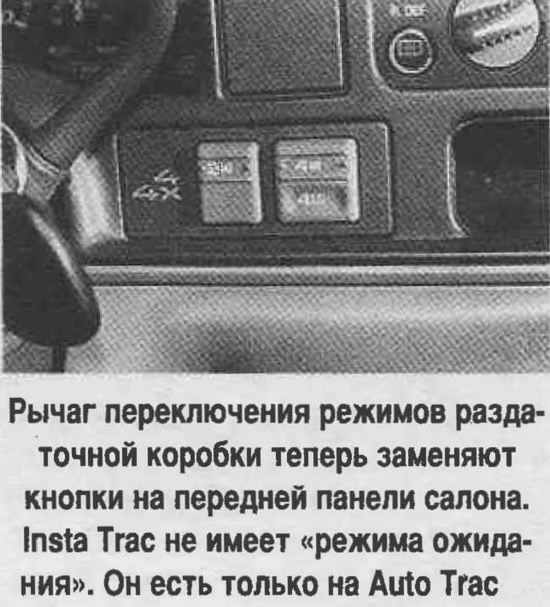
Кнопки переключения режимов раздаточной коробки
Transfer cases come in three types: manual, Insta Tgas and the latest fashion trend, the electronic Auto Tgas. The mechanical transfer case, which was installed on all vehicles from the very beginning of the release of all-wheel drive modifications, had four operating modes: 2Hi P rear-wheel drive; 4 Hi P all-wheel drive; 4 Lo — all-wheel drive with downshift and N - "neutral". Insta Trac, which replaced it, has the same modes. True, the mode switch knob, which was located on the floor in a mechanical transfer case, was replaced with switches on the instrument panel. In 1997, the Auto Tgas box appeared. In addition to all the listed modes, it has a standby mode. When 4WD mode is enabled, all-wheel drive only turns on when necessary.
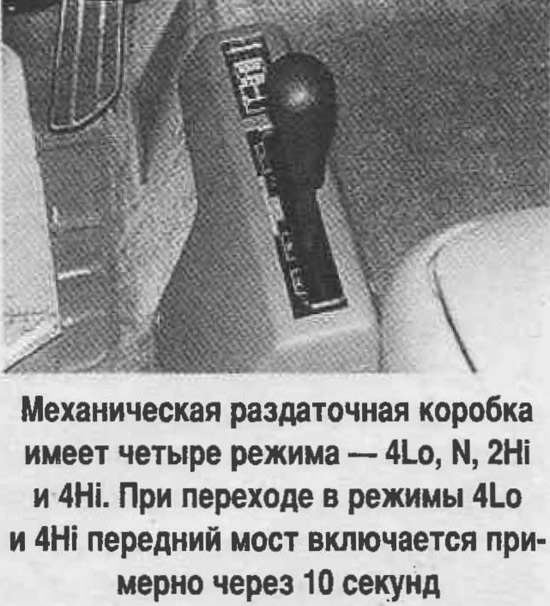
Механическая раздаточная коробка
Tah, tah, tah...
This issue requires special attention. Tahoe does not have an interaxle differential at all, and the interwheel differential is a separate conversation.
With the rear one, everything is simple - either it is not there, or it is self-locking and is engaged at your own discretion. Front differential (naturally, if there is a front drive axle) is always present and is switched on forcibly. When you want to switch to 4WD or 4Lo mode, primarily through a thermal type solenoid, which is installed in the front axle (and often breaks down), the differential is locked. Only after this does the front axle become the driving one,
From all of the above, it follows that when driving on a dry road in 4WD mode at high speed, you WILL "tear" either the front axle, or both the front axle and the transfer case. Perhaps that is why General Motors came up with the Auto Transfer Case, which saves you from these troubles and the associated costs.
Since we've looked under the car, let's take a closer look...
So what's down there?
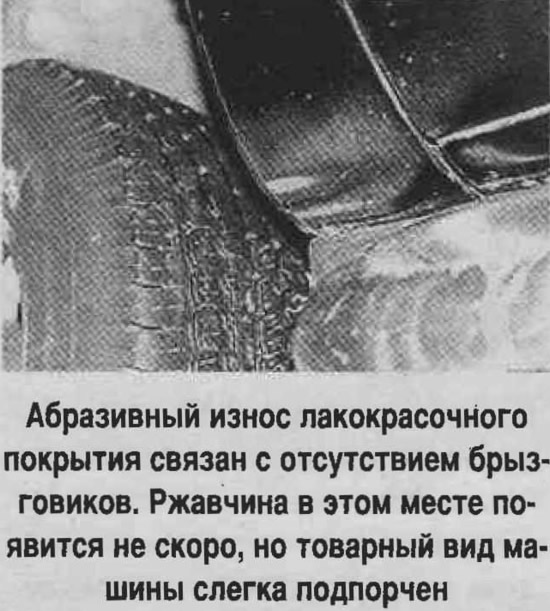
Абразивный износ лакокрасочного покрытия
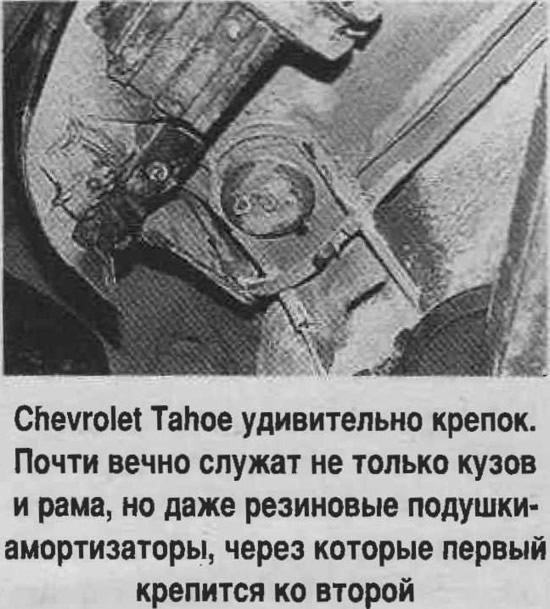
Tahoe удивительно крепок
Examination
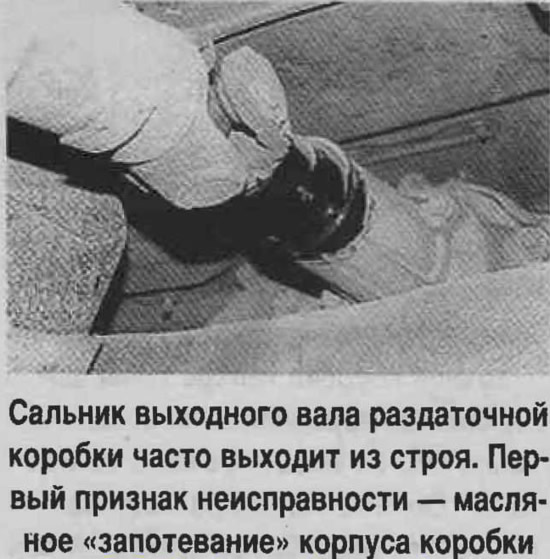
Сальник выходного вала раздаточной коробки
The Chevrolet Tahoe has leaking rear axle gearbox tail seals. The axle shaft seals also leak, but less frequently.
Another fairly common Tahoe malfunction is the failure of the cardan shaft crosspieces.
The Chevrolet Tahoe suspension is extremely reliable. There are almost no cases when replacement of ball joints is required. Relatively weak points of the suspension are the hinge joints of the pendulum arm and steering knuckle, as well as the steering rod joints.
Tahoe Suspension Joints (ball joints, steering rods) lubricate through grease nipples ("squirt"). It is best to use Mobil HP222 grease. The number of lubrication points is 11, the recommended interval is 5000 km. Even with lubrication after 10,000 km, no signs of suspension wear are observed.
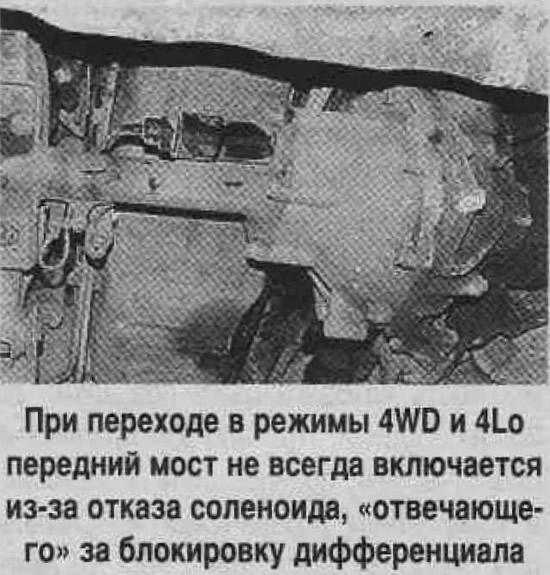
Передний мост
The Tahoe does not come standard with mudguards, which results in abrasive wear to the paintwork on the lower rear portion of the front and rear fenders. No rust was observed in these areas, but mudguards are a good idea to maintain the appearance.
The Chevrolet Tahoe accepts both 16-inch and 17-inch wheels. If your vehicle came with 16-inch wheels and you replace them with 17-inch wheels, (and vice versa), it is necessary to reprogram the computer. Otherwise, the correct operation of the speedometer and ABS system cannot be guaranteed.
If any electrical sensors fail, look for rotten or frayed wires. The problems are most likely related to them. The sensors themselves and the wire connections are quite reliable.
The brake pads have special brackets ("squeakers"). They scrape the brake discs and make a squeaking sound, signaling wear of the pads. This sound is heard only when driving, not when braking, so car owners often do not associate it with the braking system. This leads to complete wear of the linings and severe wear of the brake discs. The discs will have to be replaced! After lifting the car on a lift, you need to shake the left CV joint. Large play in the right part indicates that the CV joint bearing has become loose. This indicates that the previous owner often used the 4WD mode when driving at high speed on a dry road. As you know, such operation leads to transmission failure. Serious problems and big expenses await you! A chronic "disease" of the Chevrolet Tahoe, like most cars manufactured by General Motors, is the frequent failure of the generator bearings and relay-regulator.
On 5.7 liter gasoline engines, the valve oil seals wear out. This leads to increased oil consumption, as well as "greasing" and subsequent failure of the catalytic converter of exhaust gases.
Short
If you frequently drive in the mountains, tow a trailer, make short trips with the engine not fully warmed up, or simply operate the car in urban conditions, your Tahoe is recommended to have "heavy" service (intervals reduced by half compared to normal): change the oil in the gearbox every 25,000 km, in the transfer case every 50,000 km.
Instead of the usual antifreeze (replacement - every 50,000 km or two years of operation) in the cooling system of the Tahoe, it is better to do it once every five years (or every 160,000 km) fill with Dexcool liquid.
By reducing the engine oil change intervals to 5,000 km, as recommended by General Motors, the engine can last indefinitely. The only thing that may be required is replacement of the valve stem seals. Using Mobil 1 5W/30 Fully Synthetic oil, this interval can be extended to 10,000 km.
If the maintenance schedule is followed and oils and filters are changed regularly, cars with a mileage of 300,000 km do not show signs of wear.
Constant driving on dry roads in 4WD mode will lead to failure of the transfer case and front axle, and in 4Lo mode - also to failure of the rear axle.
In a manual transmission, ONLY GM Good Wrench oil should be poured. There is no substitute for this oil!
The Tahoe axles require 80W/90 GL5 oil or equivalent.
With the right hardware and software, the Tahoe's computer can be reprogrammed (for example, for leaded gasoline). For our operating conditions, reprogramming to the so-called "unleaded export" is recommended. In this case, the computer takes into account the readings of the oxygen sensors (the latest Tahoe models have four of them), but it is not as strict with regard to the content of harmful emissions as the "Californian" or "American" versions.
When replacing the steering knuckle, you also need to replace the ABS sensor - it will most likely not be possible to remove the sensor from the old knuckle.
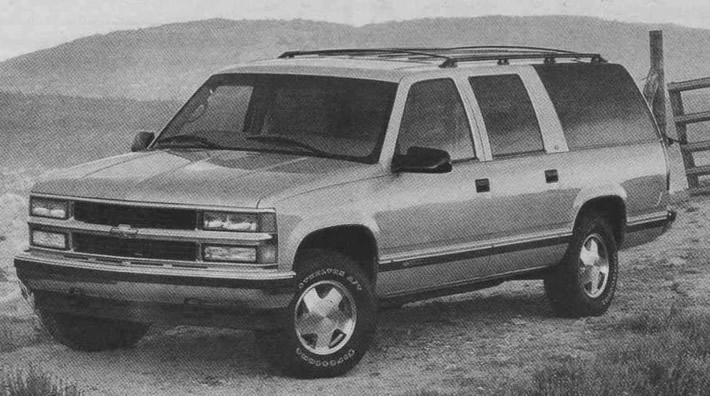
Шевроле Тахо 1998 K1500 4x4 Suburban