


- 1) lifting capacity - the maximum permitted weight of the load being lifted;
- 2) lifting height - the distance from the floor surface to the support point of the jack in the lower working position;
- 3) lifting height - the distance from the floor surface to the support point of the jack when lifting the load to full height;
- 4) working stroke - the maximum distance from the lower to the upper working position of the jack support point;
- 5) force on the jack handle (lever) - the force required to lift the load, which depends on the type of jack and the mass of the load being lifted;
- 6) stability – the ability of the jack to maintain its working position under load. This mainly depends on the area of the support platform and the rigidity of its connection with other parts of the jack.
Screw mechanical jacks
Most vehicles are equipped with diamond-shaped screw jacks.
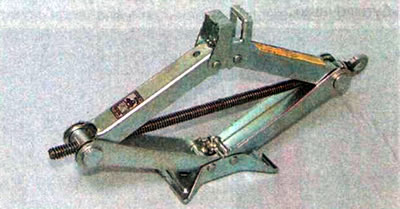
As a variety of the diamond jack, there are also screw lever jacks.
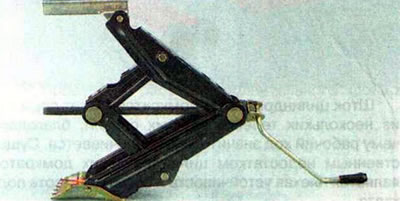
The lifting capacity of such jacks does not exceed 800 kg, but they are compact, have a small weight and a low lifting height, which allows you to lift a car with low ground clearance. The disadvantage is the high force on the handle at the beginning of the stroke and poor stability, so the standard jack is often inconvenient or even useless when performing maintenance and repair work.
Hydraulic jacks
To perform work in the garage, it is advisable to use a hydraulic trolley jack, which has good stability, a large working stroke of the rod and is capable of lifting a load of up to 3-5 tons.
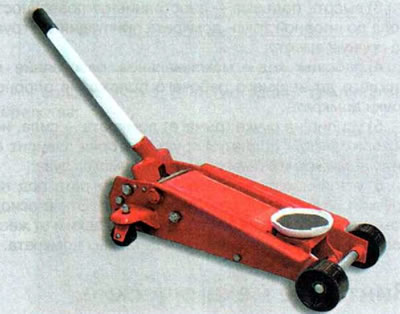
Floor jacks have a rigid construction and low force on the handle. Along with rolling jacks, there are also cylindrical hydraulic jacks in the form of a stand, called "bottle" jacks.
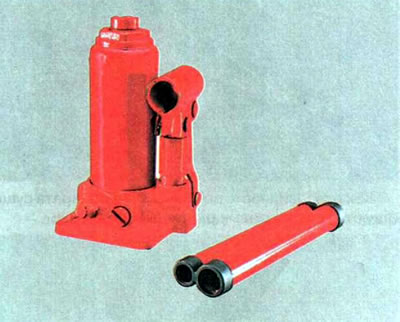
The rod of cylindrical jacks can consist of several telescopic sections, due to which the working stroke is significantly increased. A significant disadvantage of cylindrical jacks is poor stability and high lifting height.
Also, the disadvantages of all hydraulic jacks include their large weight and the need to store them only in a vertical position to prevent hydraulic fluid from leaking out.
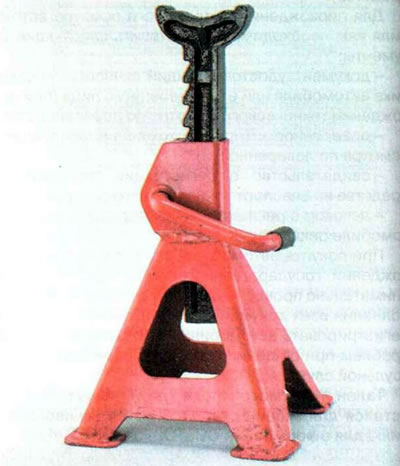
Warning. Do not start work if the car is raised only by a jack, use reliable factory-made stands and wheel chocks (at least 2 pcs.). The lifting capacity of the jack and stands must be more than adequate to the weight of the vehicle.
Checking the technical condition of the jack
The technical condition of the standard jack must be checked during each vehicle maintenance. To do this, we inspect the jack elements for deformations, cracks and damage to the body. The working screw must rotate freely in the guide bushings and have no damage to the threads. If a malfunction is detected, the jack cannot be used for further work.
To keep the jack in working order, periodically lubricate the working screw and bushings with plastic grease such as "Litol-24" or similar imported grease.