
ChevyMan.ru
Mazda Mitsubishi Toyota Land Rover Honda Kia Nissan
English Русский
Български
Беларускі
Український
Српски
Hrvatski
Română
Polski
Slovenský
Magyar
|
Articles | Sitemap | Contacts |


Home   Aveo   Captiva   Cruze   Lacetti   Lanos   Niva   Tahoe   Others  
Orlando 1 (2010-2018) Trailblazer 1 (2001-2008, petrol) Lumina 1 (1989-1994)
  • Home
  • Chevrolet
  • Orlando 1
  • General information
  • User manual
  • Battery Charger

Battery Charger (Chevrolet Orlando 1)

            0

To charge batteries, chargers powered by alternating current networks are used. For individual use, chargers powered by a 220 V network are available.

During the process of charging the battery, it is necessary to monitor and change several parameters: charging current, charging voltage, voltage at the battery terminals, electrolyte temperature. The most convenient to use are chargers with automatic control, which are capable of providing the most complete charge of the battery in the optimal mode.

Note: The optimal charging current for a battery is 10% of its capacity. For example, the charging current of a 36 Ah battery should be 3.6 A. When the battery voltage reaches 14.4 V, the charging current should decrease to prevent the electrolyte from boiling.


A typical charger is a transformer with a DC rectifier. Chargers can use either conventional transformers or frequency conversion transformers (pulse). The first ones have a larger mass and dimensions, but are simpler in design; in these devices, as a rule, the output voltage depends on the voltage in the electrical network.

There are both fully automatic chargers and devices with a certain set of settings.
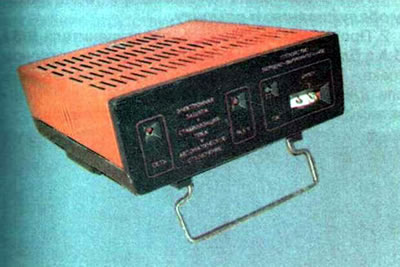
Automatic charger with the ability to set the charging current

Automatic charger with the ability to set the charging current


Warning. Even if the charger is fully automatic, do not leave the battery charging process unattended. Charge the battery according to the instructions supplied with this charger.


When choosing a device, check whether it can provide the required current to charge your battery.

It is desirable that the charger be equipped with:
  • protection against incorrect connection of wire terminals to battery terminals;
  • overheating protection:
  • protection against short circuit of wire terminals;
  • charge control devices or indicators;
  • stabilization of the charging current.

The charger wire terminals must provide a secure connection to the battery terminals, and the terminals themselves must be securely connected to the wires.

Note: To charge sealed maintenance-free batteries, a charger that supports a charging voltage of 16.0-16.5 V is required, otherwise the battery will not be fully charged.


To restore and charge deeply discharged batteries, the charger must have manual adjustment capability.

Chargers can be equipped with additional functions. Thus, diagnostic devices can be built into the charger to check the health of the battery.

Warning. Before charging, be sure to check the electrolyte level in the battery; charging a battery with a low electrolyte level will destroy its electrodes.


For car owners who use their car only in the summer or use it irregularly, with long breaks (a month or more), a charger model with a battery self-discharge compensation function will be useful. In this mode, a low charging current is automatically maintained to ensure gentle battery charging. Using this function instead of charging in standard mode (at high current) will extend the life of the battery.

To start the engine with a discharged battery, the charger can be equipped with a quick start system. Such devices are usually called starting and charging devices. Using such a device will allow you to start the trip immediately and charge the battery while driving. If there is no power supply to the parking place of the car, then a starting device with a built-in battery can be used to start the engine.

[The original article can be found on the resource: chevyman.ru]

The article was checked: Vladimir Romannikov
This article is available at russian, bulgarian, belarusian, ukrainian, serbian, croatian, romanian, polish, slovak, hungarian

Share information:

Previous articles
Orlando 1: User manual
Next articles

Starting the engine from external sources
Refueling a car
Fogging of glass
Spare wheel
Jacks — mechanical, hydraulic and pneumatic
Identification numbers
Information displays
Air conditioning system — air conditioning system
Checking the operation of the air conditioning system
Keys to the car


See similar articles on the topic of Chevrolet cars:
The battery is not recharging Chevrolet Aveo T300 (2012-2018)
Rechargeable battery Chevrolet Captiva 1 (2006-2018)
The battery is not recharging Chevrolet Cruze 1 (2008-2016)
Starting the engine from another car's battery («jump-starting») Chevrolet Lacetti 1 (2002-2009)
Starting the engine from another car's battery (jump-starting) Chevrolet Lanos T150 (2002-2009)
Battery Chevrolet Niva 1 (2002-2016)
Battery packs Chevrolet Tahoe 1 (1992-2000)
Link in different formats to this page


Visitor comments

No comments yet


How much will 18 + 37 =


Orlando 1 (2010-2018) 
  • General information
  • Introduction to manual
  • User manual
  • Maintenance
  • Troubleshooting
  • Power unit
  • Engine repair
  • Fuel and control system
  • Cooling and lubrication system
  • Ignition system
  • Transmission
  • Clutch
  • Gearbox
  • Drive shafts
  • Chassis
  • Car suspension
  • Steering
  • Brake system
  • Body
  • Exterior (external elements)
  • Doors, locks and windows
  • Electrical equipment
  • Equipment and devices
  • Windscreen wipers
  • Power devices
  • Electrical diagrams


Trailblazer 1 (2001-2008) 
  • General information
  • User manual
  • Troubleshooting
  • Maintenance
  • Power unit
  • Engine in a car
  • Engine overhaul
  • Cooling and heating
  • Fuel and exhaust system
  • Engine electrical equipment
  • Engine control
  • Transmission
  • Automatic gearbox
  • Transfer case
  • Drive shafts and cardan
  • Chassis
  • Brake system
  • Car suspension
  • Steering
  • Body
  • Exterior (external elements)
  • Interior (internal elements)
  • Doors, locks and windows
  • Electrical equipment
  • Equipment and devices
  • Electrical circuits


Lumina 1 (1989-1994) 
  • General information
  • Maintenance
  • Power unit
  • Engine 3.1L V6
  • Engine 3.8L V6
  • Engine overhaul
  • Cooling system
  • Power and exhaust system
  • Fuel injection
  • Engine electrical equipment
  • Reduced exhaust gas toxicity
  • Transmission
  • Automatic gearbox
  • Drive shafts
  • Chassis
  • Brake system
  • Car suspension
  • Steering
  • Body
  • Heating and air conditioning
  • Repair of body elements
  • Doors, covers and windows
  • Interior (internal elements)
  • Electrical equipment
  • Equipment and devices
  • Electrical circuits


ChevyMan.ru © 2017-2026 · Mobile version · Feedback · Site search · Interesting to read · Sitemap: EN BG BY UA RS HR RO PL SK HU

Aveo 2003-2008 · Aveo 2006-2011 · Aveo 2012-2018 · Captiva 2006-2018 · Cruze 2008-2016 · Lacetti 2002-2009 · Lanos 2002-2009 · Niva 2002-2016 · Tahoe 1992-2000 · Tahoe 2000-2014 · Lumina 1 1989-1994 · Trailblazer 1 2001-2008 · Orlando 1 2010-2018 ·
🛡️ For your security and to improve our service, this site uses cookies. You can disable them in your browser.