


2. Inspect the condenser (air conditioner radiator). If necessary, clean it from dirt and insects (see below "Air conditioning system maintenance").
3. Start the engine.
Recommendation! If the air conditioning system does not work in any mode, check the fuses Ef54 5A in the fuse box and the relay in the engine compartment F17 15A in the fuse box in the instrument panel.
4. Smoothly turn the electric fan speed controller clockwise. We evaluate the efficiency of its operation in increasing the intensity of the air flow from the deflectors depending on the change in its rotation speed.
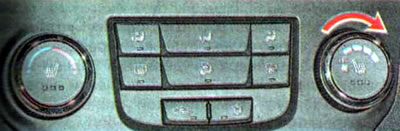
Recommendation! If the air conditioning system electric fan does not work, only in one or several regulator positions, it is necessary to replace the air conditioning system control unit. If the electric fan does not work in any position of the regulator, check the fuse F11 40A in the fuse box in the instrument panel (see above). Replace the faulty fuse. If the fuse is intact, the electric fan is faulty. It is difficult to replace it at home - contact a specialized service station. If the rotation speed of the electric fan corresponds to the enabled modes by ear, but the intensity of the stuffy flow is low, the air conditioning filter is clogged.
5. Set the maximum rotation speed of the air conditioning system electric fan. By pressing the air flow distribution mode keys one by one, we monitor the change in the direction of the air flows.
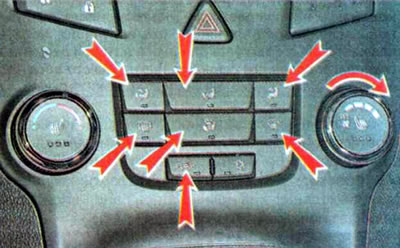
Recommendation. If the flow distribution does not change, then most likely the damper drive or the air conditioning control unit is faulty.
6. Warm up the engine to operating temperature.
7. With the air conditioning system electric fan at maximum speed, turn the temperature regulator clockwise until it stops and make sure that hot air comes out of the deflectors.
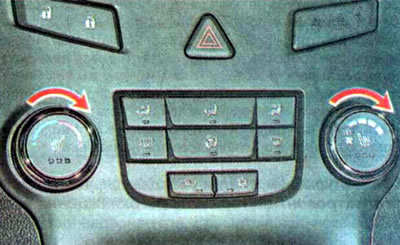
Note: The following may affect the temperature of the supplied air among the engine cooling system malfunctions: an air lock in the heater radiator, a clogged heater radiator, and thermostat malfunctions. It is difficult to clean the heater radiator at home - contact a specialized service station. If the temperature does not rise at all, the air conditioning control unit or the damper drive is faulty - contact a specialized service station for diagnostics and repairs.
8. While the heater is operating, make sure that the glass does not fog up and that the humidity in the car does not increase.
Note: Increased humidity indicates a leak in the heater radiator. At the same time, you can feel a specific smell of antifreeze. In this case, the radiator must be replaced. Fogging of the windows can also be caused by a clogged air conditioning filter and a faulty air recirculation flap actuator (recirculation does not turn off) - contact a specialized service station for diagnostics and repairs.
9. Turn on the air conditioner (the control lamp on the power button should light up) and turn the temperature regulator counterclockwise. We make sure that the temperature of the air coming out of the instrument panel deflectors begins to decrease.
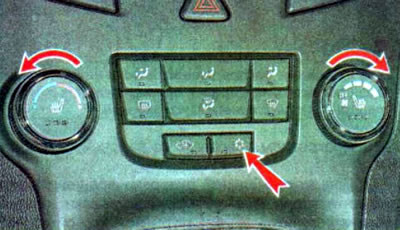
Recommendation. If the temperature does not decrease, check the condition of the accessory drive belt, as well as the Ef62 10A fuse and the Er1 relay of the electromagnetic clutch of the air conditioning compressor in the fuse and relay box in the engine compartment (see above). Replace a stretched belt and a faulty fuse or relay. If the listed parts are in good condition, contact a specialized service station for diagnostics and repair.
10. Open the hood and make sure that the electric fan of the cooling system turns on. If it does not turn on, we fix the problem.
Recommendation. If the air conditioning system is faulty, contact a specialized service station for diagnostics and repair.