


Consumption of engine oil during vehicle operation is completely normal, so you should check the engine oil level regularly. Be sure to check the oil level before a long trip.
Engine oil consumption depends on driving style, climate and road conditions. Normal oil consumption can be up to 1 l per 1000 km. An unrun-in engine may consume slightly more.
RECOMMENDATION: Engine oil plays a vital role in ensuring the performance and longevity of the engine. Use only high-quality oil.
The manufacturer recommends using API SL quality oil of viscosity grade SAE 0W-30 or API SL viscosity grade SAE 0W-40 (depending on climatic conditions). At outside air temperatures down to -25°C, the use of oils with viscosity 5W-30, 5W-40 is permissible.
WARNINGS: Before checking the oil level after driving, turn off the engine and wait 5-10 minutes for the oil to drain into the oil pan. Top up with oil of the same brand, viscosity and quality class as previously used.
The oil level in the engine crankcase should not exceed the maximum mark, otherwise leaks through gaskets and seals, as well as increased oil consumption, are possible. In addition, when the oil level is too high, it is intensively shaken by the crankshaft counterweights, forming foam. Foam that gets into the internal cavities of the oil pump disrupts its operation. Check the level by placing the car on a flat horizontal surface.
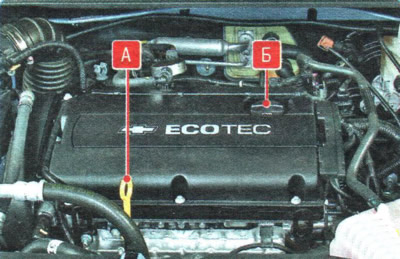
Oil level indicator A (oil dipstick) is located at the front of the cylinder block. The oil filler plug B is located on the cylinder head cover.
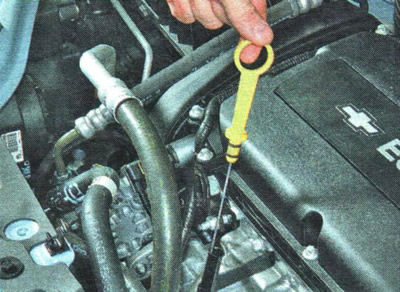
1. Remove the oil level indicator (oil dipstick)...
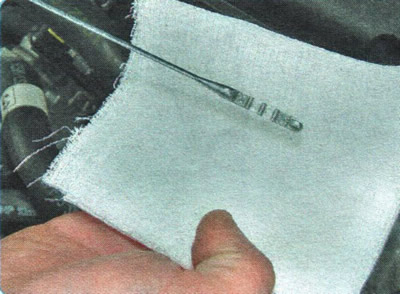
2. ...wipe it with a clean cloth...
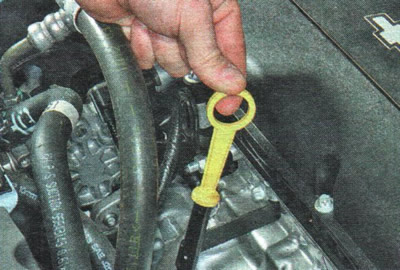
3. ...and insert it into place.
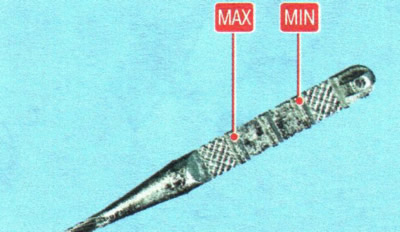
4. Remove the pointer (dipstick) again. The oil film level must be between the lower (MIN) and upper (MAX) marks. If the oil level is close to or below the lower mark, top up the oil.
NOTE: The MIN and MAX marks in the photo are applied conditionally. They are not on the oil level indicator, they correspond to the lower and upper marks, respectively.
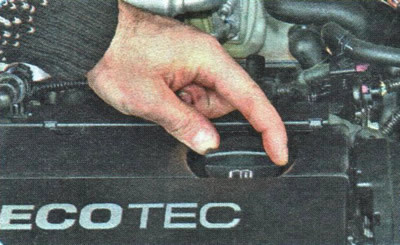
5. To add oil, turn the oil filler cap counterclockwise...
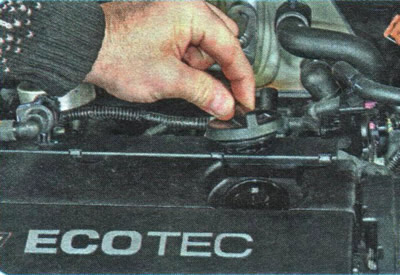
6. ...and take it off.
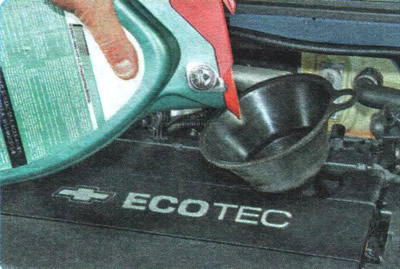
7. Insert a funnel into the oil filler neck and pour oil into the engine, monitoring its level using the indicator. Before removing the indicator, wait 2-3 minutes to allow the oil to drain into the crankcase.
8. Once the oil level reaches the required level, tighten the filler cap.