


The alloy wheel markings are cast on the inside of the spokes.
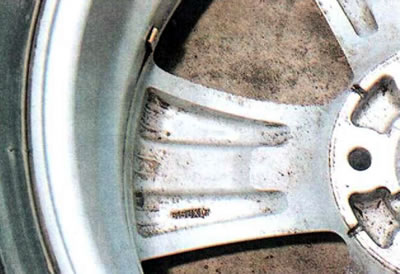
The designation of a disk, for example, 6.5Jx16 H2 ET45, is deciphered as follows:
- 6.5 - rim width in inches;
- J — conventional designation of the rim profile;
- 16 — rim seat diameter for tire in inches;
- H2 is a conventional designation of the shape of the rim landing shelves;
- ET — conventional designation of rim offset;
- 45 — rim offset in millimeters.
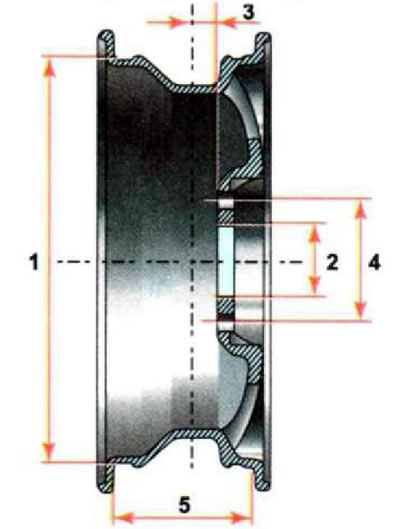
Main dimensions of the disc: 1 — rim seat diameter for tire in inches; 2 — diameter of the central hole; 3 — disc offset (ET); 4 — PCD (Packaging Diameter); S — wheel rim width
Note: Rim offset (ET) is the distance between the plane that divides the wheel rim in half (plane equidistant from the sides of the rim), and the mounting (fastening) plane of the wheel.
It is possible to install wheels with disks that have a larger central hole diameter. To do this, you need to use special centering adapter rings.
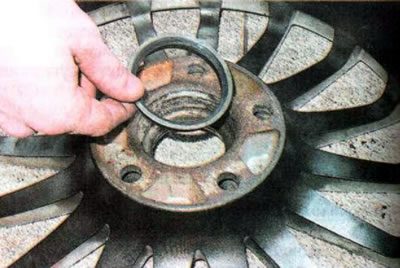
Discs with a smaller center hole diameter cannot be installed.
The car is equipped with tubeless tires, which is confirmed by the TUBELESS marking on the sidewall of the tire.
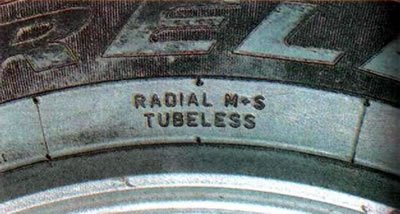
All tires have markings that contain the necessary information for the correct selection of tires.
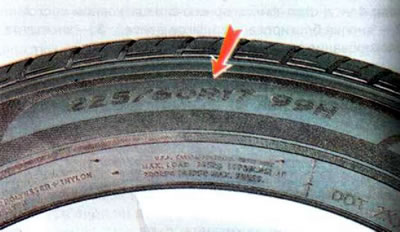
Below is an example of decoding the designation of a radial tire 215/60 R16 95H, where:
- 215 — profile width in millimeters;
- 60 — the ratio of the profile height to its width in percent;
- R — designation of radial tire;
- 16 — tire rim diameter in inches;
- 95 — load index (maximum permissible load on the tire is 690 kg);
- H — speed index (maximum permissible speed 210 km/h).
Tire and wheel parameters
| Parameter | Meaning | |||
| Tire size | 215/60 R16 | 215/55 R17 | 225/50 R17 | 235/45 R18 |
| Size of disks | 6,5Jx16 | 7Jx17 | 7Jx17 | 7Jx18 |
| Disk offset ET, mm | 45 | 45 | 45 | 45 |
| Number and diameter of PCD mounting holes, mm | 5x115 | |||
| Diameter of the central hole of the disk* DIA, mm | 70,1 | |||
| Tire air pressure, bar | Specified in the section "Tire pressure" | |||
| Minimum permissible tire tread height, mm | 1.6 | |||
| Spare wheel | Full size | |||
*Nominal diameter is indicated. The vehicle can be fitted with wheels with a larger central hole diameter by using centering rings of the appropriate size.
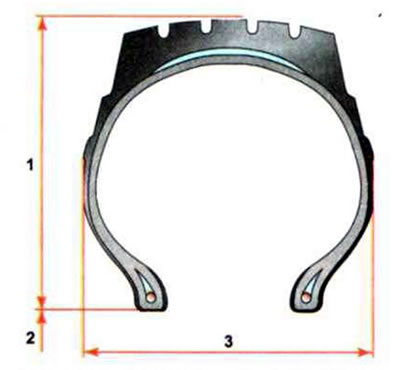
Main tire dimensions: 1 — profile height; 2 — tire rim diameter in inches; 3 — profile width
The maximum load on the tire (MAX LOAD) is duplicated in a deciphered form together with the indication of the maximum permissible pressure (MAX AT) of air in the tire.
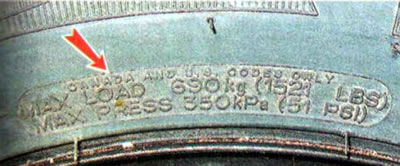
Load indices
| Index | Load, kg | Index | Load, kg | Index | Load, kg | Index | Load, kg |
| 70 | 335 | 80 | 450 | 90 | 600 | 100 | 800 |
| 71 | 345 | 81 | 462 | 91 | 615 | 101 | 825 |
| 72 | 355 | 82 | 475 | 92 | 630 | 102 | 850 |
| 73 | 365 | 83 | 487 | 93 | 650 | 103 | 875 |
| 74 | 375 | 84 | 500 | 94 | 670 | 104 | 900 |
| 75 | 387 | 85 | 515 | 95 | 690 | 105 | 925 |
| 76 | 400 | 86 | 530 | 96 | 710 | 106 | 950 |
| 77 | 412 | 87 | 545 | 97 | 730 | 107 | 975 |
| 78 | 425 | 88 | 560 | 98 | 750 | 108 | 1000 |
| 79 | 437 | 89 | 580 | 99 | 775 | 109 | 1030 |
Warning! Using tires and wheels of other dimensions, not recommended by the vehicle manufacturer, may cause malfunction of the ABS/ESP systems, since these systems receive information from wheel speed sensor signals. The information provided by the vehicle speed sensor will also be incorrect (this information is used by the engine management system, the speedometer and in some cases to control the transmission), since the speed of rotation of the wheels in this case will not correspond to the actual speed of the car.
Speed indices
| Index | Speed | Index | Speed |
| G | 90 | R | 170 |
| J | 100 | S | 180 |
| TO | 110 | T | 190 |
| L | 120 | U | 200 |
| M | 130 | H | 210 |
| N | 140 | V (VR) | 240 |
| R | 150 | W (ZR) | 270 |
| Q | 160 | Y(ZR) | 300 |
Additional marking XL (extra Load) after the speed and load indices indicates a tire with increased load capacity.
Some tire models have an information section on the sidewall where the owner can make notes themselves (for example with paint) to indicate the recommended tire pressure for wheels 2 and the location of the wheel on the vehicle 1 (front right or left and rear right or left).
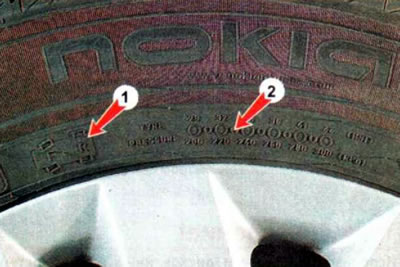
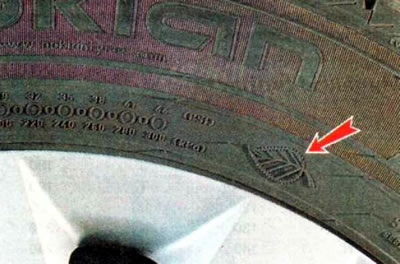
Also on the information section there is a marking in the form of a birch leaf, this means that the tire is made without harmful highly aromatic oils from environmentally friendly raw materials and has low rolling resistance and low noise levels.
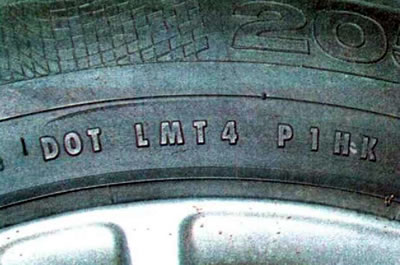
A tire may also have a DOT certification number if the tire has been tested to meet U.S. Department of Transportation standards.
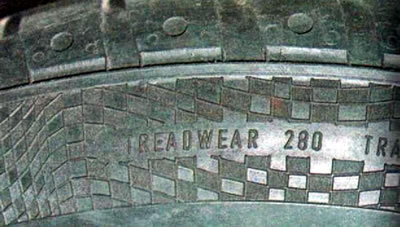
In this case, markings are applied to the sidewall of the tire. informing about the relative qualities of rubber.
TREADWEAR — characterizes the wear resistance of the tire: the higher the index value, the higher the wear resistance of the tire (for example, a tire with index 300 has a resource three times greater than a tire with index 100).
TRACTION — characterizes the ability of tires to brake on wet asphalt without slipping. Measurements are carried out using a special technique with the vehicle moving in a straight line.
Warning! This measurement method does not take into account the tire's behavior when braking in a corner or on other road surfaces.
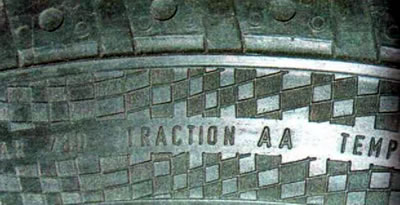
The letters next to the word TRACTION indicate the relative value of this tire parameter. The following options are possible (in order of deterioration): AA, A, B, C.
TEMPERATURE — characterizes the tire's resistance to heat generation and its ability to dissipate thermal energy. Measurements are carried out using a special technique.
Warning! Excessive load, excessive speed, and underinflation may cause the tire to overheat and fail.
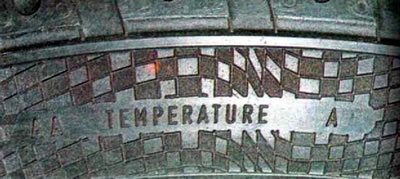
The C index indicates that the tire meets the minimum safety standard requirements. The indices B and A show the excess of these minimum requirements in ascending order.
When giving recommendations on the selection of certain tires, the manufacturer takes into account the conditions for ensuring maximum stability, controllability, cross-country ability and safety of the vehicle. Thus, wheels with a large offset can touch parts of the brake mechanisms and suspension, and those with a smaller offset increase the load on the hub bearings and can lead to unpredictable behavior of the car during emergency braking or if one of the brake system circuits fails. High-profile tires can touch body parts at maximum suspension travel, and wide tires can rub against the car frame or its fender at large turning angles. A tire with a lower load index may burst under a fully loaded vehicle, while a lower speed index may result in tire failure when driving at high speed.
Tires that can be installed on a car, depending on the temperature and weather conditions for which they are designed, are divided into three types: summer, winter and all-season. If the car is used all year round and the winter is snowy, it is better to have two sets of wheels: with winter and summer tires. Winter tires are made of softer rubber, which prevents them from "hardening" at sub-zero temperatures, and the tread has narrow wavy cuts - lamellas.
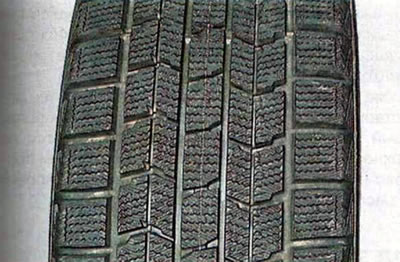
This allows the tires to better grip the vehicle on slippery surfaces. Winter tires usually have a snowflake symbol on the sidewall to indicate that the tire meets the minimum requirements for winter use.
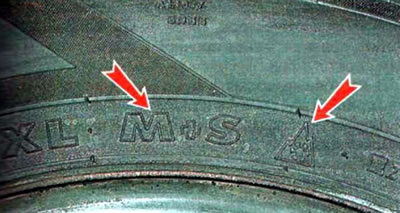
The inscription M+S, M/S or MS (from the English Mud and Snow) indicates the type of tread pattern and indicates improved cross-country ability of the tire.
The possibility of using studded tires in winter depends on the specific operating conditions of the vehicle. The grip characteristics of such tires allow you to effectively control your car on slippery hard surfaces such as ice or packed snow. At the same time, the surface layer of the tire is made of soft rubber, which also allows you to feel confident on clean asphalt. To make the final choice between studded and non-studded tires, check out the winter tire test results that are regularly published in major automotive publications. Using a winter tire in summer results in intensive wear.
Warning! According to the "Appendix to the Basic Provisions for the Admission of Vehicles to Operation and the Duties of Officials to Ensure Road Safety", it is prohibited to operate a passenger car:
- if the tire tread depth is less than 1.6 mm;
- with tires that have external damage (punctures, cuts, tears), exposing the cord, as well as delamination of the carcass, separation of the tread and sidewall;
- if the fastening nut (bolt) is missing or there are cracks in the disk and wheel rims, there are visible violations of the shape and size of the fastening holes;
- if the tires do not match the vehicle model in size or load capacity;
- if tires of different sizes and designs are installed on one axle of a vehicle (radial, diagonal, tubed, tubeless), models with different tread patterns, new and with deep tread patterns, frost-resistant and non-frost-resistant, new and restored;
- if the vehicle is equipped with studded and non-studded tires.
The rear of motor vehicles with studded tires must be equipped with an identification sign "Studs".
All-season tires can be used all year round. They are distinguished from other tires by the inscription ALL SEASON or TOUS TERRAIN on the sidewall. They perform satisfactorily in various weather conditions, but in summer they are inferior to summer tires in terms of technical parameters, and in winter - to winter tires. The marking on the tread of such a tire in the form of numbers 4, 6 and 8 indicates the height of the tire tread in millimeters.
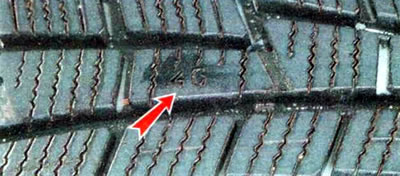
As the tire is used, the degree of wear increases and the numbers applied at different depths are erased. When the last digit 4 is erased from the tread, it means that the tread height is less than 4 mm and this tire cannot be used in winter.
The tread pattern can be universal...
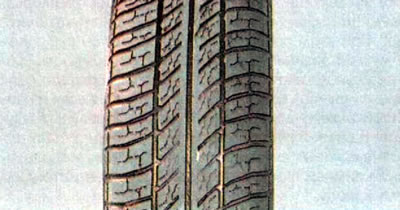
...or directed and not regulated by the requirements of the vehicle manufacturer.
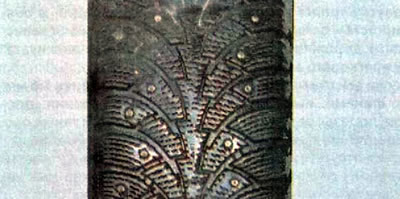
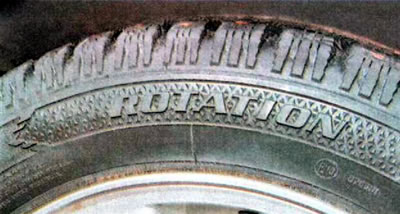
With a directional tread pattern, the sidewall of the tire has the inscription ROTATION and an arrow indicating the direction of rotation of the wheel when the vehicle is moving forward.
A special case of a directional pattern is an asymmetrical one.
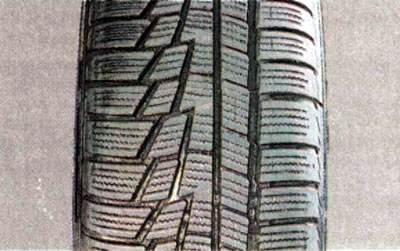
In this case, the inscription OUTSIDE is applied to the sidewall, which should be on the outside after the tire is mounted on the disk.
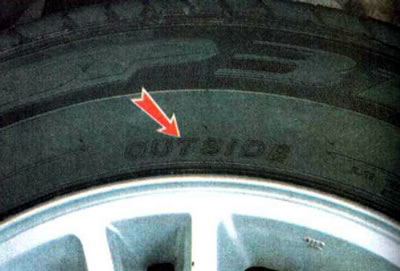
Such tires may also have the inscription INSIDE - it should be on the inside.
To avoid premature wear of tires, suspension components, steering mechanism, brake system and transmission, the vehicle wheels must be balanced. This work can be done at a service station or tire shop that has balancing machines. When balancing wheels, lead weights of different weights are installed on the disks. On a balancing machine it is possible to balance only the disk with the tire, without taking into account the operation of the brake disks, brake drums, hubs and wheel drives. For more precise wheel balancing, there is final balancing, which is performed on a car installed on a special stand. In this case, balancing is carried out taking into account the operation of the above elements.
There is also a method of wheel balancing by pumping a special powder into the tire, which, when the wheel rotates, is distributed over the tire surface in the area where a counterweight (weight) is needed. However, this method of balancing is not very common.