


The road in front of the car is illuminated by two headlights, which operate in low or high beam modes. The high beams are directed parallel to the road and illuminate the road to the maximum possible distance. High beam is convenient to use when driving a car at night on unlit roads. When oncoming traffic appears, in order not to blind the driver, high beams must be switched to low beams. When there is heavy oncoming traffic, you must drive only with low beams. High beams can also blind the driver of a car in front through his rear-view mirror. Therefore, if you are driving with a small distance to the car in front, it is better to move to the near side.
The low beam light beams must be directed so as to illuminate the section of the road directly in front of the vehicle and the shoulder, without blinding oncoming drivers. It is necessary to periodically check and, if necessary, adjust the headlights.
Note: According to the Road Traffic Regulations, it is prohibited to turn on high beams in a populated area if the road is lit. During daylight hours and when the vehicle is moving, it is necessary to turn on low beams or daytime running lights (if available).
Depending on the configuration, the car may be equipped with fog lights 3 in the middle part of the rear bumper there is an additional rear light, which contains fog lights and reversing lights.
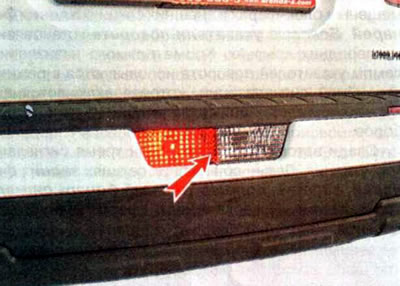
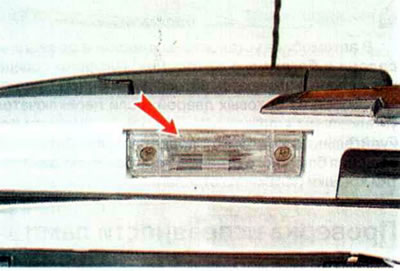
To indicate the position on the road at night, the car is equipped with side lights. The front parking light bulbs are installed in the headlight units. The rear parking light/brake light bulbs are located in the outer sections of the taillights, and the inner sections contain only parking light bulbs. Along with the side lights, two license plate lights (rear) are switched on. They are located on the tailgate (the photo shows the left one).
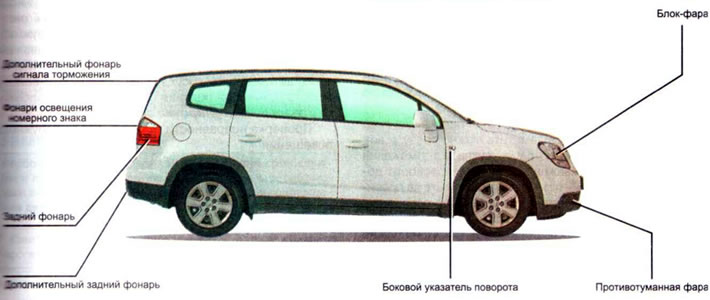
To warn other participants of upcoming maneuvers, the vehicle uses turn signals. The direction indicator lamps are located in the headlight units and the outer sections of the rear lights. Side direction indicators are mounted on the front fenders. In addition to their intended purpose, the direction indicator lamps are used in the hazard warning mode, which is activated by the hazard warning switch on the instrument panel.
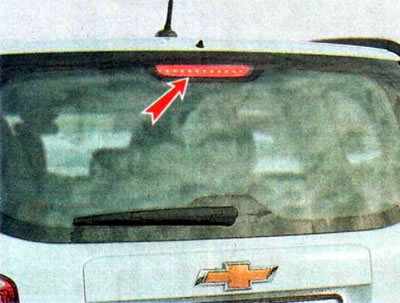
The car is equipped with three brake lights at the rear. Two are in the outer sections of the rear lights, and the third, an additional brake light, is in the upper part of the luggage compartment door.
The car is equipped with interior and luggage compartment lights. The interior lights turn on automatically when any of the side doors is opened (if the switches are set to an intermediate position) or forced by a switch. The luggage compartment light comes on when the luggage compartment lid is opened.
Checking the serviceability of outdoor lighting fixtures
Outdoor lighting and light signaling devices play an important role in ensuring road safety, so it is necessary to regularly check their condition, promptly eliminating any defects found.
A burnt-out interior light bulb or instrument panel light can be noticed right away, but, for example, a burnt-out brake light bulb (it has been given a more important role in road safety) - No. Therefore, make it a rule to check the serviceability of outdoor lighting lamps at least once a week, it will not take much time. It is more convenient to perform the test with an assistant, but you can also do it alone, using any surface that has reflective properties: the side of a clean car, a wall of a house with tiles, etc.
We sequentially turn on the side, low and high beam headlights, fog lights, reversing lights, brake lights and hazard warning lights, checking that the corresponding lamps are turned on.
In addition, when the parking lights are turned on, two license plate lights should light up.
Burnt out bulbs need to be replaced (see relevant sections). It should be understood that if all the lamps in one circuit do not light, for example, all the brake light lamps, then it is unlikely that all the lamps have burned out at once (although this happens too). In this case, you should first check the fuse for the corresponding circuit, and then try replacing one of the lamps in the faulty circuit with a known good one. If it turns out that the problem is not in the lamps, we check the corresponding switch, in this case the brake light switch, and then the corresponding electrical circuit.
It is not enough for headlights and fog lights to simply emit light. They must shine in a strictly defined way. This is a very important factor for ensuring road safety and is therefore monitored. During the state technical inspection. You can first check the direction of the headlights by placing the car opposite a vertical, flat wall at a distance of two to three meters. Turn on the low beam headlights. The light beams should have clear boundaries at the top and be at the same level. We check the operation of the electric corrector. To do this, rotate the control wheel and watch the low beam headlights: they should evenly lower and rise, stopping at the same level. If both headlights are not adjusted, the headlight range control unit is most likely faulty and needs to be replaced. If one of the headlights is not adjusted, the actuator element of the electric corrector in the corresponding headlight is faulty. Turn off the low beam headlights.
If installed, turn on the fog lights. The light beams should have clear boundaries at the top and be at the same level.
However, it should be understood that this method of checking can only reveal very large violations in the adjustment of the headlights. Therefore, it is necessary to periodically check and, if necessary, adjust the headlights at a service station with the appropriate equipment (moreover, this method is preferable when preparing a car for a state technical inspection), or using the method presented in the section "Headlight adjustment".
Checking the serviceability of the lamps of outdoor lighting devices.
[The article is based on data from the website «CHEVYMAN.RU»]