


Note: When a large number of consumers are turned on simultaneously and the engine crankshaft speed is low (idling) the generator's energy may not be sufficient. In this case, power to consumers will also come from the battery. This must be taken into account in order to avoid its complete discharge.
Batteries from different manufacturers have their own design and technological features.
A car battery consists of six series-connected batteries with a nominal voltage of 2 V, placed in isolated compartments of the case (monoblock). The compartments of the case are filled with electrolyte, in which the negative and positive electrodes of the batteries are located, having the form of plates. The filler holes of the compartments are closed with plugs. The plugs can be made either separately or attached to a common lid. The negative electrodes of the batteries are made of lead, the positive ones are made of lead dioxide, and the electrolyte is an aqueous solution of sulfuric acid.
To connect the wire terminals, positive and negative terminals are provided on the battery cover.
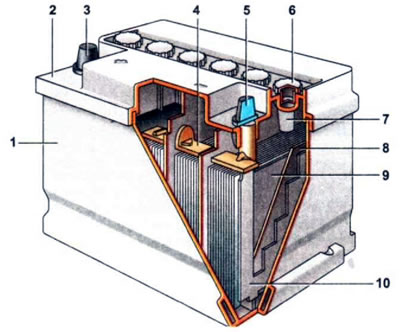
Battery: 1 — body; 2 - cover, 3 - positive terminal; 4 - inter-element connection; 5 - negative output; 6 - cork; 7 - filler neck; 8 — separator; 9 - positive plate; 10 - negative plate
Note: To prevent accidental connection of the negative terminal of the vehicle's electrical system to the positive terminal of the battery, the positive terminal of the battery is made with a larger diameter than the negative terminal.
A distinction is made between serviced and maintenance-free batteries.
The serviceable battery is an open type battery. The electrolyte of such a battery is in a liquid state. During operation, the battery requires periodic monitoring of the electrolyte level and addition of distilled water, since when the battery is recharged, it evaporates. To allow gaseous substances to escape from the battery, the battery cover has one or more ventilation holes. The frequency of adding distilled water is determined by the design features of the battery. Open batteries are divided into batteries with normal, low and very low water consumption
Note: For batteries with very low water consumption, the electrolyte level will usually drop to the minimum acceptable level beyond the service life of the battery. Such batteries can be considered maintenance-free.
The maintenance-free battery has a cover without ventilation and filling holes. During the operating period, distilled water is not added to the battery. The battery is equipped with a control valve, which is closed under normal operating conditions. When the internal pressure in the battery increases to a certain level, the valve opens and the gas comes out.
Note: Maintenance-free batteries have a long service life, but are more demanding on the serviceability of the vehicle's electrical equipment and do not allow improper operation. If the electrolyte level drops below the permissible value, such a battery must be replaced.
A type of maintenance-free batteries are gel batteries, where the electrolyte is a special composition that is in a gel state (jelly). If the case is damaged, the electrolyte from the battery almost does not leak.
The density of the electrolyte of fully charged serviceable batteries should be within the range of 1.27-1.30 g/cm³ at a temperature of 25°C; in maintenance-free batteries, the density of the electrolyte is not measured.
The battery may be equipped with a charge level indicator. The charge level indicator is installed in one of the middle batteries and is secured to the battery cover. The indicator consists of a tubular body with a viewing peephole; inside the body there is a ball whose buoyancy changes depending on the density of the electrolyte. When the density or level of the electrolyte drops, the color of the indicator changes.
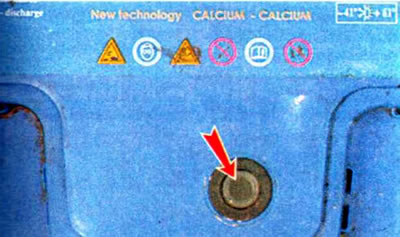
Battery charge indicator
Storage batteries are characterized by the following main parameters.
1. Nominal voltage of the battery, V. Cars use batteries with a nominal voltage of 12 V.
2. Cold cranking current, A. The manufacturer's specified discharge current that the battery is capable of providing to start the engine.
3. Nominal discharge current, A. Current that the battery must give to the external circuit for 20 hours before the voltage at the terminals drops to 10.5 V
4. Battery capacity, which is indicated as nominal (or actual) twenty-hour capacity, Ah, and nominal (or actual) reserve capacity, min. Nominal (or actual) twenty-hour capacity is the estimated amount of electricity that a fully charged battery can deliver during 20 hours of discharge at its rated current under specified conditions (the actual capacity is determined by testing), nominal (or actual) reserve capacity is the estimated discharge time in minutes during which the battery can have a discharge current of 25 A before the terminal voltage drops to 10.5 V (the actual capacity is determined by testing).
5. Charge acceptance is the ability of the battery to accept charge.
6. Charge retention is the ability of a battery filled with electrolyte and charged to retain its charge when the circuit is open.
7. Water consumption is the rate at which water decomposes when the battery is recharged (for serviced batteries).
8. Overall dimensions of the battery, mm.
9. Execution of the bottom strip. A design feature of a battery determined by the method of its attachment.
10. Battery weight, kg.
11. Polarity, direct or reverse. A design feature of a battery determined by the arrangement of its terminals. A battery has a direct polarity if, when looking at it from the terminal side, the negative terminal is located on the right, and a reverse polarity if it is located on the left.
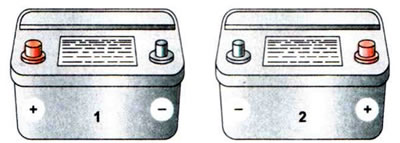
Location of battery terminals: 1 - battery with straight polarity; 2 - battery with reverse polarity
The average service life of a battery is 4 to 5 years. To ensure that the battery functions properly and does not fail before this time, it is necessary to follow a number of simple rules:
- do not allow the battery to be deeply discharged;
- do not allow the battery to overcharge (what can be caused by a faulty generator voltage regulator);
- do not short-circuit the battery terminals;
- every six months, check the reliability of the fastening of the wire terminals on the battery terminals (see below "Removal and installation");
- once every six months, clean the battery cover from dirt with a solution of baking soda or a 10% solution of ammonia (to reduce its self-discharge);
- once a year, clean the wire terminals and battery posts from oxides that have formed on the contact surfaces (see below "Checking and maintenance").
Do not leave the battery uncharged for long periods of time. Even when the external circuit is open, the battery self-discharges. A weakly charged battery may discharge completely, which will lead to the battery plates falling off and failing.
Note: A serviceable battery filled with electrolyte can be stored without use for no more than one year. The battery must first be fully charged (see "Charging" below). Periodically (once a month) check the battery charge (see below "Checking and maintenance") and recharge it if necessary.
Before and after long periods of storage, check the density and level of the electrolyte and, if necessary, charge the battery using a charger.
Note: The battery charge level is estimated by the density of the electrolyte. When the battery is discharged, the density of the electrolyte decreases.
It is necessary to check and recharge the battery regularly (see below, "Charging") if the vehicle is used in short trips with frequent stops and starts of the engine (especially in winter). During short trips, the battery does not have time to charge, which can gradually lead to its deep discharge.
As the density of the electrolyte decreases, its freezing temperature increases. Thus, electrolyte with a density of 1.20 g/cm³ (battery discharge level of 50%) freezes at a temperature of about -33°C, and with a density of 1.15 g/cm³ (battery discharge level of 75%) - about -20°C. Freezing of electrolyte in the battery will damage its casing.
If the battery has been in use for more than one year, then to monitor its condition in the fall, check the density and level of the electrolyte (see below), add distilled water if necessary and charge the battery.