


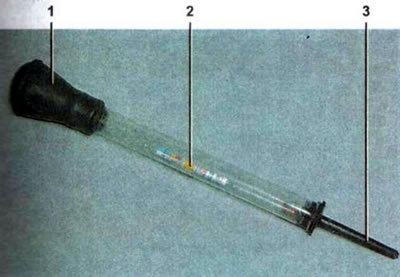
Hydrometer: 1 - pear; 2 - float; 3 - tube.
Warning. When measuring the density of the electrolyte, observe safety precautions when servicing and repairing the vehicle. Battery electrolyte is an aqueous solution of sulfuric acid. If it comes into contact with skin, it may cause a chemical burn. Drops of electrolyte falling on clothing or upholstery will cause damage. After measuring the density, be sure to rinse the hydrometer with water.
To determine the density, use a bulb to fill the hydrometer with liquid while holding it vertically.
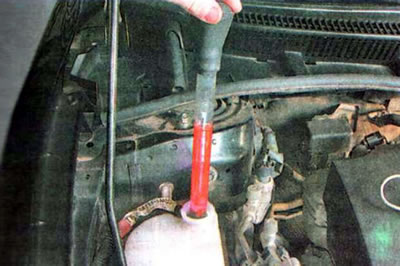
Determination of coolant density
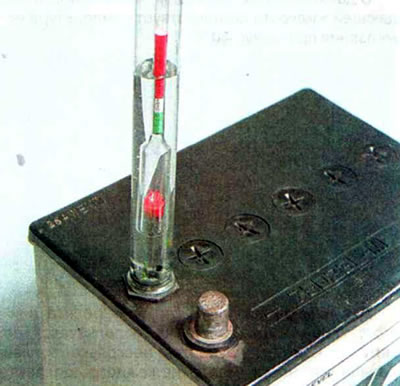
Determination of electrolyte density
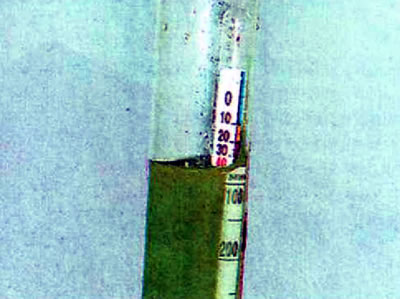
After filling the hydrometer with liquid, the float will rise to a certain height corresponding to the density of the liquid.
Warning. Fill the hydrometer with liquid smoothly, just until the float rises to the surface. If you fill the hydrometer with liquid too quickly, the float may hit the top rubber bulb and give incorrect readings.
Note. Very often, instead of or in addition to the scales of the actual density of liquids, the float is marked with scales of the degree of charge of the battery A and the freezing temperature of the coolant B. For car enthusiasts, this version of the hydrometer is preferable, since it allows you to obtain the necessary data much faster without additional tables.
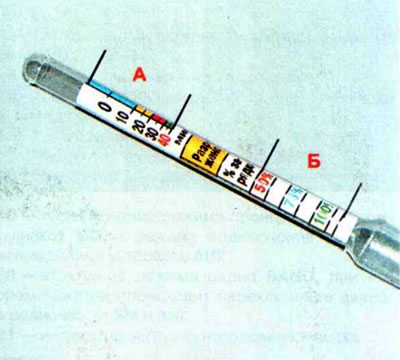
In this case, we see that the density of the coolant corresponds to its freezing temperature at minus 40°C.
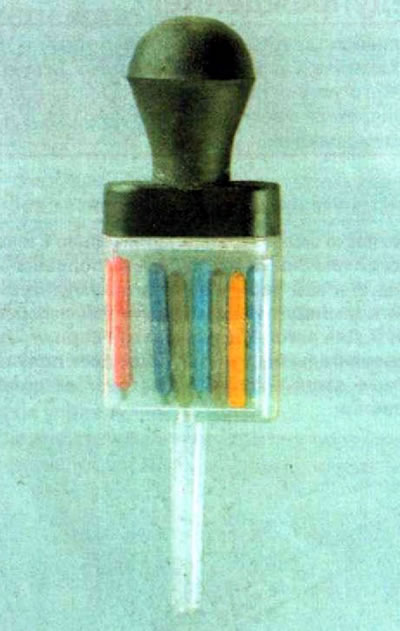
To measure the density of the electrolyte or coolant, a hydrometer is also used, which contains several floats of different densities. Opposite each float is the value of the lowest liquid density at which the given float floats. The float with the highest number indicates the density of the liquid.
The article is based on data from the website: «ChevyMan.ru»