


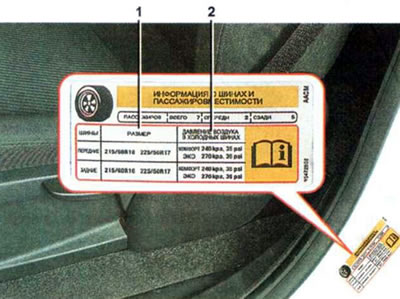
1 - Permissible tire sizes; 2 - recommended tire pressure
As indicated on the sticker, the car can be equipped with two sizes of tires: 215/60 R16 and 225/50 R17. The manufacturer also allows the use of tires 215/55 R17 and 235/45 R18. The pressure in both the front and rear tires, regardless of the vehicle load, should be 2.4 bar (240 kPa). To reduce fuel consumption, it is recommended to increase the pressure to 2.7 bar (270 kPa), but this worsens the comfort of the car.
Operating a vehicle with either over- or under-inflated tires leads to accelerated tire wear. If the pressure is too low, the edges of the tread wear out quickly, and if the pressure is too high, the middle wears out quickly.
The air pressure in the car's tires is not constant - it depends on the temperature. And their heating, in turn, depends on changes in the ambient air temperature. When it rises, the pressure increases, and when it falls, it falls. When the car is moving at high speed and making frequent maneuvers, the tires also noticeably heat up. As a result, the pressure also increases. In winter, due to the effective cooling of the tire by cold air and the low temperature of the road surface, pressure drops are small. But in summer, in hot sunny weather, the tire pressure can increase by 0.20.3 bar (20-30 kPa).
Warning. The tire pressure should only be measured when its temperature is equal to the ambient air temperature. It is best to do this after standing in the shade for a long time.
To check the tire pressure, unscrew the protective cap of the valve. Press the tip of the pressure gauge tightly against the end of the nipple, hold it in this position for 1-2 seconds and release. Then we return the pressure gauge arrow to zero and repeat the check.
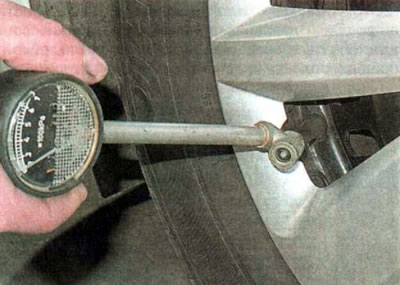
If the tire pressure is lower than required, we bring it up to the norm.
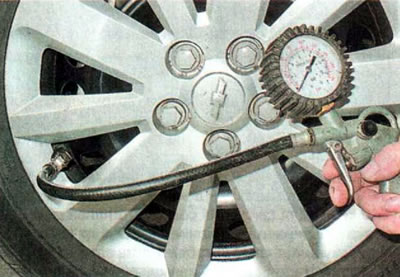
Note: When pumping, control the pressure using the pump or compressor pressure gauge readings.
Warning. When inflating, the pressure gauge shows the pressure not in the tire, but in the hose that supplies air. To determine the true tire pressure, stop the inflation process.
If the tire pressure is higher, release the air by pressing the valve with a special pin on the pressure gauge body or with the blade of a narrow screwdriver.
Note: If the wheel needs to be pumped up more than once a week, it is damaged: the tire is punctured, the wheel rim is deformed, or the valve is faulty. To find and eliminate the cause of a small air leak, it is advisable to contact a tire repair shop.