


Recommendation. When replacing the driven clutch disc, it is advisable to also replace the pressure plate (basket), even if there are no noticeable signs of wear on its working surface. The fact is that during operation its working surface wears out and the rigidity of the diaphragm spring decreases.
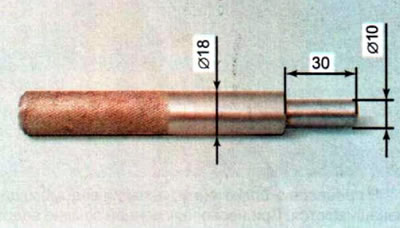
To perform the work, you will need a mandrel for centering the driven clutch disc. We carry out the work in the following order:
1. We prepare the car for maintenance and repair.
2. Remove the manual gearbox.
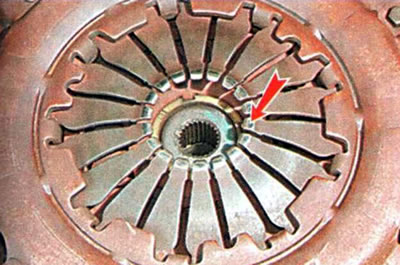
3. The presence of deep grooves on the ends of the central spring petals is the first sign that the clutch needs to be replaced.
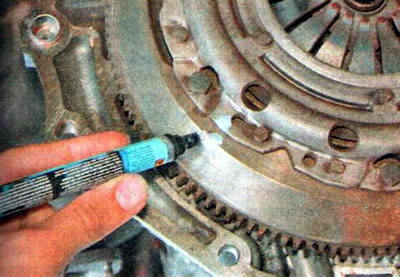
4. If the clutch will not be removed for replacement, use a center punch or marker to mark the position of the clutch basket relative to the flywheel.
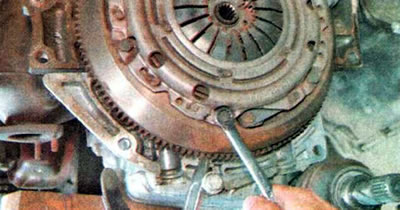
5. Screw in one of the bolts securing the gearbox to the engine and, holding the flywheel from turning with a mounting blade or a wide slotted screwdriver, use an 11 mm socket or open-end wrench to unscrew the six bolts securing the basket to the flywheel.
6. Remove the basket and driven disk.
7. Rivets that fasten the friction linings of the driven disk are sunken by less than 0.3 mm relative to the disk surface - this is the second sign that the clutch needs to be replaced.
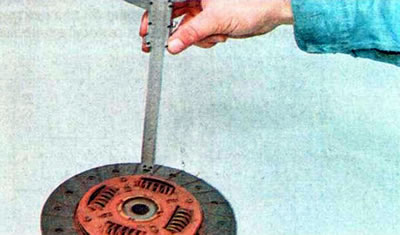
During operation, the driven disk linings wear out. If the driven clutch disc is not replaced in a timely manner, the metal rivets securing the friction linings may come into contact with the working surfaces of the pressure plate and flywheel (if, as a result of wear, the rivets are recessed less than the permissible value, see above), leaving furrows on them.
If such grooves are found, it is necessary to replace the basket along with the driven disk. And if deep grooves remain on the surface of the flywheel, then the flywheel will have to be replaced. Otherwise, jerking and twitching of the car is possible even when the clutch is smoothly engaged.
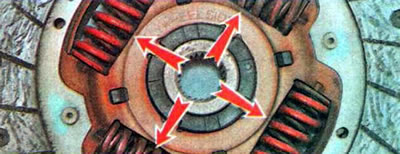
8. Loose, cracked torsional vibration damper springs (the reason for jerking and rattling even when the car starts moving smoothly) — the third sign that the clutch needs to be replaced.
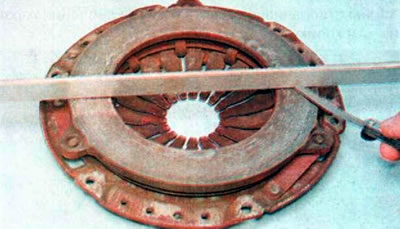
9. The amount of wear on the clutch pressure plate is more than 0.2 mm - the fourth sign that the clutch needs to be replaced.
10. Clean the flywheel surface from wear products and degrease it.
11. Check the clutch slave cylinder.
Comment.
- In addition to the universal mandrel for centering the driven clutch disc relative to the clutch basket, you can use a mandrel for centering the driven clutch disc relative to the flywheel.
- The following is the sequence of operations when using this mandrel. When using a universal drift to center the driven disc relative to the clutch basket, install the clutch according to the instructions included with the drift.
12. Place the driven clutch disc on the mandrel so that when installing the disc on the flywheel, the Flywheel inscription on the driven disc is on the flywheel side.
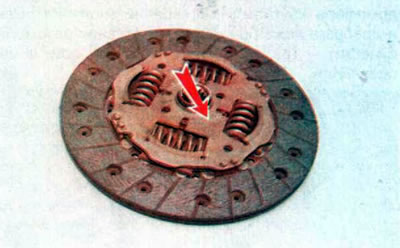
13. Insert the centering mandrel together with the driven clutch disc into the central hole of the flywheel.
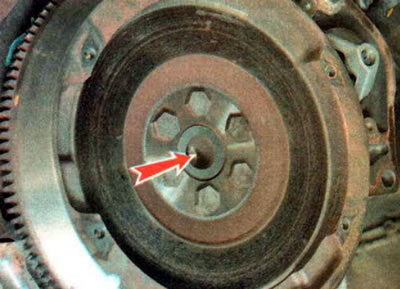
14. Install the clutch basket on the flywheel and tighten its mounting bolts step by step to a torque of 15 Nm. If necessary, hold the flywheel from turning with a mounting blade or a wide slotted screwdriver (see above).
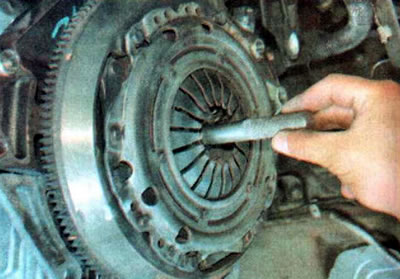
15. Remove the centering mandrel.
16. Install the remaining parts in reverse order.
Warning: When installing the gearbox, do not rest the end of the input shaft on the petals of the clutch basket spring. This may result in clutch failure.
The original text can be found on the website: «chevyman»