


Automatic transmission
Warning:
- Spinning the wheels too quickly or trying to hold the vehicle on a hill using only the accelerator pedal can damage the transmission.
- The manufacturer's warranty does not cover faults caused by such actions.
- If your vehicle becomes stuck, avoid allowing the wheels to spin too quickly.
- When stopping on an incline, hold the vehicle in place using the brake system.
Warning:
- Do not move the automatic transmission selector lever out of position P (Park) or N (Neutral) when the engine is running at high speed.
- You may lose control of your vehicle, which could result in injury to you and others.
- It is very dangerous to move the automatic transmission selector into the drive position at high engine speeds. Keep your foot on the brake pedal and do not press the accelerator pedal. After engaging the gear, wait a little and then slowly release the brake pedal. This will prevent the car from moving suddenly.
Note: Any damage to your vehicle's automatic transmission caused by shifting the automatic transmission selector lever from the P (Park) or N (Neutral) positions at high engine speeds is not covered by the manufacturer's warranty.
1. The selector has several positions (see illustration).
R(Parking)
2. In this position, the rear wheels of your car are locked. Use this position when you park your car and when starting the engine.
3. When leaving the vehicle, make sure that the automatic transmission selector is fully moved to the P (Park) position and the parking brake lever is fully applied. Do not attempt to move the selector lever to position P (Park) while the vehicle is moving.
4. If your vehicle has a four-wheel drive transmission, make sure that the transfer case is in one of the drive gears, and not N (Neutral). Otherwise, the vehicle may roll even if the automatic transmission selector is in the P (Park) position.
5. Your vehicle has an automatic transmission shift lock system. If the engine is running, in order to move the automatic transmission selector from position P (Park), you must press the brake pedal all the way down.
6. If you cannot move the automatic transmission selector lever out of the P (Park) position, ease off the force applied to the selector lever while continuing to press the brake pedal. Press the button on the selector lever and move the selector lever fully to the P (Park) position. Try moving the selector lever again from the P (Park) position to the desired position.
R (Reverse)
7. This selector position is used for reversing.
Caution: Move the automatic transmission selector to position R (Reverse) only after the vehicle has come to a complete stop. Engaging reverse gear while the vehicle is still moving may damage the automatic transmission. The manufacturer's warranty does not cover any possible damage.
N (Neutral)
8. In this position of the selector the engine is not connected to the wheels. You can use the N (Neutral) position to start a stalled engine while the vehicle is moving. Do not move the automatic transmission selector lever out of position P (Park) or N (Neutral) when the engine is running at high speed.
D (Moving forward)
9. This selector position is used under normal driving conditions in the city and on motorways. For increased traction and faster acceleration:
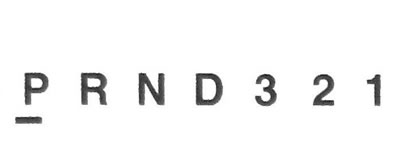
9.1 Selector position
- a) If you are moving at a speed of less than 55 km/h, press the accelerator pedal approximately halfway;
- b) If you are driving at a speed greater than 55 km/h, press the accelerator pedal all the way down.
10. If the road is slippery, downshifting may cause the car to skid. This selector position can also be used under the following conditions:
- a) Driving on winding mountain roads.
- b) Towing a trailer.
- c) Transportation of heavy cargo.
- d) Off-road driving.
11. If your automatic transmission downshifts too often, you can move the gear selector to position 3 (Third gear) or, if necessary, to an even lower gear.
3 (Third gear)
12. This position is also used for normal driving. The selector position provides more effective engine braking than position D without using the service brake system. Press the release button while moving the selector from position D (Drive) to position 3 (Third gear).
2 (Second gear)
13. This selector position provides an additional increase in traction with a further deterioration in fuel economy. Use this position when climbing steep hills. This selector position provides more effective engine braking than position 3 (Third gear), without using the service brake system.
14. Automatic transmission selector position 2 (Second gear) allows the car to start moving in second gear, reducing the torque on the drive wheels and thereby reducing the likelihood of slipping on slippery road surfaces. Press the unlock button while moving the selector from position 3 (Third gear) in position 2 (Second gear).
1 (First gear)
15. This selector position provides an even greater increase in traction compared to position 2 with a further deterioration in fuel economy. This position of the automatic transmission selector can be used when overcoming very steep climbs, or when driving in deep snow or mud. This selector position provides more effective engine braking than position 2 (Second gear), without using the service brake system. Press the unlock button while moving the selector from position 2 (Second gear) in position 1 (First gear).
16. The automatic transmission will not shift into first gear until the vehicle speed has decreased to the required value. Automatic transmission shift lock system
17. Your vehicle has an automatic transmission shift lock system. If the engine is running, in order to move the automatic transmission selector from position P (Park), you must press the brake pedal all the way down and press the release button.
(The original material is located on the website CHEVYMAN.ru)